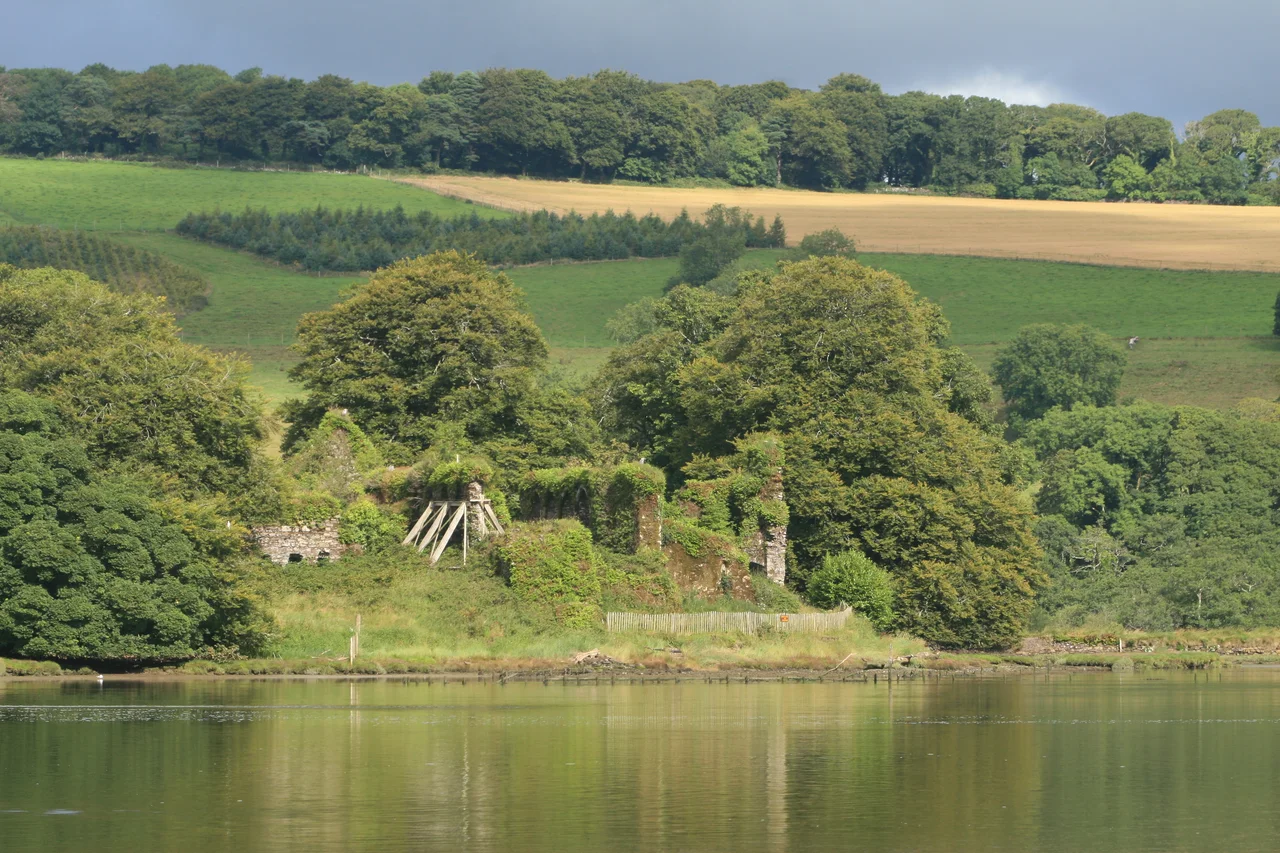

Molana Abbey
It used to be an island. Until 1806, when the Smyth family built two dams to fold the ruin neatly into the landscaped park of their new manor house, Molana Abbey sat alone on Dair Inis - Oak Island - in the middle of the River Blackwater. In the 6th century a disciple of St Carthage named Máel Anfaid arrived here from Lismore and founded a monastery in the oak trees that gave the island its name. Twelve hundred years later his name had been so anglicised that even the locals had forgotten the original Irish: Máel Anfaid became Molana, and Dair Inis disappeared from the maps.
The Founder, Mostly Lost
Almost nothing survives about Máel Anfaid except that he lived long enough to die after 608 AD, and that his community took the practice of monastic learning seriously. The early monastery had a library that included Greek Vulgate manuscripts and the resolutions of African church councils - texts that travelled by sea from Mediterranean centres to a small island in the south of Ireland in the centuries before Charlemagne. The monks of Molana also helped co-edit the Collectio canonum Hibernensis in the 8th century, an Irish compilation of canon law that influenced church thinking across western Europe. According to tradition, the sea journey from the Munster coast to Brittany could be done in three days and nights with a fair wind. The Atlantic was not a barrier; it was a road.
Vikings, Probably
No Viking attack on Molana is recorded in any surviving annal, but the monastery's position near the mouth of the Blackwater made it almost certainly a target. Every other significant Irish religious house on a navigable river was raided sooner or later, and Molana's library and metalwork would have been precisely what longship crews came looking for. The silence in the records is not evidence of safety. It is evidence that the records did not survive. After the Norman invasion of Ireland in 1169, the abbey enters history more sharply. The monks befriended Raymond Fitzgerald - Raymond le Gros, "the Large" - one of the principal commanders of the conquest, and Norman patronage rebuilt the place. Local tradition says Raymond is buried somewhere on the site, though the 19th-century memorial plaque on the refectory pediment claiming the spot is, scholars suspect, in the wrong location.
Stone Replaces Oak
The Augustinian canons took over in the 12th century, and they built in stone what the Irish monks had built in timber. The nave of the church - 17 metres long and 7.5 metres wide - dates from just before the Norman invasion, when large carefully selected stones were already replacing oak across Ireland. The 13th-century choir was extravagantly lit: six south chancel windows, four north chancel windows, a large east window. Compared to the older nave, the choir must have felt drenched in light. The refectory ran the whole south side at over twenty metres long, and the east wing rose two storeys with a chapter house, vestry, and a staircase up to the dormitory. By 1462 the monks were caring for the poor and sick despite the buildings being in poor structural condition. By 1475 the place was reported as impoverished but still functioning. The community had survived four centuries past its golden age.
Dissolved, Desecrated, Drowned in Ivy
Henry VIII closed it in 1541. The Crown report listed a church, cloister, 380 acres of land, three salmon weirs, a water mill, and a property value of twenty-six pounds and fifteen shillings. In December 1550 ownership passed to James FitzGerald, 14th Earl of Desmond, who allowed the monks to continue. Then came the Desmond Rebellions. In 1580 English soldiers visited the island, desecrated the church, and burned a portrait of Máel Anfaid - the founder whose memory had held the place together for nine hundred years. By 1600 the abbey was abandoned, the buildings so densely covered in ivy that the architectural features could no longer be examined. The land passed eventually to Richard Boyle, 3rd Earl of Burlington, then to the Smyth family who built Ballynatray House in 1795 and incorporated the romantic ruin into their pleasure grounds. The dams of 1806 finally turned the oak island into a peninsula. The grounds are still in private hands today, opened to the public a few hours a week.
Raymond's Statue
Walking the site now, there is one strange small joke that the Smyths left behind. On the north side of the old church hall, they erected a statue of the founder Máel Anfaid dressed as an Augustinian Canon Regular - an order that did not exist for six centuries after he died. The 19th century could not resist tidying up the past it had inherited. The choir's light still falls in the same places. The refectory's south wall is mostly collapsed, but the lectern window has survived. And Raymond le Gros, who once led the Norman conquest of this coast, lies somewhere under the ground here, no one quite sure where.
From the Air
Located at 52.00°N, 7.88°W on a former island in the Munster Blackwater, approximately 3 km upriver from Youghal Harbour. Best viewed from 1,500-2,500 ft AGL. The roofless abbey ruins sit at the western edge of the Ballynatray House estate, surrounded by mature parkland. The two early-19th-century dams that connect the former island to the west bank are subtle but visible. Nearest airports: Cork (EICK) approximately 55 km / 30 nm to the southwest, Waterford (EIWF) approximately 45 km / 24 nm to the northeast. The Blackwater's distinctive south-bending curve at Cappoquin lies upstream; downstream the river widens into Youghal estuary and the Celtic Sea. Excellent low-level navigation reference.
Nearby Stories
- The Glen, Cork 3.8 km away
- Liam Lynch (Irish republican) 6.1 km away
- All Together Now (festival) 9.4 km away
- Castle Oliver 14 km away
- Kilbrittain 17 km away
- 1999 Tramore helicopter crash 30 km away
- Walter Siepmann 37 km away
- SM U-27 107 km away