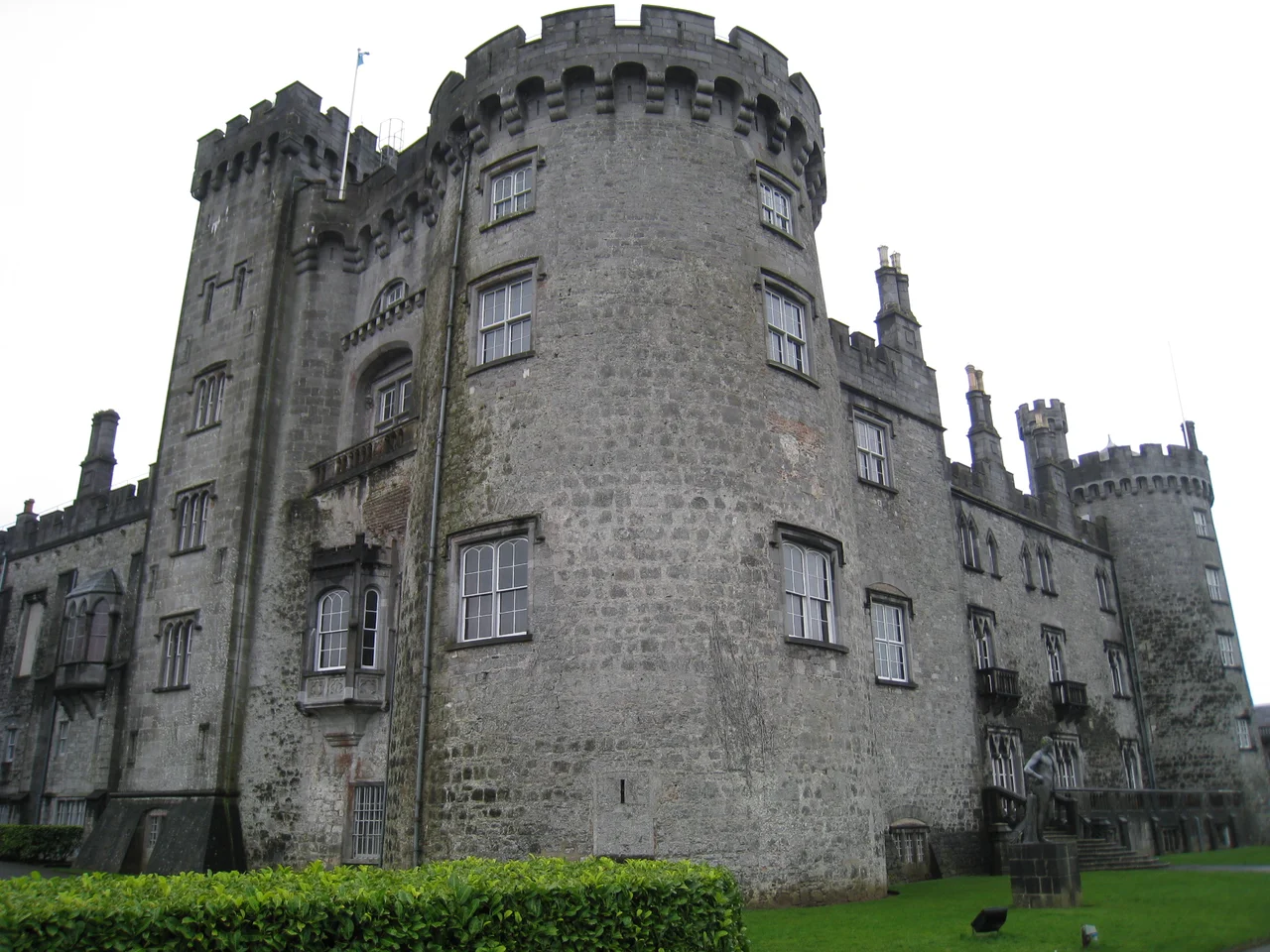

Siege of Kilkenny
Captain Tickle was an Irish officer in the garrison defending Kilkenny in March 1650, and he had been bribed. The plan was simple: at an appointed hour he would open one of the city gates and let Cromwell's army inside. When the Parliamentarians arrived at the gate at the agreed time, they found it shut and the defenders alert behind it. Tickle had been caught - his correspondence intercepted - and hanged. The walls held. Cromwell would have to take Kilkenny the old way, with cannon and assault. It would take him six days, and when it was over the surrendered garrison would march out with their colours flying and Cromwell would tell them, with grudging respect, that they had killed more of his men than Drogheda did.
The city he had to take
Kilkenny in 1650 was the capital of Confederate Ireland and the most fortified town in the country south of Dublin. It was three walled districts, not one: High Town clustered around Kilkenny Castle on the east bank of the Nore; Irish Town to the north of High Town with its own walls and gates; St John's on the far side of the river, connected to High Town only by the bridge of the same name. Each district could close itself off. Each had its own walls. To take Kilkenny meant taking, in effect, three smaller cities in succession - while the defenders fell back to the inner core. The streets of High Town still preserve the medieval names: High Street, Walkin Street, James Street, St Kieran Street. They are walking distance from each other; they were also, in 1650, lines of fire.
What the defender had
Sir Walter Butler had been placed in command of the Royalist forces in Kilkenny after the Duke of Ormond and the Confederate Commissioners fled west to Limerick. Plague had reduced his garrison from 1,200 men to roughly 300 over the winter. Three hundred men to defend three walled districts, twelve gates, several kilometres of curtain wall and a castle. Butler used his trained Royalist soldiers to hold High Town and the castle - the most defensible core - and left the defence of Irish Town and St John's to a civilian militia. It was the sort of decision a competent commander makes when he has no good options. It would also turn out, against all expectation, to work.
22-25 March: the first assaults
Cromwell arrived at Kilkenny on 22 March 1650 and immediately offered surrender terms. Butler rejected them the next day. On 24 March Cromwell moved his guns into position; on the morning of the 25th he opened fire on the southern wall of High Town from a battery placed in the grounds of St Patrick's Church to the southwest. By noon the wall was breached. Cromwell ordered the assault. His men got through the breach and into High Town - and were beaten back by musket fire from defensive works the garrison had built behind the wall. Some accounts say the assault was repulsed once; others say two attempts were made and a third refused by the soldiers themselves. Cromwell withdrew the attack for the day. He had not yet taken Kilkenny, and the day's fighting had been bloody for him.
The second front
Later on 25 March, Cromwell attacked the other walled districts. A combined infantry and cavalry force assaulted Dean's Gate in Irish Town. This time the citizen militia gave way; the Parliamentarians took Irish Town quickly. Across the river, another detachment forced its way into St John's, and the militia there broke and fled across St John's Bridge into the safety of High Town. By the end of that long day Cromwell held two of the three districts. He could now place artillery on the high ground of Irish Town to bombard High Town's northern walls, and his troops in St John's were positioned to attack St John's Bridge from the east. Butler was now facing assault from three directions, with three hundred men, and no relief possible from outside.
27-28 March: surrender on honourable terms
On the morning of 27 March, Cromwell's guns in Irish Town opened a second breach in the High Town wall near the Franciscan Abbey. General Henry Ireton arrived that same morning with a column of 1,500 fresh Parliamentarian troops. Butler now had two breaches to defend and a relief column reinforcing his enemy. Earl of Castlehaven, his nominal superior, had given him explicit orders for exactly this situation: absent relief, do not risk a massacre, negotiate the best terms you can. On 28 March 1650 Butler surrendered Kilkenny on honourable terms - the city handed over with its arms, ammunition and public stores; the citizens free to leave or stay; the garrison given safe conduct to march out with their colours flying, their weapons, their baggage, their horses. The deal was as good as a defender in his position could expect.
What Cromwell said
When the garrison marched out, Cromwell - by all accounts - complimented them for their gallantry. He told them his losses at Kilkenny had been higher than at Drogheda, where his army had taken some 3,500 of the town in a sack that has haunted Irish memory ever since. Casualty figures for Kilkenny are not reliable, but the worst losses on his side were in the failed assault on the southern High Town breach on 25 March. The garrison had bled him without yielding their honour. Cromwell would go on from Kilkenny to Clonmel on 18 May, where his army took its heaviest casualties of the entire Irish campaign. He left Ireland the following month. Ireton stayed and fought another two years before resistance ended at Galway in May 1652. The Confederation that had governed two-thirds of Ireland from Kilkenny was over. The city, surrendered honourably, was spared the fate of Drogheda - which, in the bleak arithmetic of seventeenth-century war, was something.
From the Air
The siege site is Kilkenny city, 52.583°N, 7.25°W in southeast Ireland. Best viewed at 2,500-4,000 ft. From the air you can still trace the three walled districts: Kilkenny Castle on its bluff above the Nore (south end), the medieval High Town stretching north to St Canice's Cathedral (former Irish Town), and across the Nore the smaller St John's district. The 13th-century St John's Bridge still spans the river. Nearest airports: Waterford (EIWF) ~50 km south, Kilkenny (EIKL) within the city. The M9 motorway runs east of Kilkenny.
Nearby Stories
- 2008 Irish Pork Crisis 4 km away
- Civil Defence Ireland 6.1 km away
- Thurles 6.5 km away
- Abbeyleix 9.5 km away
- Castletown Cox 11 km away
- Ardfinnan Woollen Mills 13 km away
- Johnstown Castle 16 km away
- County Wicklow 20 km away