
Civil Defence Ireland
In 1951, the Irish state stared at the new shape of war and decided it needed neighbours who knew what to do. The Soviet Union had detonated its first atomic bomb two years earlier. American officials were teaching schoolchildren to duck and cover. Ireland—neutral, agricultural, and largely defenceless—answered with something more characteristically Irish: a community organisation. Civil Defence Ireland began as a national network of volunteers trained to shelter their own villages if the worst arrived. The worst never did, in the form they expected. But the volunteers stayed, and the headquarters in Roscrea became the quiet centre of a service that now runs to about 2,500 people across every county.
Built for a War That Never Came
The original brief was nuclear. Volunteers learned to monitor radiation, to operate decontamination stations, to identify fallout zones, to shelter civilians. The blue triangle on an orange square—the international protective sign of civil defence under the Geneva Conventions—appeared on training manuals and on the shoulders of the first uniforms. As the 1960s gave way to the 1970s, a warden service was established with the explicit task of measuring radiation levels in the event of a strike. When the Chernobyl reactor exploded in April 1986, Irish civil defence volunteers were among the first in Europe ready to take field measurements. The training that had been designed for a Soviet bomb proved useful for a Ukrainian one, four decades earlier than anyone had planned.
The Troubles, Up Close
One of Civil Defence Ireland's first major deployments had nothing to do with atomic warfare. In 1969, as violence erupted in Belfast and Derry, thousands of refugees crossed the border seeking safety in the south. Civil Defence volunteers helped run reception centres, provide bedding and food, coordinate welfare services for families who had left their homes with what they could carry. The same volunteers who had trained for a hypothetical apocalypse found themselves helping real people through a very real war. It set the pattern. Whatever the country needed, on the worst nights, the orange-and-navy uniforms turned up.
Fire, Flood, and the Stardust
The list of Civil Defence callouts reads like an index of modern Irish tragedy. The 1965 North Wall depot fire in Dublin. The Stardust nightclub disaster on St Valentine's night, 1981, when 48 young people died in a fire that the Irish state would not formally acknowledge as unlawful until 2024. The Raglan House explosion in 1987. The Dublin–Wicklow Mountains forest fires of 1995. The 2002 inner-city flooding. The nationwide adverse weather of 2009, when volunteers pumped water out of flooded houses for weeks. Storm Ophelia in 2017, Storm Emma in 2018—the latter immortalised in photographs of a Kerry Civil Defence Unimog carrying hospital staff through chest-deep snow to keep wards open.
The Vehicles in Orange and Navy
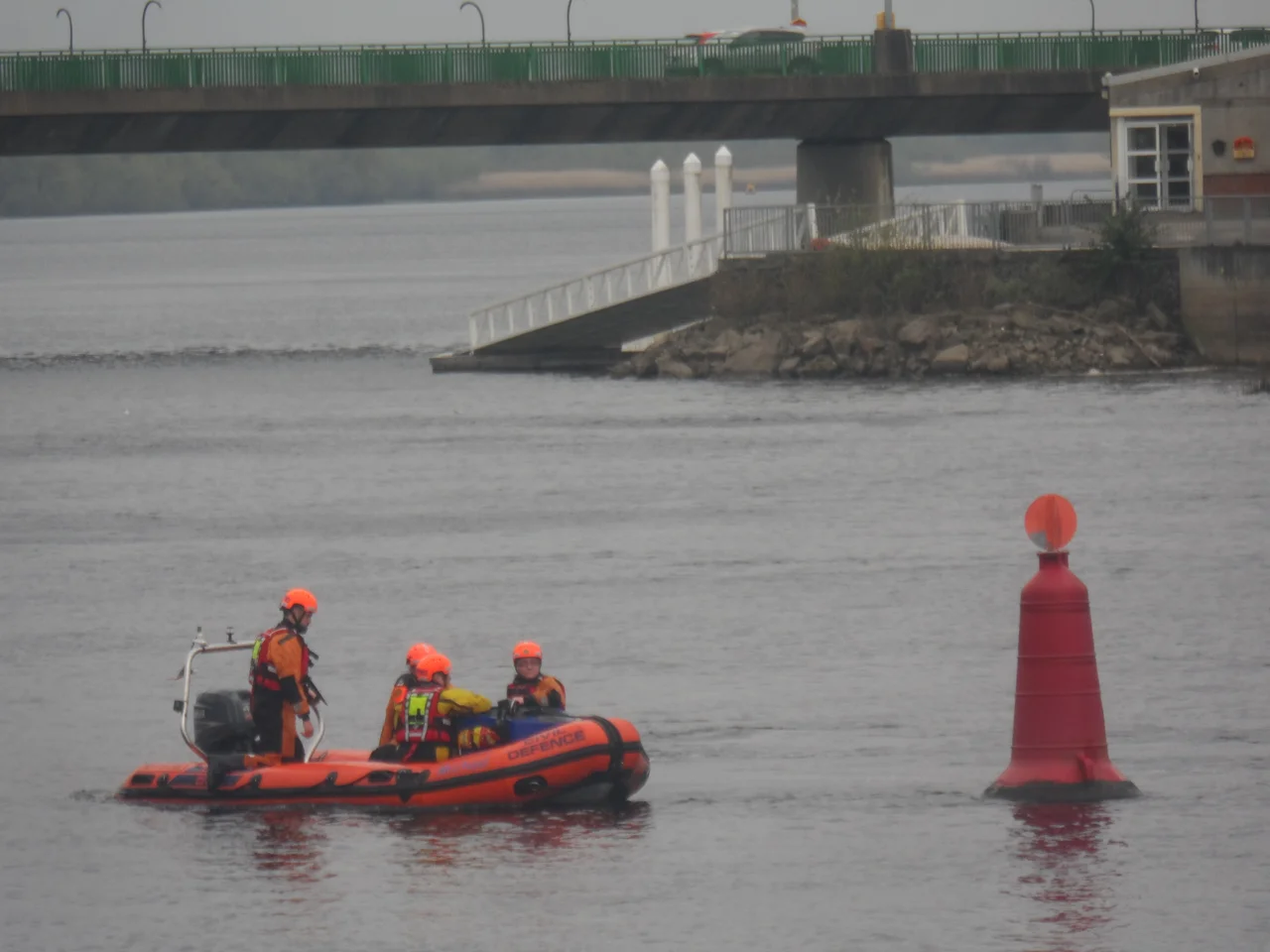
There is something distinctively Irish about the fleet. Land Rover Defenders and Mercedes G-Class field ambulances handle the boreens. Bedford and Iveco lorries shift personnel through floodwaters. The Bandvagn 206, a Swedish articulated tracked carrier originally built for arctic warfare, turns up at Irish blizzards looking entirely at home. Inshore patrol vessels and rigid-hulled inflatables wait in trailers at coastal stations for the next missing-person search on Lough Derg or the Shannon. The livery—orange and navy with white panels and high-visibility markings—is recognisable from the air and from the far end of a foggy field. Each vehicle is, in effect, a volunteer's commute to whatever the night requires.
A Pandemic and a Pattern
In March 2020, Civil Defence Ireland deployed for COVID-19. Volunteers drove medication to isolating households, transported swabs to laboratories, set up vaccination centres, supported the National Ambulance Service when its crews were overwhelmed. Some volunteers had retired from professional emergency services and returned to wear the uniform again. None of them were paid for any of it. The organisation runs almost entirely on volunteers, with a small core of paid Civil Defence Officers in each local authority to coordinate. It is one of the rare government structures that has survived austerity, reform, and reorganisation by being too useful to abolish and too modest to attract attention. The same instinct that founded it in 1951—that neighbours, trained and equipped, are the first line of national resilience—still runs the service today.
From the Air
Civil Defence Ireland's national headquarters sits near Roscrea in County Tipperary at approximately 52.96°N, 7.78°W. Cruise at 4,000–8,000 feet over the midlands and you are crossing the geographic heart of the volunteer training programme. Nearest airports are Shannon (EINN) to the south-west and Casement Aerodrome (EIME) near Dublin to the east. The training site occupies open ground south-east of Roscrea—visible as the cluster of low buildings adjacent to the N62. Local units operate from depots in every county.
Nearby Stories
- Portlaoise 6.6 km away
- Clonmacnoise 8.8 km away
- Thurles 8.9 km away
- Castletroy 11 km away
- St Canice's Cathedral 12 km away
- 2003 Derrybrien Landslide 16 km away
- Mountbellew 24 km away
- Mullingar 29 km away