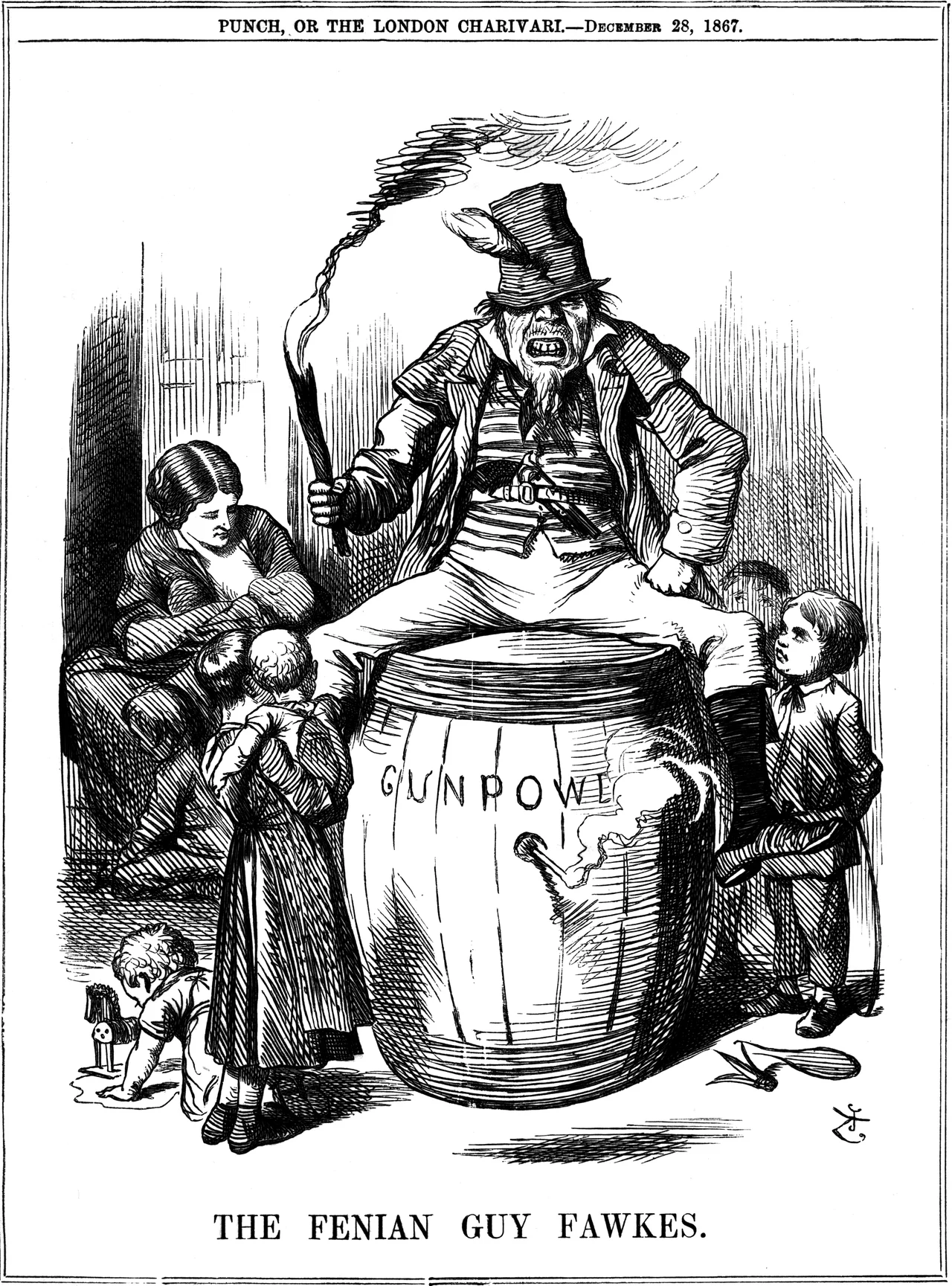

Fenian Rising
On the night of 5 March 1867, several hundred Fenians walked out of Dublin into a snowstorm. Their orders were to converge on Tallaght Hill, where the leadership had promised a coordinated nationwide rising. Most of them were unarmed or carried pikes. The Dublin Castle administration knew exactly where they were going, having been informed by paid agents inside the Irish Republican Brotherhood for over a year. The Royal Irish Constabulary intercepted them near the police barracks at Tallaght and drove them off with rifle fire. Twelve people died across Ireland that day. The rising never coalesced. Within a week the leadership was in custody. The Fenians had failed almost completely—and within fifty years their failure had become the founding moment of modern Irish republicanism.
The Transatlantic Brotherhood
The Fenians were a single movement with two heads. The Irish Republican Brotherhood was founded in Dublin by James Stephens in 1858, taking its name from the Fianna of legend. The same year, in the United States, John O'Mahony and Michael Doheny founded the Fenian Brotherhood as the American arm. Both organisations aimed at an independent Irish Republic established by force of arms, and both drew their recruits from the diaspora the Great Famine had created—a million dead between 1845 and 1850, and another million emigrated to America, Britain, Australia. The Famine had not radicalised everyone. But it had radicalised enough. By 1865 the Fenians had collected about 6,000 firearms in Ireland and counted perhaps 50,000 men sworn to the cause. In September that year, the British government moved to close down the Fenian newspaper The Irish People and arrest the leadership. Stephens escaped Richmond Bridewell jail in dramatic style. The remaining leaders—O'Leary, O'Donovan Rossa, Luby, Dillon—were sentenced to long terms of penal servitude.
Chester Castle and the Kerry Rising
In February 1867, Michael Davitt and a small Fenian party planned a raid on Chester Castle in England to seize weapons for the planned Irish rising. Irish immigrants in England were to cut telegraph lines, commandeer trains to Holyhead, hijack ships, and launch a surprise attack on Dublin. The plot relied on speed and secrecy. Both were compromised. John Joseph Corydon, a trusted agent of James Stephens, was informing the government. The Chester raid was abandoned. On 14 February, a small Fenian force in County Kerry attacked a coastguard station, robbed a man and stole horses, and killed one policeman before retreating between the Toomey Mountains and the MacGillycuddy Reeks. The Kerry rising was meant to be a feint. It became, instead, an early warning to the authorities of what was planned for March.
5 March: Snow, Confusion, Defeat
Risings took place that day in Dublin, Cork City, and Limerick. Bodies of men moved along the Crumlin, Greenhills, and Rathmines roads towards Tallaght Hill. The historian William Domville Handcock, writing in 1877, noted that the authorities had let the Fenians collect arms and organise unimpeded—'apparently' in the hope that they would commit some overt act that justified prosecution. The pattern repeated across the country. Outside Tipperary town, Colonel Thomas Francis Bourke led pike-armed rebels at Ballyhurst against the 31st Regiment; one rebel was killed, several wounded, many interned at Clonmel. In County Tipperary, police barracks at Ballingarry, Emly, Gortavoher, and Roskeen were burned. Around 40 men attacked the police barracks at Ardagh, County Limerick. A total of twelve people died across all engagements. When it became clear that the coordinated rising had not happened, most rebels simply went home. The Fenian leadership had mostly been arrested before the operation began.
The Manchester Martyrs and the Clerkenwell Outrage
The failure of the rising in Ireland did not end the campaign. On 18 September 1867, a Fenian rescue party in Manchester attacked a prison van carrying Thomas J. Kelly and Timothy Deasy. Sergeant Charles Brett, inside the van, was killed when the lock was shot off. Three Fenians—William Philip Allen, Michael Larkin, and Michael O'Brien—were hanged for his death in November 1867. They became known as the Manchester Martyrs. Their bravery on the scaffold provoked an emotional reaction across Ireland: 17 monuments were erected in their honour and annual commemorations continued well into the twentieth century. On 13 December 1867, Fenians blew up a wall of Clerkenwell Prison in London in an attempt to free Ricard O'Sullivan Burke. The explosion killed twelve people and injured one hundred and twenty. Michael Barrett was hanged for the bombing—the last public execution in Britain. The Clerkenwell Outrage powerfully influenced William Ewart Gladstone in his decision to disestablish the Church of Ireland.
The Political Aftermath
A military failure became a political success. Large protests in Ireland against the death sentences led to many of them being reprieved. Isaac Butt founded the Amnesty Association for Fenian prisoners; he went on to found the Home Rule League. In 1879, John Devoy and the IRB leadership decided on the New Departure—eschewing physical force in favour of the land question. The Fenians cooperated with Michael Davitt's Land League in the agitation of the 1870s and 1880s, and with the Irish Parliamentary Party in its long campaign for Home Rule. Not all Fenians agreed. The Irish National Invincibles assassinated Frederick Cavendish and Thomas Henry Burke in the Phoenix Park Murders of May 1882. Other factions sponsored a bombing campaign in Britain between 1880 and 1887. The Provisional Republican Government proclaimed in the 1867 Proclamation—'against the aristocratic locusts, whether English or Irish'—preceded the 1916 Easter Proclamation by almost fifty years. Patrick Pearse and his comrades on the GPO steps were heirs to the men who walked through the snow to Tallaght. The Royal Irish Constabulary, granted its 'Royal' prefix by Queen Victoria for its success in suppressing the 1867 rising, was disbanded in 1922 as part of the same process. Failure, in the end, can take a remarkable amount of time to finish failing.
From the Air
The 1867 Fenian Rising was a nationwide event in Ireland, with major engagements at Tallaght (County Dublin), Ballyhurst (near Tipperary town), Ardagh (County Limerick), and across counties Cork, Kerry, Clare and Tipperary. The waypoint at 53.35°N, 7.92°W is in the Irish midlands, roughly central to the rising's geographic span. Cruise at 6,000–10,000 feet across the midlands and you cross the heart of the territory where the rising's organisers came from. Tallaght Hill, the largest engagement site, lies 16 km south-west of Dublin city centre. Nearest international airports today are Dublin (EIDW), Shannon (EINN), and Cork (EICK).
Nearby Stories
- Saighir 7.8 km away
- Portlaoise 8.2 km away
- Castlepollard Mother & Baby Home 8.9 km away
- Mountbellew 14 km away
- St Mel's Cathedral 15 km away
- Castlerea 18 km away
- Mullingar 19 km away
- Gort 25 km away