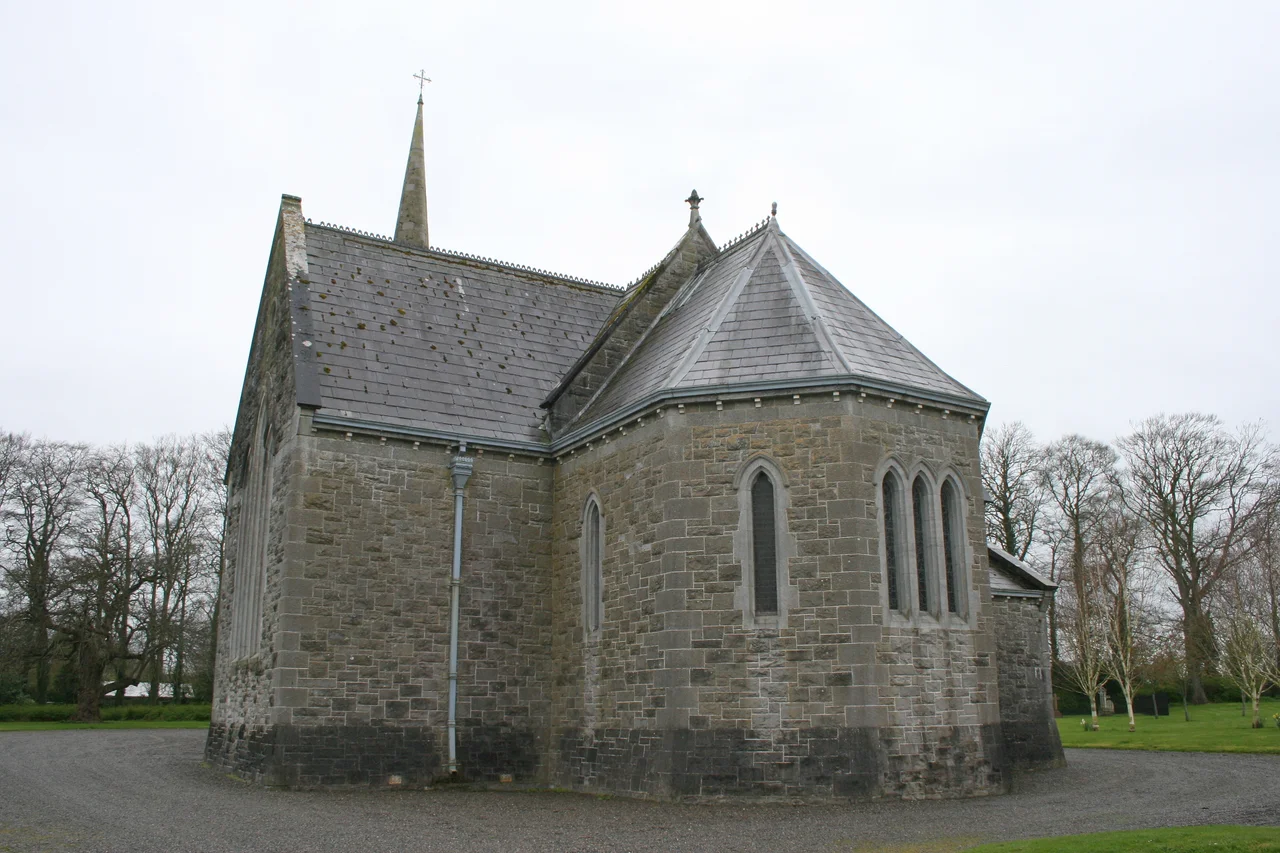

Straffan
In a Middle Irish poem called Lumman Tige Srafain, a warrior named Lumann carries a wonderful shield and dies of his wounds at a place called the House of Srafan. The poem is one of three hundred place-legends collected in the Dinnshenchas Erenn around the tenth century. The house belonged to a saint, Srafan, whose feast day was 23 May in the Martyrology of Tallaght, and the village that grew around the site eventually anglicised his name to Straffan. Today the village has a population of 1,158, more than tripled since 2002, but the older layers are everywhere: a 15th-century parish church ruin in the centre of the village, a chateau-style Victorian mansion that hosts the European Ryder Cup, a steam museum housed in a church carried here from Dublin, and a quiet rail bridge that became the site of an 1853 tragedy still remembered in song.
The Henry Family and Hogarth's Caricature
The Straffan estate has changed hands often. Maurice Fitzgerald received it from Strongbow himself in 1171. By the eighteenth century it had passed through Suttons, Boules, Talbots and Delaps before Dublin banker Hugh Henry bought it for £2,200 in 1731. Henry's son built a Palladian house resembling Oakley Park in Celbridge. His grandson Joseph Henry, MP for Longford, was a young blade who turned up in several caricatures by William Hogarth - paintings now hanging in the National Gallery of Ireland. Joseph's son John Joseph Henry gave the site for the Straffan Catholic church in 1787. He married Lady Emily Fitzgerald, daughter of the Duke of Leinster, in 1801. "Owing to his extravagance," a contemporary commentator wrote, "from one of the richest commoners in Ireland he became so embarrassed that he was obliged to sell Straffan and live abroad. Among other foolish things he built an underground passage from Straffan House to the stables." The house then accidentally burned, and the Henrys settled in France.
Wine, a Chateau and the K Club
Hugh Barton bought the burnt-out estate. He was a partner in the Bordeaux wine firm Barton and Guestier, and between 1828 and 1832 he built a new house downriver, designed by Frederick Darley and modelled on a chateau at Louveciennes near Paris. Twenty years later his successors added a mansard roof in the French style and an Italianate campanile with a gilded vane. For five generations the Bartons owned both this Liffey-side chateau and a 37-hectare vineyard in St Julien near Bordeaux, producers of Chateau Leoville-Barton and Chateau Langoa-Barton. When Bertram Barton died in a hunting accident in 1927, the estate was losing £4,000 a year. The family eventually sold for £15,000 in 1949. A handful of short-lived private owners followed - a motorcycle manufacturer, a car importer, a James Bond film producer, an Iranian general executed by the Khomeini regime. In 1988 Michael Smurfit bought the place for £7 million and spent £35 million more developing it into a country club. The Ryder Cup came to the K Club in 2006.
The Tragedy at Baronrath
On the evening of 5 October 1853, in heavy fog south of Straffan station, the noon express from Cork stalled when its piston rod snapped. A twenty-wagon goods train ran into the back of it at full speed. Eighteen people died - the third worst rail tragedy in Ireland's history to that date and still, today, the worst rail accident in what is now the Republic of Ireland. Donegal-born poet William Allingham wrote a poem about it. The station opened in 1848 and closed for scheduled services in 1947, after which the rails kept running but the platform fell silent. A century later, on 22 June 1975, a local man named Christopher Phelan was stabbed to death near the Baronrath bridge when he interrupted Loyalist paramilitaries trying to derail a train carrying two hundred republicans toward the Bodenstown commemoration. His intervention delayed the bomb long enough that it blew a three-foot gap in the track but missed the train itself.
A Village of Quiet Survivals
About fifty sites of archaeological and cultural interest cluster around the village, from an ancient hill fort to the 1913 Lych Gate that has become the symbol of Straffan. Barberstown Castle, originally raised by Nicholas Barby in the thirteenth century, still stands four and a half feet thick at its walls, with a fifty-three-step staircase and a battlemented keep - and operates as a hotel. The Church of Ireland church, built in 1833 and modelled on French churches, contains stained glass by Alfred Child and Catherine O'Brien and several Barton family monuments. The Straffan Steam Museum, housed in a church physically removed from the Inchicore railway works in Dublin, displays a large beam engine installed at Smithwick's brewery in 1847, a pumping engine from Jameson's distillery, and an assortment of model locomotives. Each autumn, the Liffey Descent canoe race starts here and runs seventeen miles downstream to Islandbridge in central Dublin. A village shaped by saints, rebels, wine merchants and disasters keeps on with its quiet work.
From the Air
Located at 53.30°N, 6.60°W on the south bank of the River Liffey, about 25 km west-southwest of Dublin. Best viewed at 2,000-4,000 ft AGL; the K Club's two golf courses are visible as a distinctive pattern of fairways and water hazards along the Liffey. Nearest airports: Weston (EIWT) 8 km east, Dublin (EIDW) 30 km east-north-east.
Nearby Stories
- Athcarne Castle 4.2 km away
- Wicklow Mountains National Park 10 km away
- Castlepollard 12 km away
- Portlaoise 19 km away
- Edward Pakenham 20 km away
- German submarine U-1051 39 km away
- HMS Manners (K568) 52 km away
- HMS Tyler 61 km away