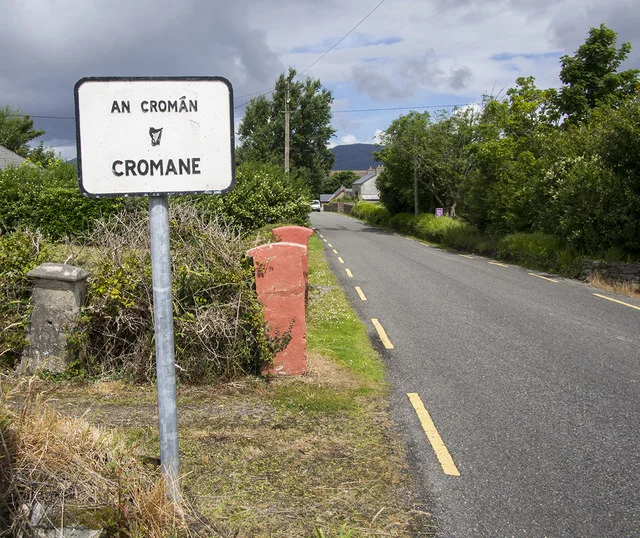

Cromane
The peninsula juts out into Castlemaine Harbour like a bent hip, and the Irish name takes the shape literally: An Cromán, the hip bone. Cromane is a small village on a curl of land nine kilometres west of Killorglin, looking north across the bay to the Dingle Peninsula and west toward Glenbeigh and the Iveragh. The bones of the place are old. The mussel beds offshore are the largest natural beds in Ireland. The oysters, a newer trade, are grown on long trestles you can see at low tide. And the father of the man who coined the term artificial intelligence came from this village before he went to America, where his son grew up to invent a discipline.
A 360-Degree View Almost Nowhere Else Has
Cromane is one of the few places in Kerry where you can stand on a single piece of ground and see, in three sweeps of the eye, the Brandon Mountain range to the north, the Slieve Mish mountains to the east, and MacGillycuddy's Reeks to the south, with Carrauntoohil rising on the skyline. The combination is not common in Ireland; it requires a peninsula low enough and shaped right enough that nothing blocks the view. The Dingle Peninsula sits across the bay, close enough that on still days you can see the smoke from chimneys above the small coastal villages. The village itself is strung out along a single road that ends at the strand, where the road runs out and the bay takes over. A piece of local memory: 180 years ago, a ten-tonne piece of Spanish marble destined for the new Catholic church in nearby Killorglin slipped from a barge and went down in the shallow water just off Cromane strand, where, by some accounts, it is still.
Mussels, Oysters, and Jack's Coastguard
Cromane was a salmon fishing village for centuries before it became something else. Since the middle of the twentieth century it has built itself into an aquaculture centre, and the change has reshaped the working week along the strand. Castlemaine Harbour holds Ireland's largest natural mussel beds, dredged by a small fleet that operates out of Cromane and the surrounding villages. In the past two decades the village has also grown into a base for oyster farming, the trestles racked in lines just below the high-water mark. At the centre of the village stands Jack's Coastguard Restaurant, an award-winning seafood place that occupies the old Coastguard Station overlooking the harbour. The stone building was raised in 1866, when the British Empire still ran the coast watch, and turned into a public house in 1961. The shellfish on the menu came in that morning, from water you can see from the table.
Twelve Men to a Boat
Cromane has a rowing club, founded in 1956, and the boat it is best known for is not a sleek modern shell but a Seine boat, a heavy traditional craft once used for mackerel fishing along the South Kerry coast. A Seine crew is twelve oarsmen pulling six oars (two men to an oar) with a cox calling the line. The boats are unique to this part of Kerry, and the racing circuit, which takes place across the summer, runs between Cromane and neighbouring villages: Cahersiveen, Kells, Valentia, Portmagee, Ballinskelligs, Caherdaniel, Templenoe, Sneem. The boats are the old shape of the fishing trade preserved at full intensity, and the rivalries between villages are inherited the way old grudges are. Every August Cromane hosts its own regatta, with races for under-twelves up through the adult Seine boat competition, and the strand fills with families. The village's GAA club, Réalt na Mara (Star of the Sea), shares its name with the parish church and primary school. Two of its players, Donnchadh Walsh and Sean O'Sullivan, won All-Ireland senior football medals with Kerry between 2006 and 2014.
The Father from Cromane, the Son in Palo Alto
John McCarthy, born 1927 in Boston, is the American computer scientist who in 1955 coined the term artificial intelligence as part of a proposal for the Dartmouth Summer Research Project. He went on to invent the programming language LISP, to develop time-sharing systems at MIT and Stanford, and to win a Turing Award. His father came from Cromane. It is the kind of detail that small villages keep because nobody else will: a man left this strand, went to America, raised a family, and his son went on to name a field of knowledge that has remade the century. There is no statue here, no plaque on a wall pointing to a house. The bay is full of oyster trestles. The Seine boats are up on the slip. The McCarthy line went west, like so many Cromane lines, and the village remembers where it began.
From the Air
Cromane sits at 52.106 N, 9.897 W, on a peninsula reaching into Castlemaine Harbour nine kilometres west of Killorglin. From the air the village is a thin string of houses along the spit, with the harbour shallows and the oyster trestles clearly visible at low tide. The Slieve Mish mountains rise north, the Reeks to the south. Nearest airport is Kerry (EIKY) about 30 km east; Shannon (EINN) lies about 85 km north. Best viewing altitude is 1,500 to 3,500 ft, ideally near low tide when the shellfish frames are exposed. Castlemaine Harbour is a Special Area of Conservation, so respect any temporary airspace notices over the SAC.
Nearby Stories
- Inishtooskert 2.5 km away
- Staigue stone fort 5.6 km away
- Listowel 7.1 km away
- Castleisland 13 km away
- Ballyheigue Castle 13 km away
- Kealkill stone circle 15 km away
- RMS Carinthia (1925) 93 km away
- Sao Miguel 1951 km away