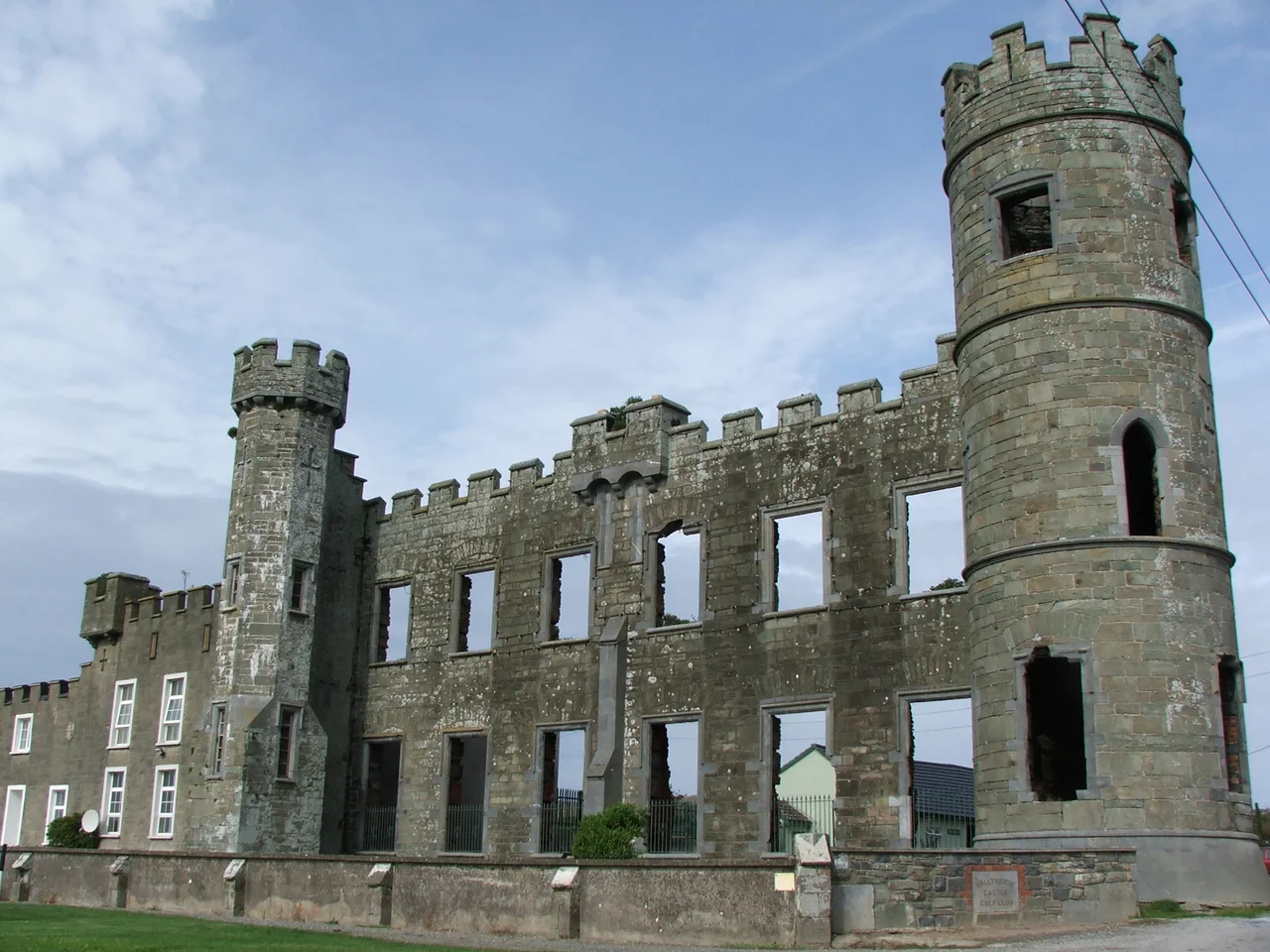

Ballyheigue Castle
On the night of 27 May 1921, a draper's assistant named Thomas Clifford walked into Ballyheigue Castle with a can of petrol. He poured it across floorboards in rooms where, three weeks earlier, hundreds of north Kerry men had been imprisoned by the Royal Irish Constabulary. He had been ordered to destroy the castle. He lit it and walked out. The Tudor-gothic mansion of the Crosbie family - High Sheriffs of Kerry, MPs at Westminster, the family that had held this stretch of coast since the bishop of Ardfert was named John Crosbie a few centuries earlier - burned. The walls survived. Almost everything else didn't. Today the ruin is a clubhouse for a golf course.
The Crosbie Story
The Crosbies were once the Mac an Chrosáin, a bardic family of Leinster - poets, in other words, attached to a Gaelic lord's household. At some point in the late 16th or early 17th century, the family converted to Protestantism, anglicised their name, and started moving up the colonial hierarchy. By 1601, John Crosbie - born Sean Mac an Chrosáin - was Church of Ireland Bishop of Ardfert, a remarkable transformation. From 1709, the Ballyheigue estate passed through generations of Thomas, James, and Pierce Crosbies, who served as MPs for Kerry and Dingle, High Sheriffs of the county, colonels of the militia, and finally, in the case of James Dayrolles Crosbie (1865-1947), a brigadier-general in the First World War. The house they lived in was rebuilt and enlarged in 1809 by Richard Morrison, one of Ireland's finest Regency architects, on the foundations of a 1758 building. The 'castle' in the name came from the crenellated parapet - decorative rather than defensive. The house had a south-facing front of six bays flanked by three-storey circular corner turrets, and was originally thatched, which gave it a peculiar combination of Tudor-gothic show and Irish vernacular practicality.
The First Burning
Trouble started early. On 1 December 1912, a hay shed at the castle was set on fire. The next day, two more hay sheds went up, destroying 200 tons of hay. James Crosbie claimed £1,000 in damages. The fires came in a context of escalating tension over land and politics across rural Ireland: the Land War was decades past but the underlying grievances - tenant farmers under absentee or quasi-foreign landlords, communities watching the British administration favour one religion over another - had not gone away. Between 1916 and 1920, James Crosbie quietly liquidated his position. He auctioned off the demesne lands of the estate to local people. He sold the castle itself to Jeremiah Leen. The Crosbie connection with Ballyheigue, which had begun before the Battle of the Boyne, ended in a series of paper transactions during the First World War.
The Internment Camp
In early 1921, the building stood vacant. A Mr. Palmer and Mrs. Erskine moved in for a few weeks - Palmer ran local creameries, and Erskine was in the process of negotiating some kind of transaction with him. Erskine then informed Michael Pierce, the captain of the local Irish Volunteers, that the British military was about to occupy the castle. In March 1921 the RIC moved in. During a sweep across north Kerry from the coast as far inland as Kilflynn, hundreds of local men were rounded up and detained in the castle's outbuildings - only one of them, by some accounts, was an actual IRA volunteer. The rest were ordinary residents of the district, scooped up by British forces casting a wide net. The detentions lasted weeks. People were released, mostly, after questioning. The castle, once a centre of local gentry life, was now functioning as an interrogation centre.
Petrol on Floorboards
On 25 May 1921, an auction was held at the castle to sell off the building's contents - furniture, drapes, fixtures. Two days later, on 27 May, local Irish Volunteers came at night with cans of petrol. Thomas Clifford - the draper's assistant - was the man who did the lighting. He testified to it later, openly, in court. The blaze gutted the building. Walls survived; floors didn't. Palmer was awarded £127 in compensation by a Tralee court in October for his lost furniture. Jeremiah Leen, the new owner, sued Lloyd's of London for his insurance and was awarded £9,500 plus costs in a King's Bench Division case in June 1923, after the underwriters argued (unsuccessfully) that he had failed to disclose that the building had been occupied by Crown forces and used to detain political prisoners. The judge effectively ruled that you couldn't refuse a claim because the insured had been caught up in events that affected the entire country.
Apartments and Greens
For most of the 20th century, the burned-out shell of Ballyheigue Castle stood as a ruin on a piece of coast spectacular enough to make ruin photogenic. In 1975, a low section of the building to the left of the main front elevation was reconstructed and converted into apartments. The main shell stayed open to the sky. In 1998, Ballyheigue Castle Golf Course opened around the ruin, officially inaugurated by Dick Spring, the Minister for Foreign Affairs at the time and the Labour Party leader. The course wraps the property in fairways and greens; the ruin sits on the grounds like a gigantic folly, picturesque in a way no golf course architect could have invented from scratch. A romanticised 1818 print by John Preston Neale shows the castle imagined from much closer to the sea than it actually stood, the artist taking a typical liberty with topography. The real building was about 200 metres back from the shore, with continuous farmland either side.
Bardic to Brigadier
The arc of Ballyheigue Castle traces something larger about Ireland. The Mac an Chrosáin family produced poets for Leinster lords in the 16th century. Four hundred years later, their descendants were producing British army officers and high sheriffs, lived in Tudor-gothic mansions, and married into the wider Anglo-Irish gentry. By the time of independence, the family had cashed out and left, and the building they left behind was burned by men whose ancestors might have written in the same bardic tradition the Crosbies' had once practiced. Today the ruin sits between the Atlantic and the Slieve Mish Mountains - waves on one side, low hills on the other, Banna Strand stretching to the south. The wind moves through empty window openings. The golfers play through. The story keeps unfolding.
From the Air
Ballyheigue Castle ruin sits at approximately 52.39°N, 9.83°W, just inland from Ballyheigue Strand on the north Kerry coast, about 16 km north of Tralee. From the air look for the ruined shell of the castle set in the green fairways of the surrounding golf course, with the long curve of Ballyheigue Bay to the west and the broad sweep of Banna Strand extending southward. Kerry Airport (EIKY) is 25 km southeast at Farranfore. Shannon Airport (EINN) is 60 km north. Best viewing altitude is 2,000-4,000 feet, with the Atlantic surf, the golf course, and the castle ruin all clearly visible together. The Maharees peninsula and Tralee Bay open to the south.
Nearby Stories
- Conor Pass 2.9 km away
- County Kerry 4.7 km away
- William Smith O'Brien 6.1 km away
- Newhall House and Estate 12 km away
- Dromagh Castle 14 km away
- Rineen Ambush 24 km away
- Ballynavenooragh 28 km away
- RMS Carinthia (1925) 62 km away