
Newhall House and Estate
Every seven years, according to local belief, the waters of Killone Lake turn red. The red is said to be the blood of a mermaid - wounded once by an O'Brien wine thief and his servants, who scalded her with boiling water - and the lake's discolouration foretells a change in the occupants of Newhall House on the shore above it. The mermaid's curse, recorded as: "As the mermaid goes on the sea, so shall the race of O'Briens pass away, till they leave Killone in wild weeds," sounds like the kind of story Irish gentry made up about their own estates. The strange thing about Newhall is that the O'Briens did pass away from here, eventually, and the wild weeds did come.
From Abbey Stones
Newhall was built from a stolen abbey. The historic core of the house, constructed beginning in 1650, is said to have been raised from stones taken out of Killone Castle, a medieval fortification that stood on the same estate and is now entirely vanished. In 1544, Henry VIII had granted Killone Abbey - the Augustinian nunnery suppressed four years earlier - along with much surrounding property to Murrough O'Brien, 1st Earl of Thomond. The grant followed a transaction known as surrender and regrant: Murrough had handed the kingdom of Thomond to the English crown and received it back as a feudal subject, complete with the church land. The O'Briens then built themselves a country house on the new estate. The abbey was already a ruin by 1617, and its stones were apparently fair game.
Lord Clare and the Wars
Daniel O'Brien, 3rd Viscount Clare, owned Newhall during the middle 17th century. The viscount was a Catholic Jacobite who lost everything when William of Orange defeated James II - the lands forfeited, the title attainted, the family exiled to France. The complications of inheritance through this era are intricate. In 1708, Colonel John O'Brien left Newhall and Killone to his wife Honora O'Brien in his will. Honora subsequently had a relationship with Richard Burke, 2nd Earl of Clanricarde, and their illegitimate son Richard Burke had a daughter Marcella whose marriage in 1747 to Donough O'Callaghan of Kilgorey complicated the title further. Eighteenth-century Irish gentry families produced this sort of genealogy as a matter of course.
The Georgian Front
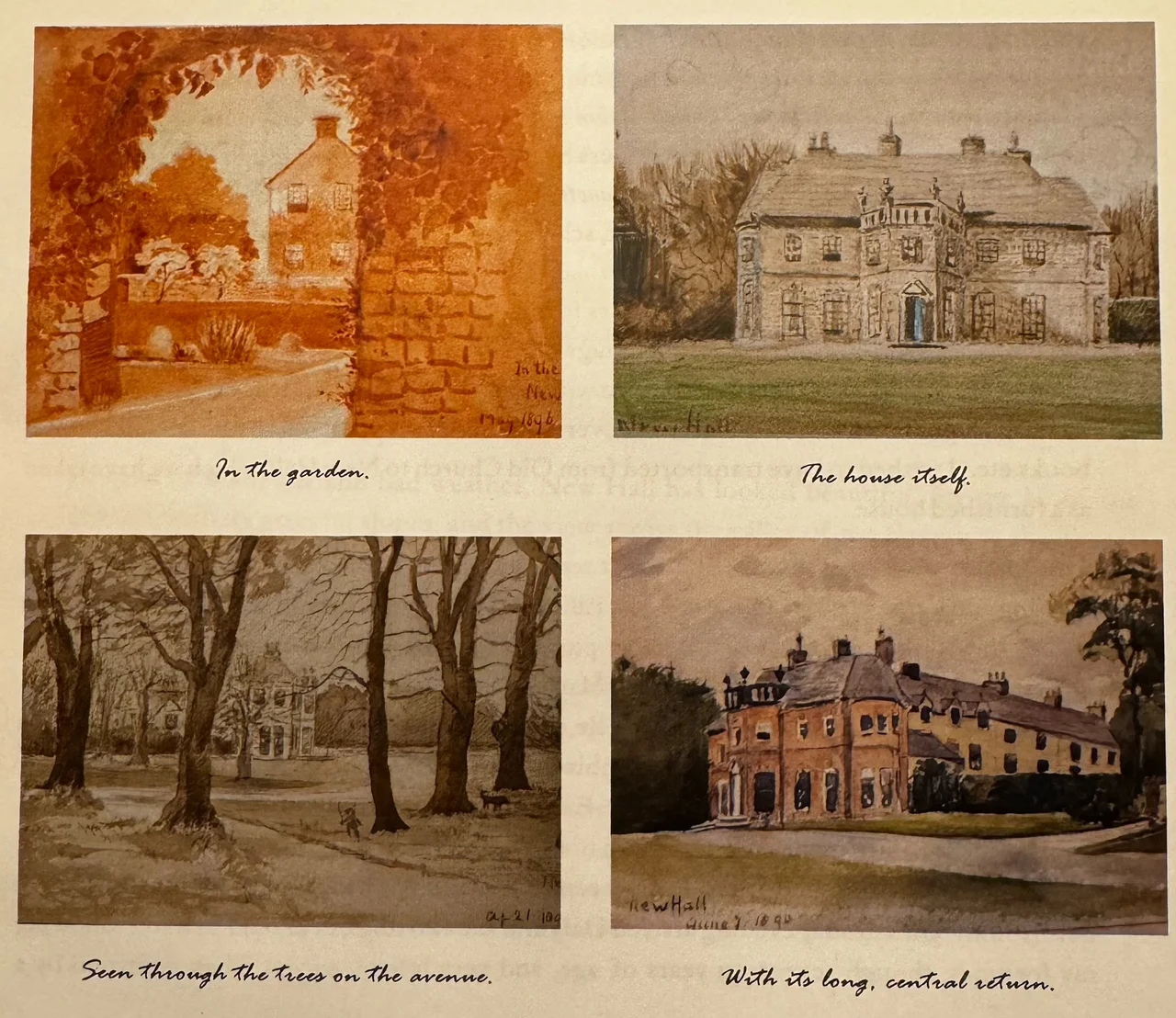
In 1764, Charles MacDonnell - whose father James had married into the O'Brien family - purchased Newhall from his maternal uncle, Sir Edward O'Brien, 2nd Baronet of Dromoland Castle. Charles MacDonnell promptly married Sir Edward's daughter Katherine, keeping the property within the extended family. He then commissioned a major expansion: a new Georgian or Queen-Anne style front section attached to the older 17th-century rear, possibly designed by Francis Bindon or Isaac Rothery (both prominent Irish architects of the period). The result was the distinctive T-shaped layout that survives - a polite Georgian face for entertaining presented to the world, the older working house tucked behind. The 1864 estate covered 6,670 acres.
Soldiers and Heirs
Charles MacDonnell's son, also Charles, born 1761, was the kind of restless Anglo-Irish landed gentleman whose career could only be assembled from fragments. He was appointed lieutenant-colonel commandant of the Earl of Belvedere's regiment in 1794. During the American War he had earlier raised and commanded a regiment of volunteers in Canada. He served as Member of Parliament for County Clare, then for the borough of Yarmouth, and in 1802 was appointed a commissioner of accounts. He died in Bath, England, on 6 September 1803. The estate passed to his granddaughter, who married William Henry Armstrong in 1809. Their son William Edward Armstrong inherited from his uncle John MacDonnell in 1850 and took the additional name and arms of MacDonnell by royal license. By the late 19th century the estate was sometimes occupied by cousins; Charles Randal Armstrong MacDonnell inherited in 1883 and married Mary Stacpoole of neighbouring Edenvale.
The Land Acts
In 1912 Charles R.A. MacDonnell transferred 3,485 acres of tenanted land and 256 acres of untenanted land to the Congested Districts' Board for a sum exceeding £26,000. This was a typical late-Edwardian Irish land transaction: the Land Acts that ran through the 1880s, 1890s, and into the 20th century gradually broke up the great estates of the Protestant Ascendancy, transferring ownership to tenant farmers backed by long-term British government loans. Newhall, like dozens of other Clare estates, contracted from a vast working demesne to the house, parks, and immediate surroundings. The acreage went to the smallholders who had worked it. The big house remained.
The View and the Lake
A 19th-century description of Newhall calls it "a convenient, and not unpicturesque edifice, built of red brick with cut limestone accents, standing upon an eminence, commanding a magnificent view of the River Fergus and broad waters of the Shannon." Two lakes and romantic islands sit on the estate. One side is dressed with lush shrubs and trees; the opposite shore is precipitous limestone cliffs. In the distance, the noble mountains of Tipperary close the view. The estate's demesne includes the holy well of Saint John the Baptist, gate lodges, the ruined Killone Abbey, woodlands, parklands, and Killone Lake itself. The Commane family now own and operate the estate. The mermaid, depending on whom you ask, has either moved on or simply waits for the next seven years to roll round.
From the Air
Coordinates 52.81°N, 9.01°W. Newhall sits 5 km south of Ennis in County Clare, with Killone Lake on the southern boundary of the estate. Shannon Airport (EINN) lies 18 km southeast. From altitude the estate appears as a wooded demesne with two lakes - Killone Lake the larger - set in the wider pastoral landscape of the Fergus valley. The ruined Killone Abbey is visible on the north shore of Killone Lake. The River Fergus runs east of the property toward its broad estuary south of Clarecastle. Best viewed from 1,500-2,500 ft AGL; the woodland canopy makes the house itself hard to spot from above except in winter.
Nearby Stories
- Kinvara 6.1 km away
- William Smith O'Brien 9.3 km away
- Newport, County Tipperary 13 km away
- Aran Islands 14 km away
- Portumna 15 km away
- Kilkee 19 km away
- Tipperary (town) 21 km away
- Kilflynn 25 km away