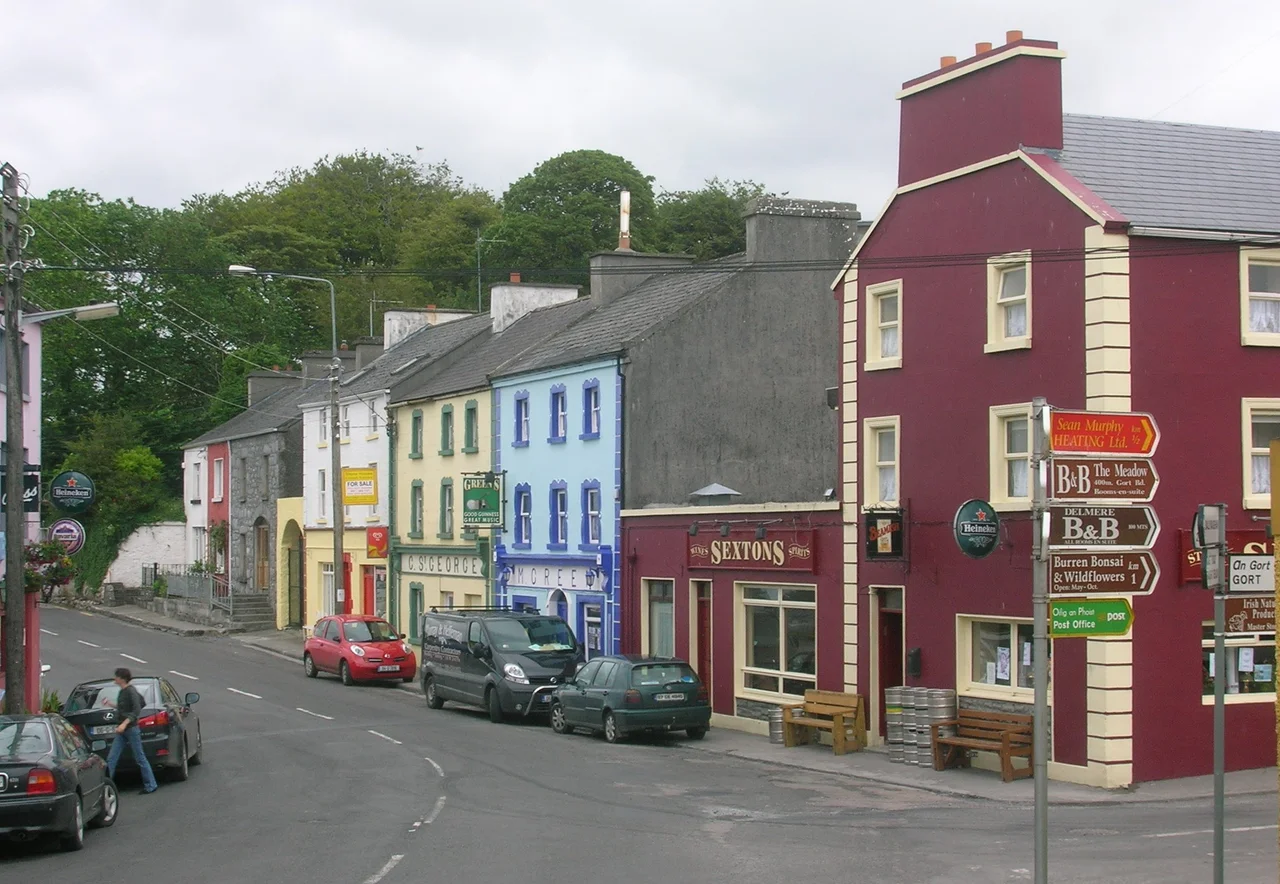

Kinvara
Cinn Mhara, the Irish name, means the head of the sea. The English Kinvara - or Kinvarra - is the same idea, anglicised. The village sits at the head of a shallow inlet at the south-eastern corner of Galway Bay, the kind of place where the tide goes a long way out and comes back unhurried. Dunguaire Castle stands on the rocks at the eastern edge of the village, a sixteenth-century tower house of the O'Hynes that has somehow refused to fall. John Prine, the American singer-songwriter, kept a house here. So did poets and judges and saints, in their turn.
Castle of Guaire
Dunguaire - the Castle of Guaire - is named after a seventh-century king of Connacht famous for hospitality so reckless his courtiers worried for the kingdom's finances. The tower itself dates from around 1520, built by the Ó hEidhin (O'Hynes) clan. A 1574 list of Galway castles, probably compiled for Lord Deputy Sir Henry Sidney in advance of the Tudor composition of Connacht, names Fearadhach Ó hEidhin - Faragh O'Hynes - as the owner. The castle changed hands repeatedly, fell into ruin, and was restored in the twentieth century. Today it stages medieval banquets in the summer, the kind of touristic theatre that the building has every right to refuse but instead seems to bear with stoic Irish dignity.
Chasm of the Heads
Outside the village a Mass rock survives - the Poulnegan Altar, known in Connaught Irish as Poll na gCeann, the chasm of the heads. The story attached to it is one of the small horrors of the Cromwellian conquest. According to local tradition, there was a college nearby where student monks were attending Mass when Cromwellian soldiers arrived. The students were killed and their heads thrown into a nearby chasm. The historian Tony Nugent records the tradition; the rock itself is among the most evocative of Ireland's Mass rocks, those outdoor altars used during the period when Catholic worship was suppressed. Two centuries later the same fields hosted the Terry Alts, an agrarian secret society. In 1831 a large group gathered between Kinvara and New Quay on Abbey Hill and challenged British troops to battle. The Terry Alts dispersed before the soldiers arrived. They were less lucky at Corranroo, where an attempted ambush cost one of them his life.
Famine Port
Before the Great Famine, Kinvara was a thriving port - corn shipped out, seaweed harvested from the bay, hookers and pucans plying back and forth to the Aran Islands and the Clare coast. The Famine of the 1840s broke that economy as it broke so many others, and the steady emigration that followed - lasting essentially until the 1960s - cut the village to a few hundred residents. The recovery came late and slowly. Between the 1991 and 2016 censuses the population grew by 70 percent, from 425 to 734. Saint Colman's Church, built in 1819, and Saint Joseph's, built in 1877, anchor the Catholic parish - which forms part of the wonderfully cumbersomely-named Diocese of Galway, Kilmacduagh and Kilfenora. The Church of Ireland presence in Kinvara falls under the united Diocese of Limerick and Killaloe.
Cuckoos and Boats
Two festivals shape the Kinvara year. Fleadh na gCuach - the Cuckoo Festival - is an Irish traditional music gathering in early May, when the cuckoo first calls and the musicians arrive to fill the village pubs. In mid-August comes Cruinniu na mBad, the Gathering of the Boats, when the Galway hookers - the heavy, brown-sailed sailing boats native to this coast - race across the bay and crowd into the harbour at Kinvara. They were working boats once, carrying turf from Connemara to the Burren and bringing back limestone, and the gathering preserves a working craft that very nearly died out. Kinvara GAA plays hurling almost exclusively, with junior Gaelic football on the side. The pubs run live trad music. The harbour fills at high tide.
Songwriters and Saints
Francis Fahy, the songwriter who wrote 'Galway Bay,' was a son of Kinvara - not the more famous Bing Crosby version from 1947 but the older, gentler song that came before it. Ailbhe of Ceann Mhara, a ninth-century cleric, and Coman of Kinvara, an early medieval saint, gave the village its religious lineage long before Saint Colman built his church. Mathilda Twomey, born and raised here, became the first female Chief Justice of the Seychelles. Maire Whelan was Ireland's first female Attorney General from 2011 to 2017. P. J. Mara, the political fixer to a generation of taoisigh, is buried in the village. And John Prine - the singer of 'Angel from Montgomery' and 'Hello in There,' who died of COVID-19 in April 2020 - kept a home in Kinvara, the kind of unsung connection that small Irish villages quietly accumulate.
From the Air
Kinvara sits at 53.14 N, 8.94 W at the head of an inlet in the south-eastern corner of Galway Bay, in County Galway about 25 km south of Galway city. Galway Airport (EICM) lies 22 km north-east; Shannon (EINN) about 48 km south. The visual signature from altitude is the inlet itself - a narrow finger of water reaching east from the bay into the karst country at the northern edge of the Burren. Dunguaire Castle stands on the rocky promontory at the village's eastern edge and is large enough to be picked out in low oblique light. Best viewed clear westerly mornings; Atlantic systems can close visibility quickly.
Nearby Stories
- Connemara Railway 3.8 km away
- Ennis 7.2 km away
- Headford 10 km away
- Inishmaan 12 km away
- Ballygar 12 km away
- Ardgraigue Bog 13 km away
- Nenagh 17 km away
- Kilkee 27 km away