
Aghadoe Cathedral
When the Scottish journalist Charles Mackay walked the grounds around Aghadoe Cathedral in the summer of 1849, he counted what the local people already knew. Over the previous three years, approximately 2,000 famine victims from the local workhouse had been buried within the one-acre church grounds. The cathedral itself had been a ruin for centuries by then - a roofless shell of stone overlooking the Lakes of Killarney - but the ground around it was still being used. The dead from the workhouse were laid in a corner of the churchyard, with no individual markers. Two thousand people. Within an acre, within three years, within a single corner. Their names, mostly, did not survive them.
Place With Two Yews
Aghadoe means 'place with two yews' in Irish - Achadh Deo - and the site may have been sacred before any of the surviving stone was laid. Pagan religious activity is likely to have preceded the Christian foundation. By the seventh century, the missionary tradition associates St. Finian the Leper with founding a monastery here. Ogham stones - the early Irish writing carved into stone edges - date from the same period and offer the first clear evidence that this was an important place. The first written reference comes from 939 AD, in the Annals of Innisfallen, which call Aghadoe the 'Old Abbey'. By then the site already had centuries of accumulated religious use behind it. The yews themselves are gone, but yew trees were sacred to pre-Christian Ireland and frequently survived around early monastic foundations.
The Great Church of 1158
In the middle of the twelfth century, Amhlaoibh Mor O Donoghue - leader of the O Donoghue clan and the new rulers of the kingdom of Eoganacht Locha Lein - commissioned a new church on the Aghadoe site. Built in the Romanesque style and dedicated to the Holy Trinity, it incorporated parts of the existing stone building into its northwest section. It was completed in 1158 and became known simply as the Great Church. A later twelfth-century addition served as a chancel or choir, separated from the rest of the church by a wall. The Romanesque doorway on the western face survives with its carved jambs. They are similar in style to the carvings on the Aghadoe Crosier - a walrus-ivory bishop's staff carved in the Urnes style of the Vikings, evidence that the artistic culture of Aghadoe was networked into the Norse-Irish world of the eleventh and twelfth centuries.
Crosiers, Crosses, and a Salmon
The Aghadoe Crosier, made of walrus ivory carved in the Urnes style, is one of the great surviving artefacts of medieval Ireland. A second crosier, possibly associated with Aghadoe, was pulled from the Lakes of Killarney in 1867 by a fisherman who at first thought it was a salmon - an image that has stayed with this story ever since. The Annals of Innisfallen record that Aghadoe's high cross toppled in a strong wind in 1282. Two ogham stones have been found at the site. One is now cemented into the south wall of the chancel, bearing the inscription BRRUANANN, possibly intended as BRREANANN - a reference to St. Brendan the Navigator. A second ogham stone has gone missing, its inscription transcribed before its disappearance as GGVVSS MN. A bullaun stone - a hollowed boulder - was originally a quern for grinding grain. Later it became a holy water receptacle, and the rainwater that collected in its hollow was said to have healing powers.
The Workhouse Dead
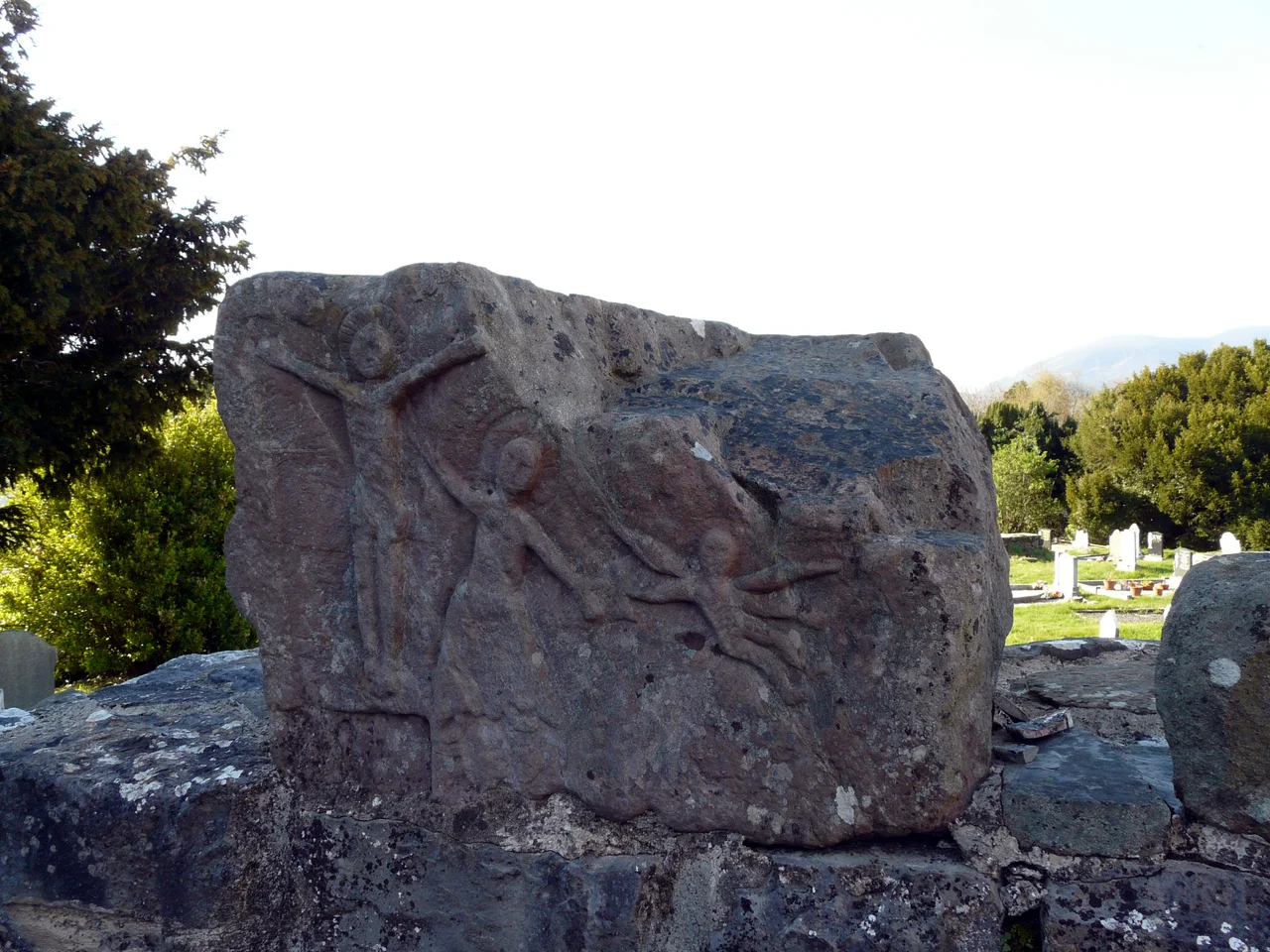
The Great Irish Famine reached Killarney like every other corner of Ireland. From 1846 to 1849, the local workhouse held the people who had no other shelter - and the workhouse, by design, killed as many as it sheltered. Disease, malnutrition, exhaustion. When workhouse inmates died, they were buried in the grounds of Aghadoe Cathedral. Charles Mackay's estimate of 2,000 burials in three years means roughly two people per day, every day, going into one corner of the cathedral grounds. There are no markers. There never were. The famine killed approximately a million people across Ireland and forced another million to emigrate. The dead at Aghadoe represent a small fraction of that catastrophe, but the spatial concentration is what registers when you stand here: an acre of ground, a corner of an acre, two thousand human beings. A seventeenth-century carved stone fragment found on the site shows the crucifixion with a female figure passing a chalice to Christ on the cross. The carving suggests Aghadoe was still in religious use centuries after the Great Church was abandoned. The famine dead lay beneath ground that had been holy since before written record.
From the Air
Located at 52.08 N, 9.55 W, on a hillside above the Lakes of Killarney, County Kerry. The cathedral ruins are a few miles north of Killarney town and command a view of Lough Leane and the surrounding mountain landscape. Nearest airport: Kerry (EIKY) at Farranfore, about 16 km north. The MacGillycuddy's Reeks rise to the southwest - Carrauntoohil, Ireland's highest peak, is visible on clear days. Best viewed from low altitude approaches into Kerry; the lakes form the dominant visual context.
Nearby Stories
- Emlagh East Ogham Stone 2 km away
- Carrignacurra Castle 2.6 km away
- Uragh Stone Circle 5.2 km away
- Ballinskelligs 6.2 km away
- Eurovision Song Contest 1993 8.2 km away
- Newcastle West 9.6 km away
- Ballyheigue Castle 11 km away
- RMS Carinthia (1925) 98 km away