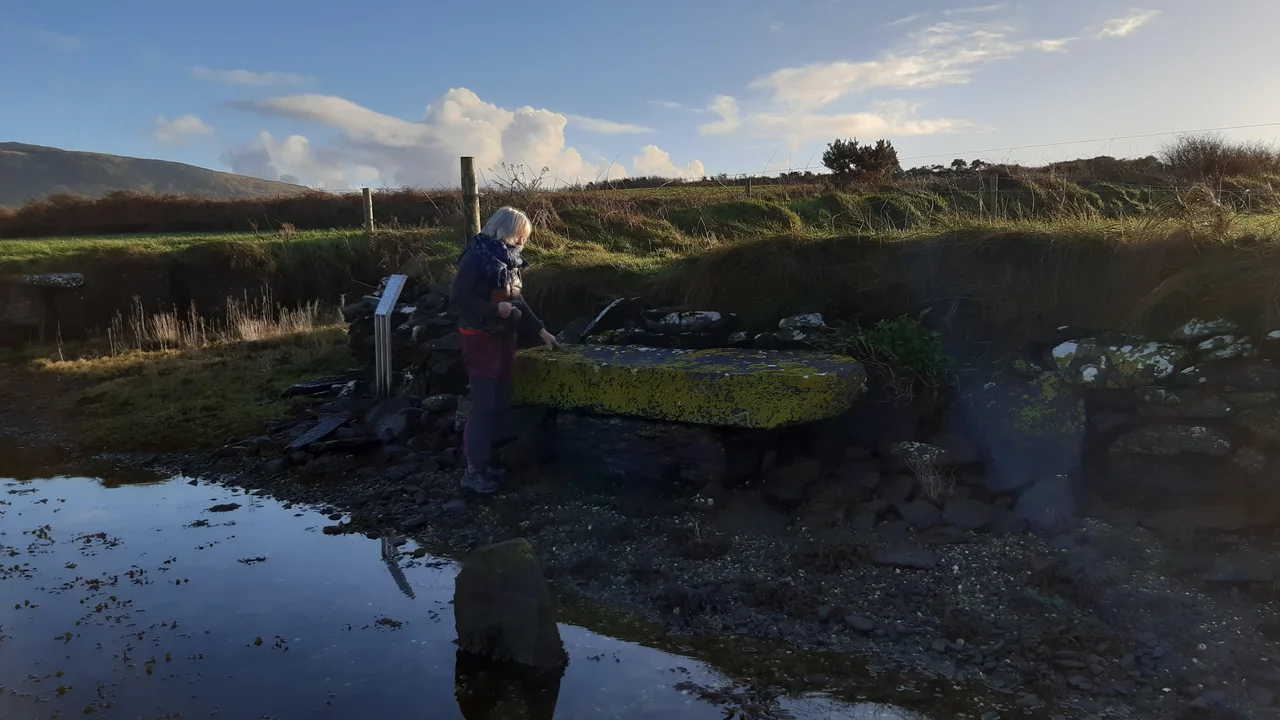

Emlagh East Ogham Stone
Run your fingers up the edge of the stone and you can still feel them - the small notches and short straight lines of an alphabet that died before English was born. Someone carved this monument sometime between AD 400 and 470, while Saint Patrick was alive and walking the same island. The inscription names a man called Bruscus, son of Cailech. We do not know what he looked like, what trade he kept, or how he died. We know only that his family wanted his name to outlast everything else around them. They were right. The stone is still here. Bruscus is, in his own strange way, still here.
An Alphabet Made of Lines
Ogham is one of the strangest writing systems Europe has produced. Instead of letters with bowls and stems, it uses groups of straight lines cut along the edge of a stone - one line for B, two lines for L, three for V, and so on through twenty letters of the Primitive Irish alphabet. The lines run vertically up the corner of a standing stone, using the natural arris of the stone as the central spine. Read from bottom to top, the Emlagh East inscription says BRUSCCOS MAQQI CALIACI - 'of Bruscus son of Cailech.' MAQQI is an archaic form of the modern Irish word mac, meaning son. The genitive case turns the whole stone into a possessive: this place, this grave, this stone belongs to Bruscus.
First to Be Recorded
The Welsh naturalist Edward Lluyd noticed the stone in 1702 and wrote it down. That seemingly small act made the Emlagh East monument the first ogham stone ever formally recorded in Ireland. Lluyd was a polymath of his age - keeper of the Ashmolean Museum, friend to Isaac Newton, fluent in several Celtic languages - and his journey through Munster produced one of the earliest scientific catalogues of Irish antiquities. Before him, the local people of course knew the stones. They had names for them, stories about them. But Lluyd brought writing to the writing - he placed an ancient Irish inscription inside the European Republic of Letters, where it could be studied, debated, and eventually deciphered.
A Stone with Two Faiths
A cross is carved into the stone, but no one is sure who put it there. It might be contemporary with the ogham, marking a Christian grave at the very moment Christianity was arriving on the Dingle Peninsula. It might be a later addition, carved by a passing monk centuries afterwards to baptize a pagan monument into the new religion. The ambiguity is itself the point. The Emlagh East stone sits exactly on the seam between two worlds - the older Gaelic society that believed in something we can only partly reconstruct, and the Christian Ireland that would build oratories and monasteries on every nearby hilltop. The name Bruscus, perhaps meaning 'thunder,' has the ring of the older world. The cross belongs to what came next.
Stories the Locals Kept
Near the ogham stone lies a flat slab called Lackshivaunnageelagh in English, or in Irish Leac Shiobhán na nGeimhleach - 'the flagstone of Siobhán of the captives.' Who Siobhán was, and what captives she kept or freed, has been lost to legend. But the surrounding landscape preserves traces of what archaeologists call a long-vanished ecclesiastical site: there was once a church here at Trabeg, with a graveyard nearby. The stone was a grave marker that outlived the grave and outlived the church that came to stand watch over it. It is the stubbornness of stone - cut once, carry the name forever - that gives the Dingle Peninsula its remarkable density of monuments. Bury someone in earth and they vanish in a generation. Carve their name in grit, and they last.
Hidden in Plain Sight
The stone is unprepossessing in person. It is 239 centimetres tall, 61 centimetres wide, made of coarse grit, and it now rests on a low concrete base near where it originally stood. There is no visitor centre. No fence. No queue. Pilgrims of a different kind arrive - linguists, epigraphers, the occasional curious traveller - and they trace the edges with their fingertips, sometimes with a sheet of paper and a wax crayon to take a rubbing. The Royal Irish Academy published a translation of the inscription in 1879. Two and a half centuries after Lluyd first noticed it, the Emlagh East stone is still teaching its students. Bruscus, whoever he was, picked a remarkably durable way to be remembered.
From the Air
The Emlagh East Ogham Stone sits at 52.132°N, 10.216°W near Short Strand and Doonshean on the northeastern shore of the Dingle Peninsula. The stone is too small to spot from cruise altitude - this is a destination, not a landmark. The nearest airport is Kerry (EIKY) about 38 nautical miles east near Farranfore. For a flyover, descend to under 1,500 feet and aim for the coastline between Doonshean and Trabeg; the stone stands on a concrete base in a low field near the strand. Dingle town and harbour are 5 nautical miles to the southwest as a navigational anchor.
Nearby Stories
- Ballyheigue Castle 1 km away
- Killemlagh Church 2.8 km away
- Pouldergaderry Sinkhole 6.8 km away
- Derreen Garden 11 km away
- Kilkee 59 km away
- The Laki Eruption: The Volcano That Changed World History 1366 km away
- The Northern Lights: The Sky Show That Vikings Thought Was Bridge to the Gods 1469 km away
- Sao Miguel 1935 km away