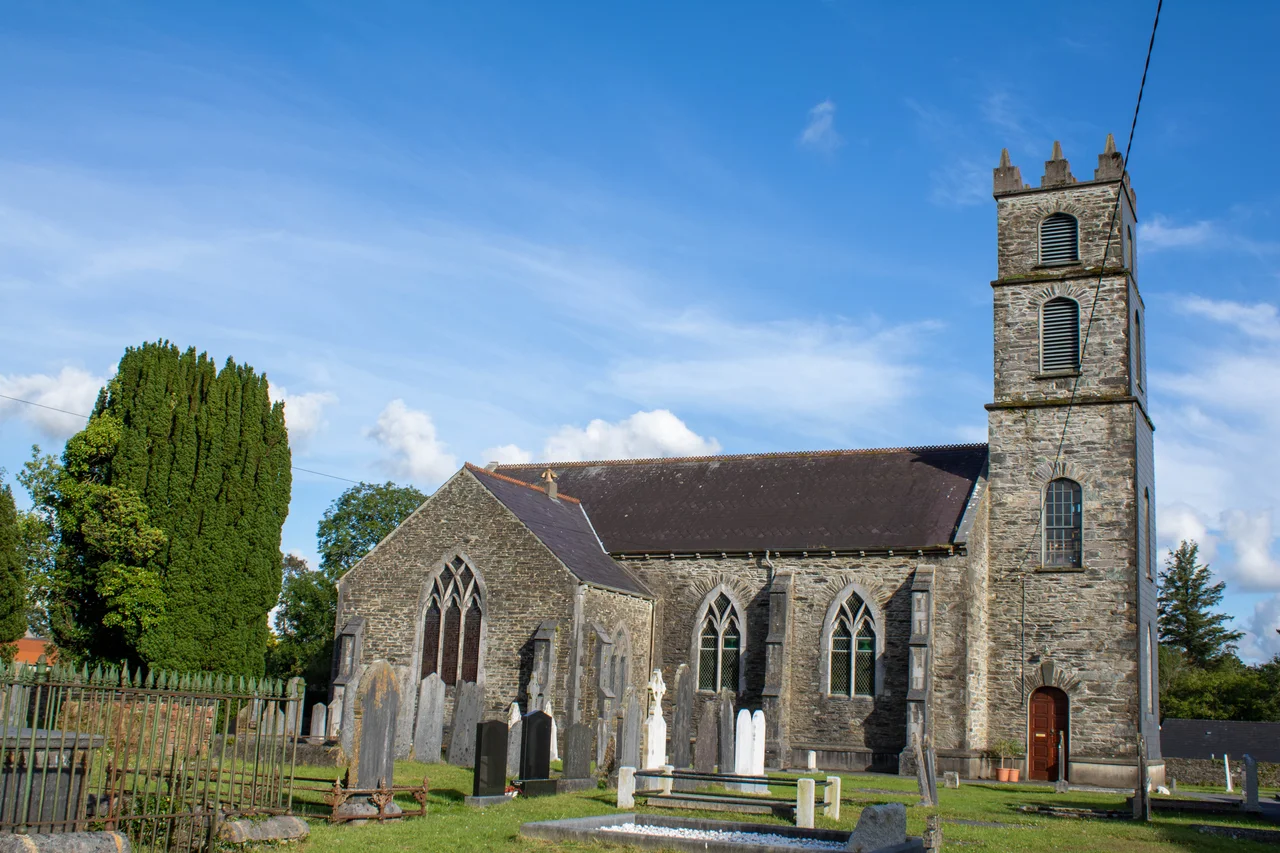

Dunmanway
Every September, when the All-Ireland Senior Football Championship is decided at Croke Park, the winning captain lifts a silver cup named for a man from a small market town in West Cork. Sam Maguire was an Irish Protestant republican born near Dunmanway, and the trophy that bears his name has become the most coveted prize in Gaelic football. The town that produced him sits at the geographical centre of West Cork, built around two small rivers that tumble into the Bandon. It is a place where a Cromwellian-era lawyer once handed out cash bonuses to schoolgirls who could work a loom well.
Castle of the Yellow River
The Irish name Dun Manmhai resists tidy translation. Samuel Lewis, writing his Topographical Dictionary in 1837, offered two readings: castle of the yellow river, or castle on the little plain. Other sources prefer fort of the yellow women. All three point back to the same vanished building: a tower house that once stood on the bank of the Sally River along present-day Castle Street. The MacCarthys of Gleannacroim built it in the late 15th century, a cousin branch of the MacCarthy Reagh sept who held most of West Cork. Catherine Fitzgerald, by tradition, raised the tower. The clan grip lasted three centuries before the surrenders and regrants began. Older still are the ringforts, standing stones and ogham-inscribed pillars in the surrounding townlands, and a Bronze Age trumpet pulled from local ground that now sits in the British Museum.
Cox and the Looms
By the late 17th century, the MacCarthy estate was forfeit, and a Cromwellian-era lawyer named Sir Richard Cox saw an opportunity. Cox, who would later serve as Lord Chancellor of Ireland from 1703 to 1707, secured a grant from King William III in 1693 to hold markets and fairs. Then he set about manufacturing a town. He imported skilled artisans from Ulster to teach flax processing and weaving. He offered rent-free housing to top linen producers, bonuses for efficient labourers, and competitions with cash prizes. He even paid out rewards to schoolgirls who showed skill at the loom. In 1700, thirty families lived in Dunmanway. By 1747 the population was 557. Two years later it had jumped to 807. The town also served a colder purpose: a strategic rest point for British troops moving between Bandon and Bantry.
The Letter to America
When the Great Famine reached West Cork in the 1840s, the women of Dunmanway formed a relief committee and wrote across the Atlantic. On 9 February 1847, U.S. Vice President George M. Dallas chaired a meeting in Washington where their letter to the Ladies of America was read aloud. The committee asked their American sisters to picture what they themselves saw daily: able-bodied men staggering on the roads, scarcely clad, despair in once-cheerful faces; fathers, mothers, and children lying coffinless; survivors screaming not from grief but from the agony of hunger. In the early 1850s, after the migrations and evictions, more than seventy percent of Dunmanway's residents owned no land at all. The linen industry that Cox had nurtured had collapsed with the removal of protective tariffs in 1827, leaving the town to find its footing in corn, milling, and the slow work of survival.
The Hardest Years
The Irish War of Independence pulled Dunmanway into the centre of a guerrilla war. On 28 November 1920, just east of town at Kilmichael, IRA volunteers killed seventeen British Auxiliaries in an ambush that helped trigger the burning of Cork city by British forces. Two weeks later, on 15 December, an Auxiliary shot Canon Magner dead because the priest had refused to ring his church bells on Armistice Day. A local boy named Tadhg Crowley was killed the same day in what was reported as a random incident. The most difficult chapter came in the spring of 1922, after the truce, when local IRA forces killed ten men over three days, all of them Protestants. Three were from Dunmanway. Historians still argue over whether these killings were sectarian reprisals or targeted responses to informers; what is undisputed is that the dead were neighbours, and that a community lost people it had known for generations.
Tidy Town, Football Town
In 1982, Dunmanway won the Irish Tidy Towns Competition, the national award for civic care and presentation. It is twinned with Queven in Brittany. From 1975 to 1999 the Swedish multinational Molnlycke Health Care ran a factory here that employed over 250 people at its peak. In 2009, when Liverpool Football Club played a pre-season friendly nearby, the town briefly became international news. But the deepest sporting thread runs through Sam Maguire, born in 1877 to a Church of Ireland farming family near Dunmanway. Maguire became a customs clerk in London, was sworn into the Irish Republican Brotherhood, and helped recruit Michael Collins to the cause. He died in 1927. Two years later, his friends commissioned a silver replica of the Ardagh Chalice in his memory. Every September it goes home with somebody.
From the Air
Located at 51.72 degrees N, 9.11 degrees W in West Cork, at the centre of the region. The town sits in a shallow valley where two tributaries meet the River Bandon at its eastern edge, with the Sheehy Mountains rising to the west and the rolling drumlins of mid-Cork stretching east. Cork Airport (EICK) is roughly 60 km east-northeast; Kerry Airport (EIKY) lies 70 km northwest. Best viewed at 3,000-5,000 feet on the west-to-east approach to the Cork coast, with the patchwork of small dairy farms making the geographical centre of West Cork visually distinct from the rougher uplands to the west.
Nearby Stories
- Ross Castle 2.9 km away
- Nohoval 5.6 km away
- Rathcoole Ambush 6.7 km away
- Walter Siepmann 7 km away
- Cape Clear Island 7.9 km away
- French frigate Surveillante (1778) 8 km away
- Fermoy 17 km away
- Cloghan Castle, Lough Hyne 23 km away