
Ballinacarriga Castle
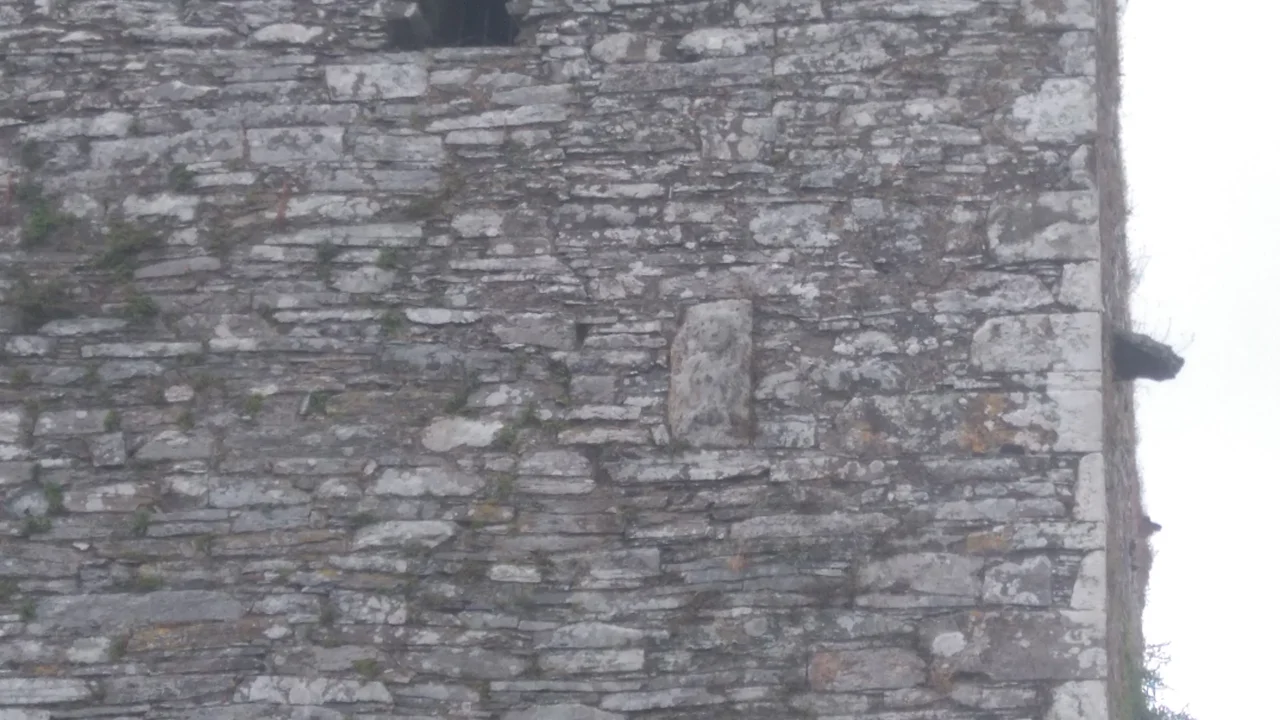
Halfway up the eastern wall of Ballinacarriga Castle, set into the masonry where most castles would have a coat of arms or a defensive slot, there is a Sheela Na Gig. She is a small, exaggerated stone carving of a naked woman displaying her vulva - one of those medieval figures found scattered across cathedrals, castles and parish churches from Ireland to Spain, whose meaning no one is entirely sure of. Some scholars argue she wards off death, evil and demons. Others see a survival of a pre-Christian fertility goddess or mother figure. At Ballinacarriga she watches the approach to a 16th-century tower house perched on a rock above a small village in West Cork - Béal na Carraige in Irish, the Mouth of the Rock - and she has been watching for roughly four hundred years.
The Hurleys and Their Castle
The Ó Muirthile family - anglicised as O'Hurley - built Ballinacarriga in the sixteenth century. They were a native Irish clan, not the Norman or English colonists who built so many of Ireland's other tower houses, and they raised this one in stone on a rocky rise about nine kilometres from Dunmanway. They did not get to keep it long. After the 1641 Irish Catholic rising - an attempted coup by Irish Catholic gentry against the increasingly Protestant administration of Ireland - the Ó Muirthile lost both the castle and their lands. The tower passed first to their allies the MacCarthys, then briefly back to the Hurleys through clan ties, and finally in 1654, after the Cromwellian conquest had crushed Catholic Ireland, the Hurleys lost it for good. The castle was granted to the Protestant Crofts family, who held it through the long century of Protestant ascendancy that followed.
A Chapel in the Tower
What the new Protestant owners did not entirely know - or perhaps did know but tolerated - was that a room in the tower had been used for Catholic worship during the years when public Catholic services were illegal across most of Ireland. The chamber still bears some of its devotional decoration. In a period when the Penal Laws forbade Catholic priests from saying Mass openly, when bishops were exiled and ordained clergy hunted, ordinary worship retreated into hidden corners: hedge schools in the open, Mass rocks in the mountains, and rooms tucked inside the very Norman and Gaelic strongholds whose owners' faith had been declared a crime. Ballinacarriga has one of those rooms. The decoration is modest, the room small, the survival improbable. It is the kind of detail that turns a ruined tower from a romantic silhouette into something quieter and more human.
Bartizans and Murder Holes
Architecturally Ballinacarriga is dense with defensive features for so small a building. Overhanging corner turrets called bartizans project from the upper walls, equipped with arrow slits. The castle once had a machicolation - the opening through which boiling liquid or stones could be dropped on attackers crowding the door below. Unusually for an Irish tower house, there is also evidence of a portcullis: a heavy gate raised and lowered by chains. Only a small number of Irish castles ever had one, and most were grander affairs. Then there is the Sheela Na Gig on the east wall, smiling or grimacing or doing whatever it is she does. Together these features make Ballinacarriga look more bristly and more layered than its size would suggest - a small clan stronghold that took its defensive architecture seriously, then watched as that architecture became obsolete the moment Cromwell's artillery arrived in Munster.
Quiet Ruin
Today Ballinacarriga is in good structural condition but is not open to the public. The walls stand. The bartizans are still there. The Sheela Na Gig is still set into her wall, weathered but visible to anyone who knows where to look. Just beyond the castle is a school - a small national school nestled at the foot of the rock - and the contrast is hard to miss: a building where children chase each other across the yard, a hundred metres from a tower whose owners lost their faith, their land, and their lineage in a single generation of the seventeenth century. The Dublin Penny Journal sketched the castle in 1834 and called it picturesque. It still is, in the particular Irish way where picturesque means a structure that has outlived almost everyone who ever owned it, and now belongs primarily to the rooks and the wind.
From the Air
Located at 51.71 N, 9.03 W in West Cork, about 9 km northeast of Dunmanway and 7.5 km from the village of Ballineen. The tower house stands on a small rocky outcrop and is best seen from low altitude (1,000-2,500 ft). Surrounded by green farmland, the squat four-storey silhouette is distinctive against open countryside. Cork airport (EICK) is about 32 nm to the east; Kerry (EIKY) about 38 nm to the northwest.
Nearby Stories
- Ross Castle 2.9 km away
- Nohoval 5.6 km away
- Rathcoole Ambush 6.7 km away
- Walter Siepmann 7 km away
- Cape Clear Island 7.9 km away
- French frigate Surveillante (1778) 8 km away
- Fermoy 17 km away
- Cloghan Castle, Lough Hyne 23 km away