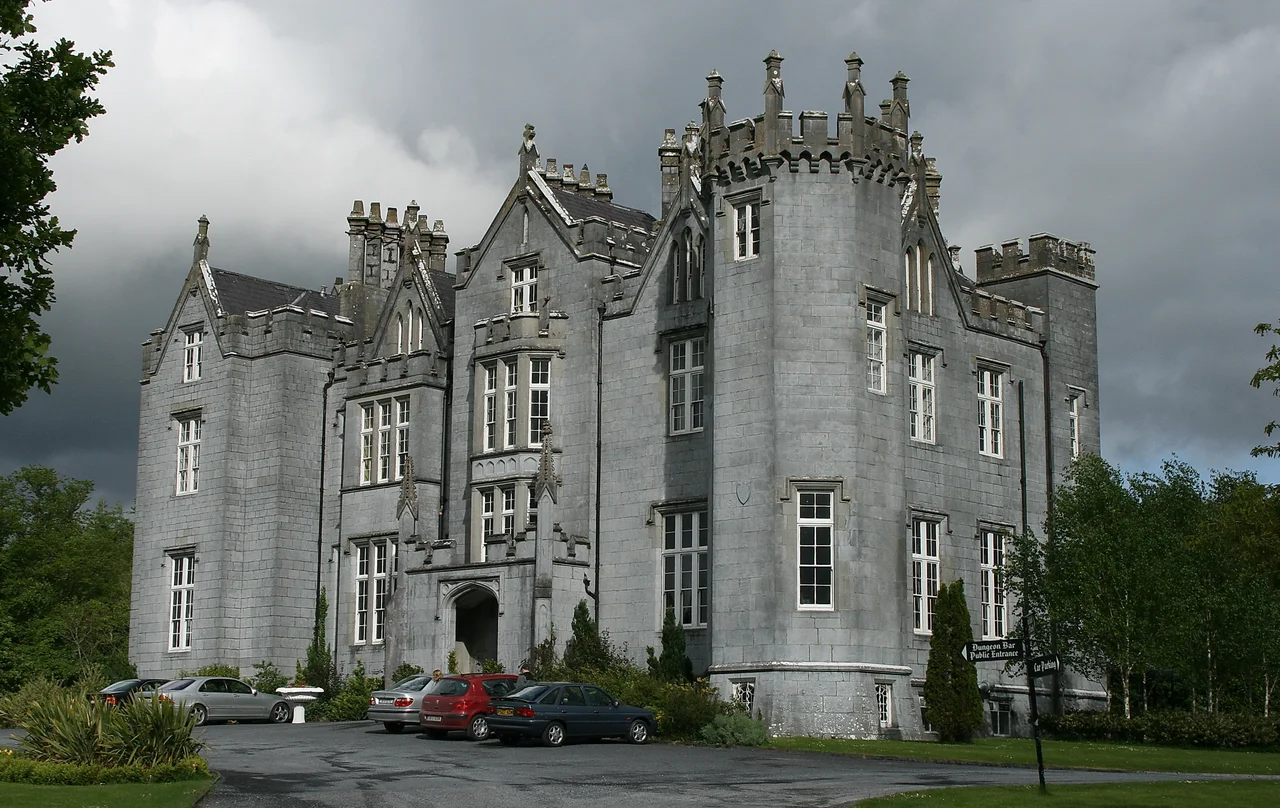

Kinnitty Castle
There is a thirty-foot stone pyramid in the graveyard of St. Finnian's Church in Kinnitty, County Offaly. It is the family mausoleum of the Bernards, who lived in the castle nearby through the nineteenth century. Captain Richard Bernard, who fought in the Crimean War and was much loved by Augusta Magan, is buried inside it. So are several other Bernards. The Egyptian Revival style was fashionable in the 1830s among aristocratic landlords who wanted something more permanent than the family vault. The pyramid has now outlasted both the family and the castle they built it for - though the castle itself is still standing, having been burned, rebuilt, sold, repurposed, foreclosed on, and bought again across two centuries of Irish change.
Eight Hundred Years of Sieges
The first castle at Kinnitty was destroyed in 1209, less than forty years after the Normans had arrived in Ireland. The Normans rebuilt it in 1213 and stayed. Around the same time, the Augustinian Abbey of St. Finnian was established alongside the castle, and the Kinnitty High Cross - an early-medieval carved sandstone cross that survived everything that came after - was raised in the abbey graveyard. By the late Middle Ages, the O'Carrolls of Ely had displaced the Normans. In 1630, William O'Carroll built a new castle next to the old abbey. He held it for eleven years. In 1641, the rising and the subsequent Cromwellian wars led to the castle's confiscation as part of the plantation of King's County. The land was granted in 1664 to Colonel Thomas Winter for military service. His descendants sold it to the Bernards, who renamed the place Castle Bernard and moved in for the next two hundred and eighty years.
The House That James Pain Built
In 1811, Lady Catherine Hutchinson, wife of Thomas Bernard, commissioned the architect James Pain to extend the existing house into a full Tudor-revival gothic castle. Pain - a London-trained pupil of John Nash - had already built dozens of churches and country houses across Ireland; Kinnitty became one of his most elaborate. He gave it crenellated towers, mullioned windows, an entrance hall designed to overwhelm a visitor before they had even reached the drawing room. Thomas's son Colonel Thomas Bernard succeeded him, served as Lord Lieutenant and High Sheriff of King's County, and died unmarried in 1882. The estate passed to his niece's husband, Captain Caulfield French. The Bernards held on through the Land War, the Irish Parliamentary Party, the rise of Sinn Fein, and almost - but not quite - through Irish independence.
Burned and Rebuilt
In 1922, during the Irish Civil War, the Irish Republican Army burned Castle Bernard. It was one of dozens of Big Houses destroyed in those years - symbolic targets, the visible architecture of British landlord power. The Bernards survived; the house did not. After Irish independence, in 1928, the Irish Free State government provided a £32,000 grant to rebuild it - a remarkable concession to a family whose class had just been politically swept aside. The Bernards returned. They lived in the rebuilt castle until 1946, when they finally sold up and left. Lord Decies bought the house, held it briefly, and in 1951 sold it to the state. For thirty years, from 1955 to 1985, Kinnitty Castle was the Irish Forestry Training College - generations of Coillte foresters learned silviculture in the rooms where Bernards had once held shooting parties.
A Wedding Castle
The Ryan family of Limerick bought the castle in 1994 and converted it into a four-star hotel, with thirty-seven bedrooms, a dungeon bar, and an event space configured for weddings. The Slieve Blooms above the building, the lawns running down to the woods, the gothic-revival silhouette - all of it adapted easily to the wedding industry. In 2008 KBC Bank seized the property in the aftermath of the Irish banking crisis but kept it open as a hotel. In 2015 a new ownership group bought it, including Derek Warfield, founding member of the Wolfe Tones folk band, and Colin Breen, the Tampa, Florida owner of the Four Green Fields pub. Renovations followed. The castle still functions as a hotel and conference venue. Couples still get married in front of the same fireplace where Catherine Hutchinson once received visitors. The pyramid is still in the churchyard. The high cross still stands. The Slieve Blooms still rise behind it all, indifferent to whichever Bernard or Ryan or Warfield happens to be paying the bills.
From the Air
Kinnitty Castle sits at 53.10N, 7.70W, in the foothills on the northern side of the Slieve Bloom Mountains, in southwestern County Offaly. The R421 regional road connects it to the village of Kinnitty and on to Cadamstown. The Slieve Bloom ridge rises immediately south, with the county high point of Arderin (527m) at its summit. From cruising altitude, the castle itself is a single building hidden in a wooded estate, but the dark patch of mature woodland against the Slieve Bloom slope is visible. Dublin (EIDW) is 110 km east-northeast; Shannon (EINN) 75 km southwest. Tullamore is 25 km north; Birr (with its own castle and famous telescope) is 15 km west.
Nearby Stories
- Clonard Abbey 2.2 km away
- Eyrecourt Castle 3.9 km away
- County Westmeath 8 km away
- Kildare Cathedral 8.2 km away
- Nenagh 9.2 km away
- Ballygar 18 km away
- Garda Síochána College 23 km away
- County Carlow 30 km away