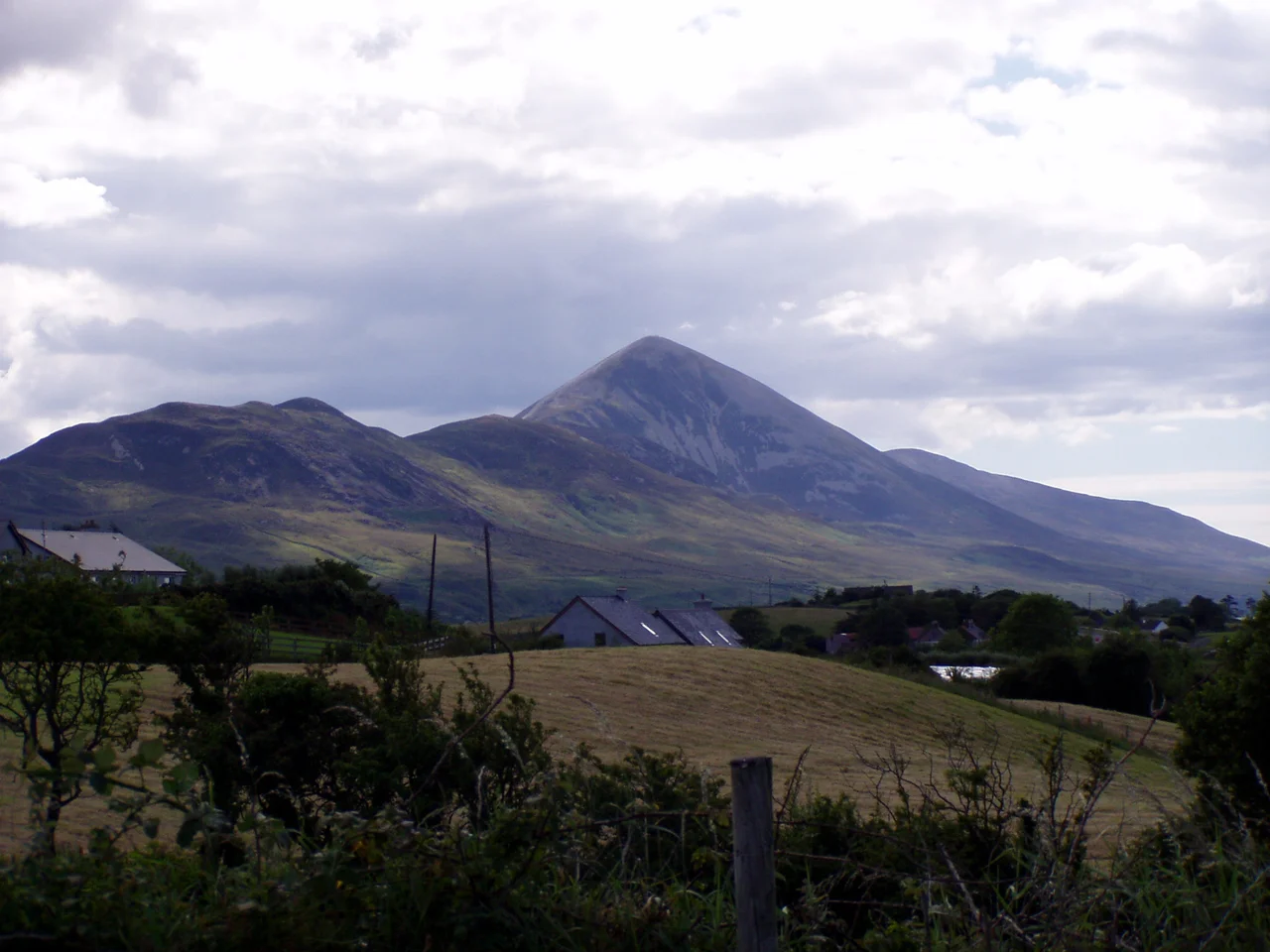

Croagh Patrick
On the last Sunday of every July, as many as 40,000 people climb a single pyramid of quartzite rising 764 metres above Clew Bay. Some climb barefoot. Some carry stones. Some have walked through the night to reach the base by dawn. They are doing what Irish people have done on this mountain since at least the Middle Ages, and possibly since the Bronze Age before that. The mountain is Croagh Patrick. Locals call it the Reek, from the Hiberno-English word for a stack. Saint Patrick is said to have fasted on its summit for forty days, like Moses on Sinai, and ever since, the slope has belonged as much to faith as to geology.
The Holy Mountain Before Patrick
The archaeologist Christiaan Corlett, surveying the prehistoric monuments that ring the Reek, concluded that the mountain has been a local spiritual inspiration since at least the Neolithic. By the Bronze Age it had become the focus of an extensive ritual landscape. A short walk east of the summit lies the Boheh Stone, an outcrop covered with more than 260 rock carvings, one of the most detailed pieces of ancient rock art in Ireland. In 1987, observers noticed something extraordinary: from the Boheh Stone in late April and late August, the setting sun appears to roll down the slope of Croagh Patrick. It is believed the stone was placed precisely to mark this alignment. A stone row at Killadangan further marks the niche where the sun sets on the winter solstice.
Patrick's Forty Days
In the 7th century, the Connacht writer Tirechan recorded that Saint Patrick spent forty days on the mountain. The 9th-century Bethu Phadraic adds that demons in the form of black birds harassed Patrick at the summit until he banished them into a hollow called Lugnademon, the hollow of the demons, by ringing his bell. According to the tradition, Patrick broke his fast only when God granted him the right to judge all the Irish at the Last Judgement and agreed to spare the land from final desolation. Another legend tells of a demonic female serpent named Corra whom Patrick banished into Lough Na Corra below the mountain, the lake bursting forth from the hollow she created in her fall.
Reek Sunday
The folklorist Maire MacNeill argued that the pilgrimage predates Christianity entirely. In her view, the climb was originally a ritual of Lughnasadh, the Celtic harvest festival. Christianity absorbed and renamed it. Today the climb takes place on the last Sunday of July, and Mass is held at the small summit chapel, which was dedicated on 20 July 1905. Some pilgrims climb barefoot as an act of penance, walking on quartzite scree that cuts and bruises the soles. Others perform rounding rituals, walking sunwise around ancient cairns called Reilig Mhuire, Mary's graveyard, which archaeologists believe are Bronze Age burial mounds. Until 1970 it was traditional to climb at night, possibly a survival of the older practice of summiting after viewing the rolling sun phenomenon at the Boheh Stone.
The Erosion of Faith
Forty thousand pilgrims a year, climbing a single steep slope of loose quartzite, leaves a mark. By the 2010s the mountain was suffering severe erosion that made the climb increasingly dangerous. Local stakeholders responded by building a stone path up the mountain, composed of stone from Croagh Patrick itself and laid in the dry-stone manner of traditional Irish walls. The work, more than three years in the making, neared completion in 2024. The path is a compromise between preserving the mountain and preserving the pilgrimage, and it represents an old Irish negotiation: how to honour what was while protecting what is left.
The Gold the Mountain Keeps
In the 1980s a seam of gold was discovered in the core of the Reek. The discovery could have been transformative for the local economy, and applications for mining licences followed. But the Mayo Environmental Group, headed by Paddy Hopkins, organised resistance, and Mayo County Council ultimately decided that no mining would be permitted on the holy mountain. The decision was unusual in Irish economic history and revealing of how the mountain is regarded locally. Even the name of the Owenwee River on the south slope, the yellow river in Irish, may preserve an ancient awareness of the gold below. The river still runs, the gold remains in the quartzite, and the pilgrims still climb.
From the Air
Coordinates: 53.7595 N, 9.6584 W. Croagh Patrick rises 764 m above Clew Bay on the south shore, a near-perfect quartzite pyramid visible from a wide arc of western Ireland. The summit chapel is a tiny white structure that catches sunlight against the bare rock. Westport sits 8 km northeast. Nearest airports: Ireland West Knock (EIKN) approximately 50 km east-northeast, Galway (EICM, GA only) about 80 km southeast. Recommended viewing altitude 3,500 to 5,500 ft to clear the summit comfortably; the peak generates lee-side turbulence in westerly winds, and Atlantic fronts can shroud the mountain in low cloud within 20 minutes.
Nearby Stories
- Annaghdown 6.9 km away
- Claremorris 9.4 km away
- Inishbofin Island 9.9 km away
- Attymass 10 km away
- Ballycroy 11 km away
- Toombeola 13 km away
- Blackrock Island, County Mayo 14 km away
- RMS Carinthia (1925) 40 km away