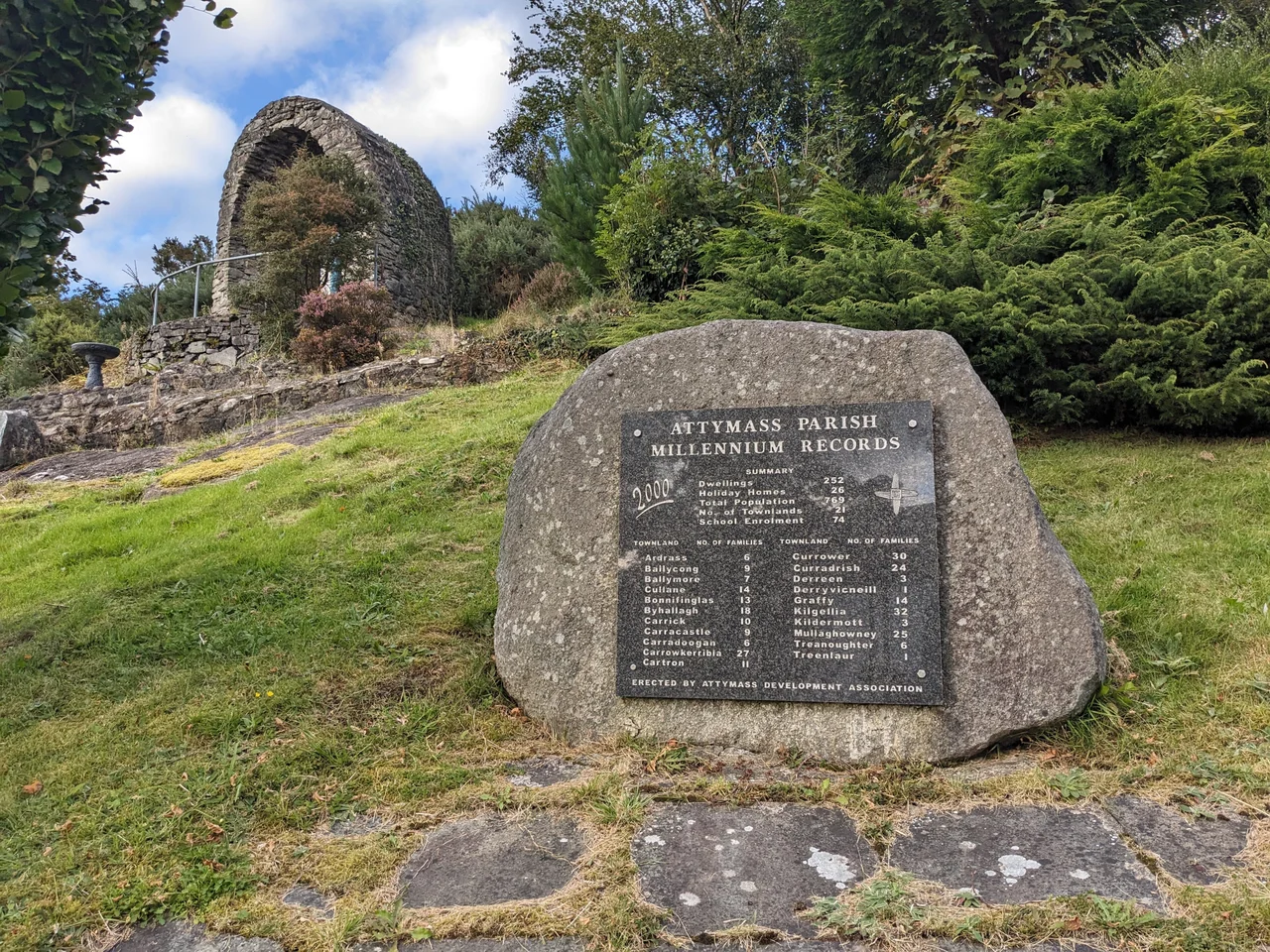

Attymass
If you walk through Battery Park City in lower Manhattan, you'll come to the Irish Hunger Memorial - a slanted hillside of Irish stones, flora and an authentic stone cottage transported across the Atlantic. The cottage belonged to the Slack family of Carradoogan in Attymass, County Mayo. It was deserted in the 1960s, like so many small Irish farms whose people had emigrated, and stood empty until it was carefully dismantled and shipped to New York to anchor the memorial that opened in lower Manhattan in 2002. The cottage that gives the memorial its emotional centre comes from a Mayo village most Americans will never visit - a place whose other great export is also a man, born here in 1909, who built a global Catholic devotional movement out of one repeated prayer.
Ringforts and Crannogs
Evidence of ancient settlement in the Attymass area runs deep. Ringforts in the townlands of Carrick and Kilgellia mark out the circular earthen homesteads of Iron Age and early medieval farmers. Crannog sites at nearby Ballymore Lough - artificial islands built up in the shallow water as defensible dwellings - suggest a community that lived with one foot in the lake and one foot in the surrounding pasture. The parish church of Attymass, dedicated to the Immaculate Conception, was built in 1958 on the site of an earlier 19th-century chapel; its predecessor served a parish whose forebears had worshipped on this ground for centuries. Attymass is a civil parish as well as a village, the kind of dual category that reflects the way Irish administrative boundaries grew up from medieval ecclesiastical units rather than being mapped onto them from above.
Father Peyton, the Rosary Priest
Patrick Peyton was born in Attymass in 1909. He went on to become a priest of the Congregation of Holy Cross in the United States and to found the Family Rosary Crusade, an international movement built around the conviction that the family rosary - the entire household praying together each evening - could anchor and repair the spiritual life of modern households. The Crusade became one of the most far-reaching mid-20th century Catholic devotional movements, with rallies, radio broadcasts and missions across multiple continents. Peyton became known the world over as the Rosary Priest. The Fr Patrick Peyton Memorial Centre, officially opened in 1998, marks the parish's connection to him; it offers exhibitions on his life and work, alongside the kind of meditative space that suits a centre built around a saint-in-waiting from a small Mayo village.
The Cottage in Manhattan
The Irish Hunger Memorial opened in Battery Park City in lower Manhattan in 2002. Its designers wanted a material connection to the Famine - not just a symbolic monument but actual Irish stones and an actual abandoned cottage shipped from the depopulated west of Ireland. The Slack family cottage in Carradoogan, deserted since the 1960s, was identified, taken apart stone by stone, packed, transported and reassembled on a slanted slope on the Hudson waterfront, surrounded by Irish plants and stones from the 32 counties of the island. The memorial, opening less than a year after the September 11 attacks, became a place of layered grief - American and Irish, modern and historical, public and intimate. The cottage that once held a Mayo farming family now holds the memory of the Famine dead, on the other side of the Atlantic from where it was built.
Moy Villa on Astro Turf
On a more immediate scale, the modern life of Attymass turns largely around its football club. Moy Villa Football Club, established in 1992 and based in Kilgellia, plays in the Mayo League and was promoted to Premier A in September 2012. In late 2013, the club reached the Elvery's Sports Super League for the first time in its history. In 2006, the club built itself an astro turf training pitch with floodlights, funded through a combination of local fundraising and the Sports Capital Development Fund - a small but typical Irish rural achievement, the kind of capital project that takes years of fundraising raffles and the unpaid labour of committee members. The club provides one of the village's regular Friday-night gathering points, alongside the church and the Memorial Centre.
What Stays, What Leaves
Attymass is a small place, by every measure. Its population is modest. Its commercial centre is a few buildings. Its physical features are subtle - a few low hills, a few small lakes, the quiet pastures of north Mayo running away to the larger lakes of Conn and Cullin and eventually to the Atlantic. But two of the things it has produced have travelled extraordinarily far: a priest whose family-rosary movement reached half the world, and a cottage whose abandoned walls now stand on the Hudson River as one of the most quietly powerful memorials in the United States. The two stories are not unrelated. They come from the same emigrant century, the same hollowed-out west of Ireland, the same insistence that what looks small from outside can carry meaning a long way.
From the Air
Located at 54.05 degrees north, 9.08 degrees west, in north County Mayo near the borders with Sligo. The village is set in gentle pasture and bog country, with small lakes (including Ballymore Lough) scattered nearby. Ireland West Airport (EIKN) is about 30 km to the south-east. Sligo town lies about 45 km to the north-east.
Nearby Stories
- Knock (Ireland) 3.2 km away
- Carrowkeel Megalithic Cemetery 3.9 km away
- Bellacorick 9.3 km away
- Croagh Patrick 11 km away
- Tulsk 12 km away
- Creevykeel Court Tomb 14 km away
- Lissadell House 25 km away
- Action of 7 May 1794 86 km away