
Ballycroy
In 1982, RTÉ filmed William Trevor's story 'The Ballroom of Romance' at a crossroads called Doona Cross, west of Ballycroy village. The film, directed by Pat O'Connor, was a quietly devastating portrait of rural Irish loneliness, of a Saturday-night dance hall where unmarried men and aging women came once a week to grasp for the lives they had not managed to build. Forty-four years later, the ballroom is still there, derelict now, its corrugated roof rusting, its dance floor empty. So is Ballycroy, more or less, with a population that dropped from 663 in 2011 to 617 by 2022. But this is also where Ireland chose to put one of its six national parks, and where the darkness at night is so complete that an entire festival now celebrates it.
Town of the Stacks
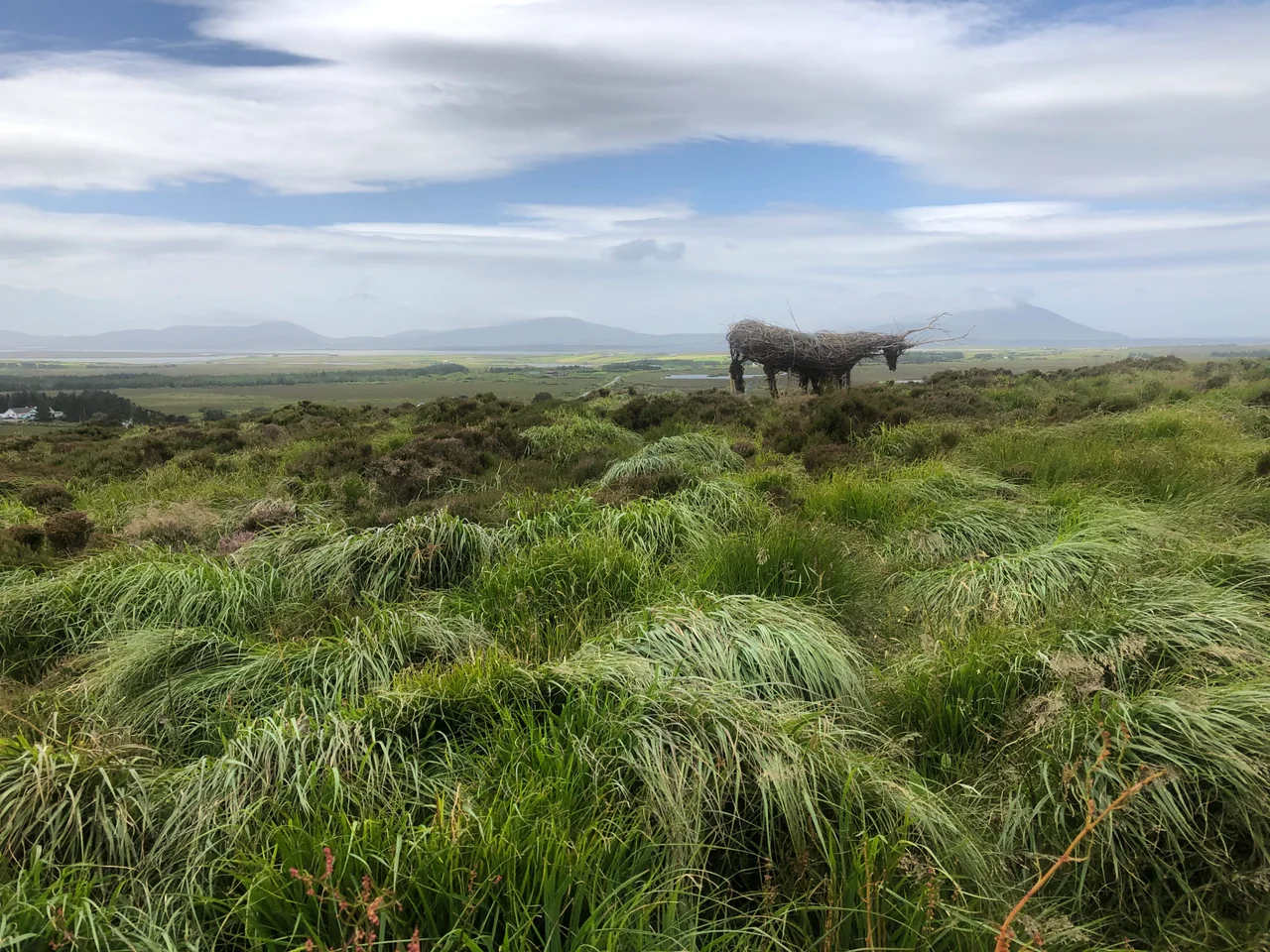
The name Ballycroy comes from Baile Chruaich, which means 'town of the stacks', either hay stacks or turf stacks depending on whom you ask. Both stacks have shaped this landscape for centuries. The two electoral divisions that make up greater Ballycroy cover about 51,943 acres across the parish of Kilcommon, much of it mountain pasture and blanket bog. The bedrock is quartz and mica-rich slate. The Owenduff and Bellyveeny rivers run through it. In 1832, the writer William Hamilton Maxwell, in his book Wild Sports of the West, described the terrain as 'bogs, morasses, expansive waters, and grazing lands'. The description has not aged. The land is largely the same. The black turf piles are still cut and stacked along the same roads by people whose grandparents cut from the same bog.
The Fir Domnann
According to tradition, the first settlers in Ballycroy were the Fir Domnann, a branch of the Belgic Damnonii tribe, the same people who eventually gave their name to Devon and Cornwall. They left behind a portal tomb near Claggan Hill and a court cairn in the townland of Drumgallagh, both probably four or five thousand years old. A separate fortified site at Lettra was apparently old enough by the medieval period to be associated with the Táin Bó Fliadhas, one of the lesser-known cattle-raid epics of Irish mythology. Fahy, a nearby townland, has the remains of a castle. None of these sites is curated or interpreted in any detail. They simply exist in the fields, the way they have for millennia, occasionally found by walkers and occasionally added to maps.
Wild Nephin
Ballycroy is the gateway to Wild Nephin National Park, formerly called Ballycroy National Park, the second largest of Ireland's six national parks. It covers about 150 square kilometres of blanket bog, mountain, and remote river valley. The park's visitor centre is in Ballycroy village. The terrain inside is some of the least-touched landscape in Western Europe, a vast quiet of peat and water with the Nephin Beg range rising to the east. You can walk for hours here without seeing another person. The park was created in 1998 to protect one of the largest expanses of intact Atlantic blanket bog in Ireland, the kind of ecosystem that forms over thousands of years and almost never survives close to populated areas. The land mostly survived because there were not enough people to ruin it.
The Darkest Skies
The flip side of having almost nobody live in a place is that nobody turns on the lights. Ballycroy, Mulranny and Newport collectively sit inside Mayo Dark Sky Park, designated by the International Dark-Sky Association in 2016 as one of only sixteen Gold Tier reserves on Earth at the time. The night sky here is functionally untouched by light pollution. On a clear winter night you can see the Milky Way as a definite ribbon, count moons of Jupiter with binoculars, watch satellites cross the field of view. The Mayo Dark Sky Festival takes place each year on the first weekend of November, with star parties, talks, and astrophotography workshops. It is one of the few festivals in Ireland whose central attraction is the absence of something, namely artificial light.
What Remains After Romance
The ballroom at Doona Cross was already an anachronism when Trevor wrote about it in the late 1970s, the kind of country dance hall that had been the centre of rural social life from the 1930s through the 1960s before television and improved roads emptied them out. The 1982 film captured the last gasp of that world. The derelict structure remains, more or less, a roofless rectangle with grass coming up through its dance floor. The dance hall in Ballycroy itself, near the cemetery and the visitor centre, also closed decades ago. A community centre opened in 1984 to give the village its modern gathering space. The school is still open. The Garda station is still open. Two pubs are still open. Tourists still come for the national park and the dark sky festival. The population still slowly declines, the way it has for most of a century, in a village whose central monument is now a fictional ballroom of romance.
From the Air
Ballycroy sits at 54.02°N, 9.82°W on the N59 road in northern County Mayo, between Bangor Erris and Mulranny. Wild Nephin National Park extends to the east. Best viewed from 3,000-5,000 ft AGL. Ireland West Airport Knock (EIKN) is approximately 55 nm east-southeast. The terrain is wide blanket bog with mountains to the east. Watch for low cloud over the Nephin Beg range. The village itself is small; the visitor centre sits at the south edge.
Nearby Stories
- Croagh Patrick 3.3 km away
- Attymass 3.8 km away
- Connacht 6 km away
- Blackrock Island, County Mayo 8.3 km away
- Inishbofin Island 20 km away
- Lissadell House 36 km away
- Action of 7 May 1794 41 km away
- Streedagh Armada Wrecksite 72 km away