
Inishbofin Island
The ferry from Cleggan takes thirty minutes. Lapwing House is south of the empty runway, so it is nice and quiet. There is no mobile signal from any carrier - your accommodation will have Wi-Fi because their business depends on it. The legend is that Inishbofin was not a fixed island at all but wandered the western seas at will, refusing to settle, until a stranger lit a fire on it and the island finally stayed put. The legend itself wanders. The island has only stayed put in the sense that it has remained, against several centuries of trying, very hard to settle.
Island of the White Cow
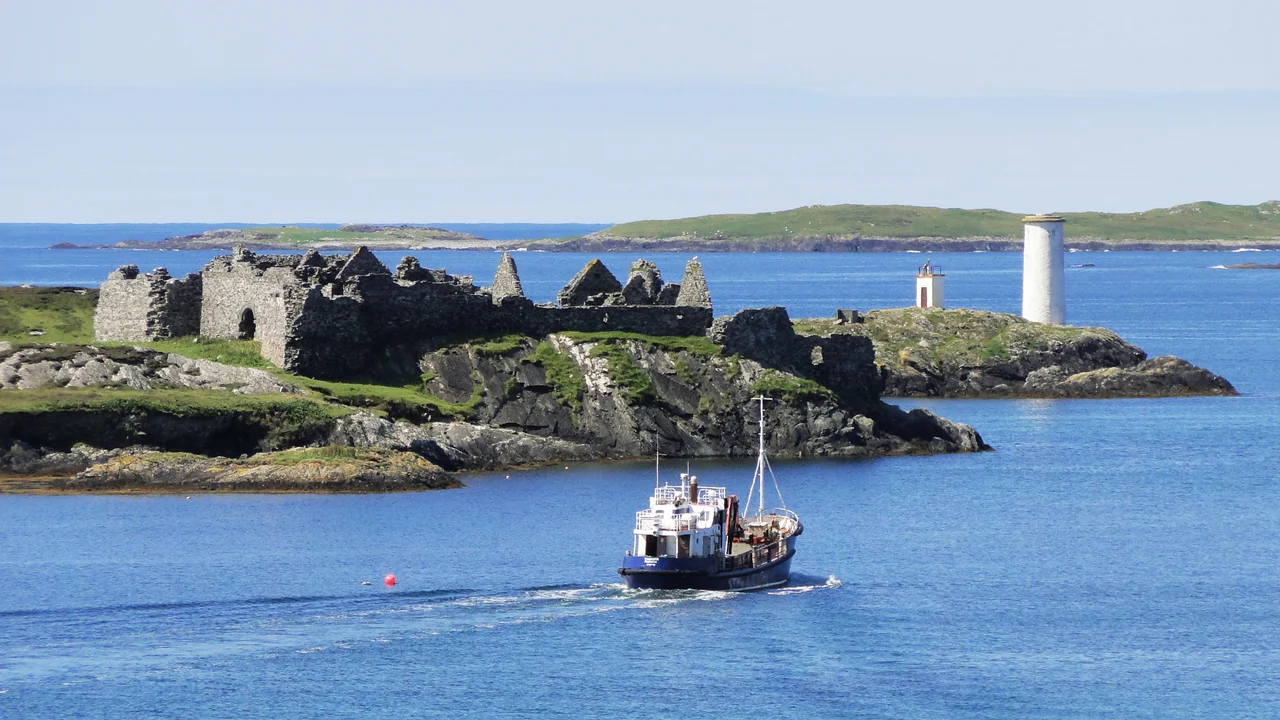
Inis Bó Finne - Island of the White Cow - rises five and a half kilometers long by three wide out of the Atlantic. The land is low, treeless, sprayed by salt wind. Its 184 inhabitants (as of the 2022 census) live mostly around the southern harbor. For most of recorded history the population scratched a living from fishing and a little farming on heath that nothing grew on willingly. Then London noticed. Elizabethan forces took the island, the Royalists held it, and in the 1650s Oliver Cromwell sent forces to subdue it. The star fort his men built still overlooks the harbor on tidal Port Island. It was useful as a coastal defense against pirates and Dutch privateers. It became more useful as a jail for Catholic priests gathered up across the western counties. They were rowed out to a fort no boat could approach without being seen.
St Colmán's Argument
In 664 a synod was convened at Whitby in Northumbria to settle a long dispute over when Easter should fall. Two methods of calculation were in use across western Christendom. The Iona tradition, brought to Lindisfarne by Aidan and continued by Colmán, calculated one way; the Roman tradition, championed by Wilfrid, calculated another. King Oswiu ruled in favor of Rome. Colmán, then Bishop of Lindisfarne, packed up and left. He returned with his monks first to Iona, then in 668 founded a new monastery on Inishbofin. The arrangement quickly fell apart. His Saxon monks and his Irish monks fell out so badly that he moved the Saxons to the mainland and founded Mayo Abbey for them. Colmán returned to Inishbofin to live out his life and died there in 675. The fourteenth-century abbey ruins you see today, deep in nettles and old crosses, sit on the same spot as his original seventh-century foundation.
Grace O'Malley's Mooring
On a hill above the harbor, with no visible remains, once stood a castle held by Gráinne Ní Mháille - Grace O'Malley, the Pirate Queen of Connacht. She ruled Mayo by sea during a period of Tudor encroachment in the late 16th century. Her trade and her power were both seaborne; her castles - including the one that stood here - guarded the channels her galleys used. In 1593 she sailed up the Thames and met Queen Elizabeth I at Greenwich Palace to petition for the release of two of her sons whom Sir Richard Bingham had imprisoned. The two women, both then in their sixties, conversed in Latin because Grace had no English and Elizabeth had no Irish. The petition succeeded. A castle was still marked on charts of Inishbofin as late as 1776, but the stones have largely vanished into farmhouse walls. A worked doorway stone turned up in 2016.
The Runway That Waits
Five hundred meters north of the pier sits one of the strangest infrastructure projects in modern Ireland: a fully-built airport that has never opened. Construction began in 2009. The runway was paved. The buildings went up. The maintenance contracts began. Even private aircraft are not permitted to land. The corresponding airstrip on the Cleggan mainland, the planned other end of the air link, suffered the same fate. The whole project has now cost the Irish taxpayer in the region of 10 million euros, with management fees still accruing. Crosses have been painted along both runways - X - X - X - to mark them as permanently closed. That paint job, locals are quick to mention, cost another 500,000 euros. For now the ferry remains the only way in, and Inishbofin keeps the dark skies and absent traffic noise that come with being a place no plane visits.
From the Air
53.6130 N, 10.2120 W. Inishbofin sits 8 km off the northwest coast of Connemara, between Inishshark to the west and the mainland at Cleggan. The island appears as a low, treeless, kidney-shaped landmass with the southern harbor clearly visible. The completed but unused runway can be seen on the northern half of the island - paint crosses mark its closure. Connemara Regional Airport (EICA) at Inverin is about 70 km southeast. Shannon Airport (EINN) is roughly 130 km south. The seas between Inishbofin, Inishshark, and the mainland are notorious for tide races and submerged rocks. The mainland village of Cleggan, where the ferry originates, lies on an inlet protected by Cleggan Bay. Atlantic weather dominates; clear skies are rare but spectacular when they happen, with views as far as the Twelve Bens of Connemara to the southeast.
Nearby Stories
- Twelve Bens 3.6 km away
- Clew Bay 5.7 km away
- Inishmore 17 km away
- RMS Carinthia (1925) 20 km away
- Clare Island Abbey 25 km away
- The Laki Eruption: The Volcano That Changed World History 1216 km away
- The Northern Lights: The Sky Show That Vikings Thought Was Bridge to the Gods 1325 km away
- Sao Miguel 2055 km away