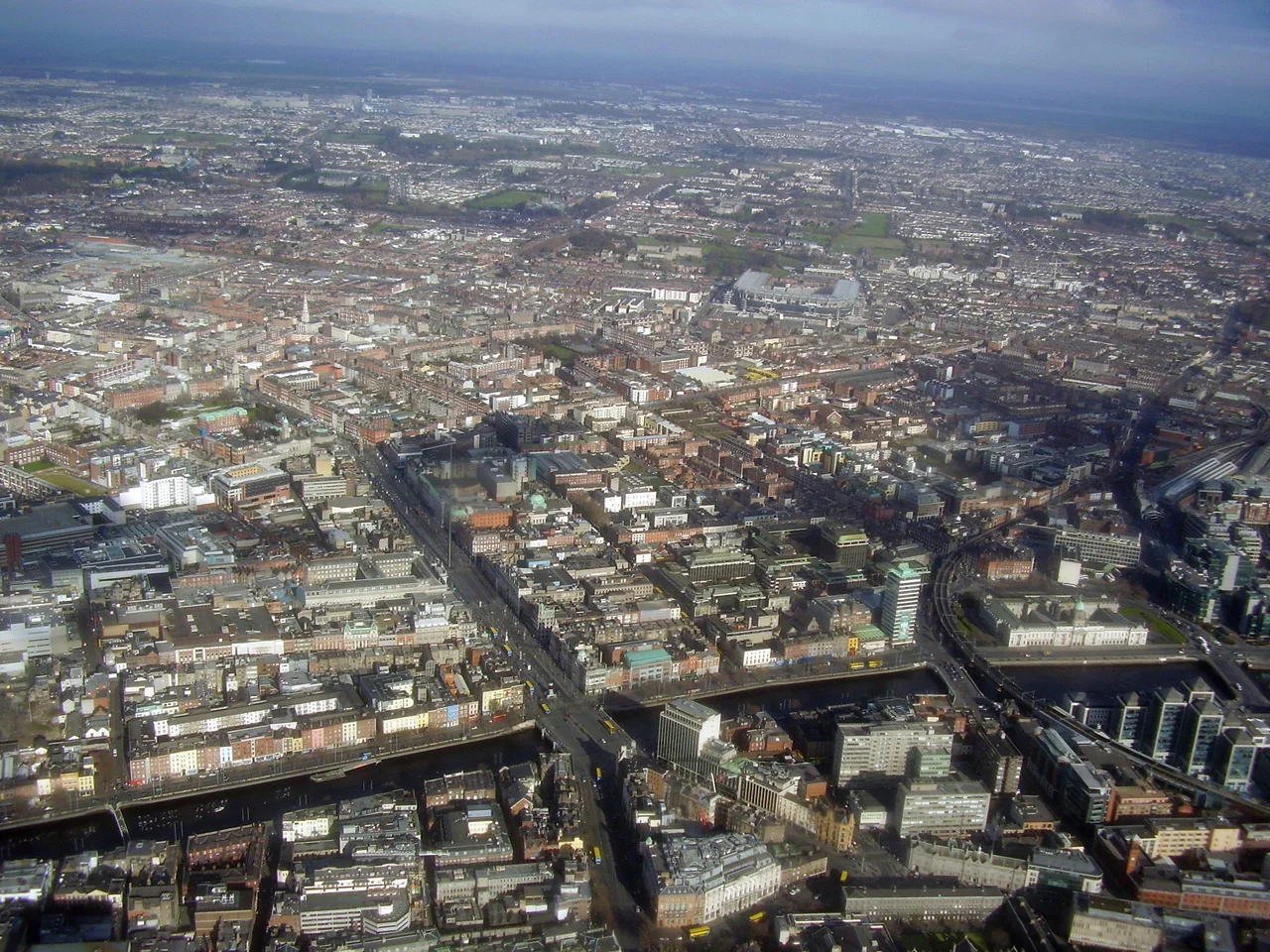

City Status in Ireland
Armagh has fewer than seventeen thousand inhabitants and is officially a city. Tallaght, a Dublin suburb with over seventy thousand people, is not. The reason is that in Ireland, the word "city" has almost never meant what most people assume it means. It has meant a royal charter, or a bishop's seat, or in some cases just a long enough history of being called a city by people who ought to know. The story of how Irish towns earned, lost, and disputed the title is a story of bishops and kings, the Acts of Union, two competing post-partition jurisdictions, and a 2002 Golden Jubilee competition that gave one city to a strongly Protestant town and another to a strongly Catholic one on the same afternoon.
Cities Of Bishops
The English jurist Edward Coke, writing in 1634, gave the classic definition: "A city is a town incorporated, which is or hath been the see of a bishop; and though the bishoprick be dissolved, as at Westminster, yet still it remaineth a city." For centuries this was the rough working rule in Ireland too, though the actual legal mechanism was the royal charter, written in Latin, in which civitas denoted "city" and villa denoted "town." Seven Irish settlements were historically given charters using civitas: Dublin, Cork, Limerick, Waterford, Kilkenny, Derry, and Cashel. Armagh had no such charter but claimed the title by long-standing custom; acts of the Parliament of Ireland in 1773 and 1791 simply called it the city of Armagh anyway. The label carried prestige but no special powers. A city was a city because everyone agreed it was a city.
Belfast Breaks The Rule
By the late 19th century, the bishop-rule had begun to look absurd. Cashel had a population of about 4,000 and city status. Armagh, with around 10,000, had it too. Belfast, the largest manufacturing town in Ireland and the second most populous town on the island, had nothing. In 1887, on the occasion of Queen Victoria's Golden Jubilee, the city fathers applied for a charter, and the Home Office initially objected on the grounds that it would set a precedent for non-episcopal cities. In the House of Commons Thomas Sexton put it bluntly: "Like civility, a Charter of this kind costs nothing." The charter was granted in 1888 by letters patent, and Dundee and Birmingham soon followed. The precedent had been set. The bishop's rule was dead.
Free State And After
The Acts of Union 1800 brought Ireland under British law for the purposes of city titles, and the Municipal Corporations (Ireland) Act 1840 abolished a number of unrepresentative borough corporations, including those of Armagh and Cashel. Whether this meant those two towns ipso facto lost their city status was genuinely contested; later 19th-century sources continued to call them cities. After partition in 1921, the Irish Free State inherited four county boroughs: Dublin, Cork, Limerick, and Waterford. Galway was raised to the fifth in 1986, and was finally legally confirmed as a city under the Local Government Act 2001. Kilkenny was demoted to a town in 2014 but its municipal district is still called the Municipal District of Kilkenny City, a face-saving compromise that means about what it sounds like.
The Golden Jubilee, And Two Cities At Once
By the year 2000, Northern Ireland had only two recognised cities: Belfast and Derry/Londonderry. A UK-wide competition for new city status was held to mark the millennium. Two Northern Irish towns entered (Lisburn and Ballymena) and neither was successful. The competition rules were changed for the 2002 contest, marking Elizabeth II's Golden Jubilee, with Northern Ireland guaranteed at least one new city. This produced a flood of applicants: Lisburn, Ballymena, Carrickfergus, Craigavon, Coleraine, and Newry. The decision shocked everyone. Both Lisburn and Newry were granted city status. Lisburn lay in a strongly Protestant heartland; Newry was about eighty per cent Catholic. The pairing was widely seen as a deliberate political balance, although some Sinn Féin councillors in Newry objected to accepting any honour from the British monarchy. The award was made anyway. Armagh, meanwhile, had already had its own city status restored by Prince Charles in 1994, on the 1,550th anniversary of its founding by Saint Patrick.
Bangor In The Shadow Of A Queen
The next round came in 2022 for Elizabeth II's Platinum Jubilee. Bangor in County Down was among the eight new cities announced on 20 May 2022. The town's formal letters patent were delayed by the death of the Queen in September of that year and had to be reissued under the royal sign manual of Charles III on 22 November. Anne, Princess Royal, presented the document at Bangor Castle on 2 December 2022. A local Green Party councillor noted that the £10,000 to update Bangor's four welcome signs might be better saved during a cost-of-living crisis. The signs were updated anyway. Northern Ireland now has six cities. In the Republic, there are still only five: Dublin, Cork, Galway, Limerick, and Waterford. Cities and Counties since 2014, in the latter two cases. The label still costs nothing. It still means whatever the people who hold it want it to mean.
From the Air
This article is about a concept rather than a single location. The cities of Northern Ireland (Armagh, Belfast, Derry, Lisburn, Newry, Bangor) cluster mostly in the eastern half of the province; the Republic's five cities (Dublin, Cork, Galway, Limerick, Waterford) span the island. Default coordinates point to Armagh, the historic primatial city, at 54.35°N, 6.66°W. Best viewed at high cruising altitude with good east-west visibility for a sense of how the bishop-cities pattern across the island. Nearest airports to Armagh: Belfast International (EGAA), Dublin (EIDW).
Nearby Stories
- 1990 British Army Gazelle shootdown 2 km away
- Slieve Gullion 4.7 km away
- Cootehill 11 km away
- Carrickfergus 12 km away
- Castledawson 13 km away
- Gortin 14 km away
- Castlewellan 16 km away
- German submarine U-1051 67 km away