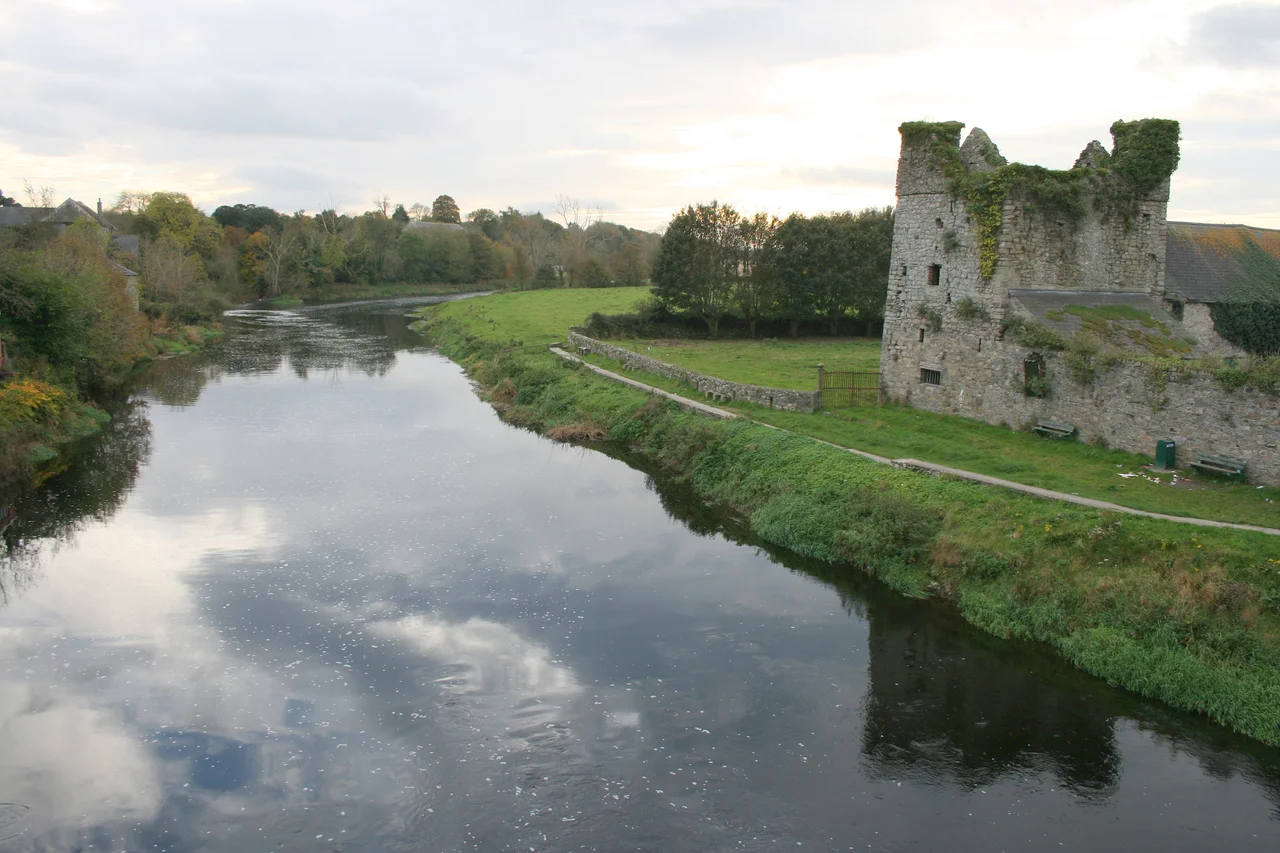

Thomastown, County Kilkenny
Thomas FitzAnthony was a mercenary from Wales who came over with the Norman invasion of Ireland and ended up as Seneschal of Leinster. In the early 13th century he chose a crossing point of the River Nore and built a town to his own name. He died in 1229. Today, eight centuries later, the town he founded is still called Thomastown, still sits where the salmon and trout run, and is still a market town with a name that carries oddly far -- to Texas, where it produced an empresario who helped settle the Republic, and to philosophy, where its hinterland produced one of the most original British minds of the 18th century.
FitzAnthony's Town
Before Thomastown there was Grennan -- the older Irish settlement whose name means Sunny Place. When William Earl Marshall, son-in-law of Strongbow, granted a large area of the region to Thomas FitzAnthony, the Anglo-Norman built his own fortifications on the high ground above the Nore. The town and a nearby Grennan Castle both rose during his lifetime, and from him the place took its new name. By the end of the 13th century, Thomastown had more than 200 burgesses, and its first town walls were built in 1449. Successive English monarchs -- Edward III (twice), Henry VI, Mary I, James I, and James II -- granted the town royal charters. Under a 1553 charter from Queen Mary I, the burgesses had the right to choose two members of Parliament, a privilege they continued to exercise until the Acts of Union dissolved the Irish Parliament in 1800.
Cromwell, Mills, and the River
In 1650 Cromwell's army arrived. Grennan Castle was laid siege to, and after two days the defenders surrendered. Several mill buildings in good condition can still be seen upstream from the bridge, surviving from the era when grain milling was the dominant rural industry along the Nore. The town's medieval bridge over the river is still in place, with the ruined towers of FitzAnthony's old fortifications near each end and the remains of the 13th-century church of St. Mary nearby. Of FitzAnthony's original walled town and castle, these towers and the church are the principal remains -- the rest absorbed into later building, or quarried away, or simply weathered down.
Berkeley and the Texan Empresario
Dysart Castle, close to Thomastown, is reputed to have been the birthplace of Bishop George Berkeley -- the Irish philosopher whose immaterialism shaped 18th-century thought and whose name was attached to the Californian city, and then the university, that bears it today. Berkeley's idea that to be is to be perceived made him one of the most original Western philosophers. Thomastown was also the birthplace of James Hewetson, who would become one of the empresarios of early Texas, granted land contracts to bring colonists into what was then Coahuila y Tejas. The painter Mildred Anne Butler (1858-1941), associated with the Newlyn School, was born in Kilmurry near Thomastown and spent most of her life at her family home there. Earlier the same Kilmurry house had belonged to the Bushe family, whose most distinguished member was Charles Kendal Bushe, Lord Chief Justice of Ireland, born there in 1767.
Mount Juliet, John Martyn, and Hurling
Modern visitor attractions cluster within easy reach: Jerpoint Abbey, the ruined 12th-century Cistercian house just outside town; Kilfane Glen gardens with its picturesque waterfall; and Mount Juliet Golf Course, the Jack Nicklaus-designed course that hosted the 2002 and 2004 WGC-American Express Championships. British songwriter and guitarist John Martyn, one of the great voices of British folk-rock, lived in Thomastown from 1998 until his death in 2009. A bronze statue of Ollie Walsh, a Thomastown-born hurler who became one of the great Kilkenny goalkeepers, stands on Mill Street. Monsignor Tommy Maher played hurling for the local Thomastown club and the Kilkenny senior inter-county team in the 1940s, then coached Kilkenny to seven senior All-Ireland titles between 1957 and 1978. On the River Nore -- known for its salmon and trout -- kayaking and fishing are still common pursuits, and the river still bends south past the town toward Inistioge, much as it did when Thomas FitzAnthony picked his crossing point eight centuries ago.
From the Air
Located at 52.53 degrees N, 7.14 degrees W in County Kilkenny, Ireland, on the River Nore between Bennettsbridge to the north and Inistioge to the south. From altitude Thomastown appears as a small market town straddling the Nore with a medieval bridge, surrounded by mixed pasture and tillage country. Mount Juliet's golf course and Jerpoint Abbey are visible nearby. Nearest airports: Waterford (EIWF) approximately 35 km south; Cork (EICK) approximately 120 km southwest. Best viewed below 2,500 ft AGL.
Nearby Stories
- County Wexford 3.4 km away
- Loughmoe Castle 6.6 km away
- Castlecomer 8 km away
- Waterford Airport 8.5 km away
- Mount Melleray Abbey 8.7 km away
- Cashel, County Tipperary 12 km away
- Wicklow Gold Rush 27 km away
- HMS H47 92 km away