
Penrhyn Du Mines
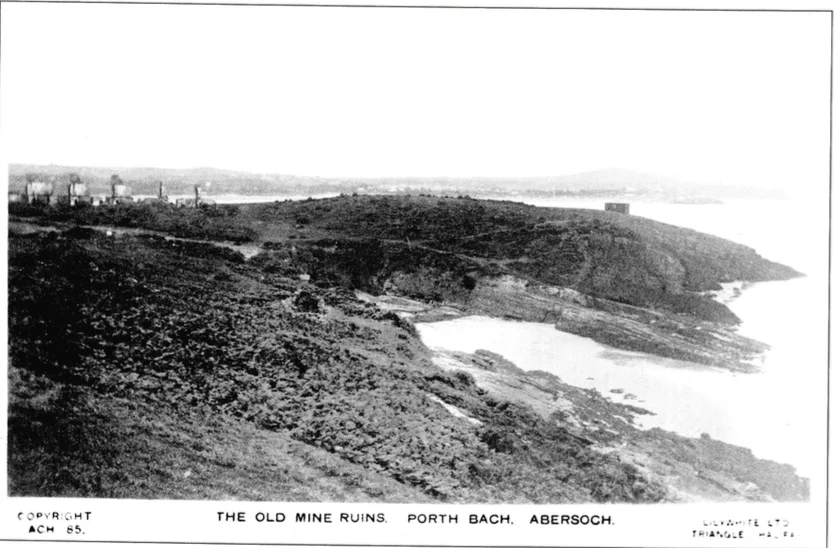
Penrhyn Du means black headland, a name given to the dark-rocked promontory south of Abersoch that has been mined for at least four hundred years and possibly twice that. The Romans may have taken lead from here. Elizabeth I's adventurers certainly did. The Cornish miners brought in to drive the deepest shafts during the Victorian boom left behind a row of cottages, an engine house, and a ruin still known as Cornish Row, set into the heather on a headland where the wind never quite stops.
The Black Headland
Penrhyn Du is technically a collective name for four interconnected mines, Penrhyn, Assheton, Western, and Tan-y-Bwlch, worked across the headland east of Llanengan on the south coast of the Llyn Peninsula. Tan-y-Bwlch was the richest of them. Between 1873 and 1886 it produced a recorded eight thousand seven hundred and twenty-two long tons of lead ore, four thousand six hundred and fifty-two long tons of copper ore, and four hundred and fifty long tons of zinc ore, a substantial output for a remote Welsh hillside. After any speculative Roman workings the mines lay largely idle until the reign of Elizabeth I, when a new generation of mineral adventurers tried to put them back into production.
Pennant's Verdict
The naturalist and topographer Thomas Pennant, riding through the Llyn in the 1770s, was unimpressed. He noted in 1781 that there had been considerable adventurers for lead ore, and of late years attempts to drain the mines by means of a fire engine, but the expences proved superior to the profits. The fire engine in question was an early Newcomen-style atmospheric pumping engine, the kind of beast that consumed enormous quantities of coal to lift water out of deep shafts. Coal had to be shipped to this remote headland by sea. The arithmetic rarely worked out. Ore was still being exported in 1789, but by that November the operators conceded that the engine will soon be destined for a coalmine and unless [the situation is] altered for the best, this will take place in the spring.
The Cornish Era
The nineteenth century brought new capital and a Cornish-engine pumping technology that finally made deep working economic. The engine house was rebuilt, fresh shafts were sunk, and recruiters travelled west across the Bristol Channel to bring experienced Cornish miners to the Llyn. They came with their families, settled in a row of cottages purpose-built on the headland, and worked the shafts through the boom years of the 1870s and early 1880s. The cottages are still there, in ruin, in a line above the cliffs. Locals call them Cornish Row. The terrace is one of the more poignant traces of the brief industrial chapter on a peninsula that otherwise feels (and largely is) agricultural.
What the Heather Hides
Mining at Penrhyn Du tailed off through the late nineteenth century and finally ended in the early twentieth. Modern developments, particularly the spread of caravan parks and holiday cottages on the headland, have covered much of what once stood here. But the engine house ruin still rises against the sky. In 2018 the Old Day Level, an adit driven horizontally into the cliff to drain the workings, was rediscovered and recorded. The Black Headland keeps producing minor finds for the patient walker: a tumbled chimney base, a flooded shaft mouth fenced off in someone's garden, the iron strap of a long-vanished ore wagon. Lead, copper, zinc, manganese, iron, all of them came out of this hill at some point, and almost all of them are gone, except for the names.
From the Air
Penrhyn Du Mines lie on the dark-rocked headland south of Abersoch, centred at 52.808N 4.492W. From the air, look for the C-shaped Abersoch bay with the headland forming its southern arm. The remains of Cornish Row and the engine house ruin sit in pasture above the cliffs, visible as small rectangular features in the heather. St Tudwal's Islands lie about 1 nm offshore to the east. Nearest airfield is Caernarfon (EGCK) 18 nm north-east.
Nearby Stories
- Swallow Falls 2.3 km away
- Dinas Dinlle 3.9 km away
- Cardigan Bay 6.7 km away
- Battle of Mynydd Hyddgen 7.5 km away
- Irish Sea Bridge 20 km away
- Ysbyty Ifan 24 km away
- Cantre'r Gwaelod 29 km away
- Irish Sea 46 km away