
Battle of Mynydd Hyddgen
By the spring of 1401 Owain Glyndŵr had begun to look like a failed rebel. He had declared himself Prince of Wales the previous September, been defeated twice in north Wales at Mawddwy and Cadair Idris, and seen his Pembrokeshire allies pillaged by the English king's forces. He had retreated, with what one chronicle calls "six score wicked men and thieves," into the empty quartz-grey uplands of Plynlimon, where the rivers Severn, Wye, and Rheidol all rise within a few miles of one another. The English settlers of west Wales mustered around 1,500 men to finish him. They climbed onto Mynydd Hyddgen one June morning expecting to capture a fugitive. What they encountered there ended differently than they had planned, and what happened on that bare slope between June 1401 and the autumn changed the next fifteen years of Welsh history.
Six Score Men and a Trap
The sole surviving account, the fifteenth-century Annales Oweni Glyndwr, is brief and partisan. "The next summer after that, Owain rose up with six score wicked men and thieves, and he brought them as to war into the uplands of Ceredigion. And fifteen hundred men from the lowland of Ceredigion and Rhos and Pembroke assembled there and they came to the mountain to try to capture Owain. And on Hyddgant Mountain was the encounter between them, and as soon as the English host turned their backs to flee, two hundred of them were killed." Six score is 120. The ten-to-one disparity is almost certainly exaggerated, but Glyndŵr was undoubtedly outnumbered. He may have been supplemented by Welsh archers at the typical three-to-one ratio of the period, bringing his force to perhaps five hundred. The English had cavalry and Flemish mercenaries; Glyndŵr had hill ponies and men who knew the ground.
The Ground That Won the Day
Walk up onto Mynydd Hyddgen today, with the Nant y Moch reservoir below you and Plynlimon's broad summit a few miles north, and the landscape itself gives a sense of why the larger force lost. The Hyddgen valley is boggy ground threaded with springs and small streams, the kind of place where heavy infantry sinks and laden cavalry founders. Above the valley, on the east bank of the Hyddgen river, an exposed rock shelf called Banc Lluestnewydd offers commanding sight lines across the uplands. A spring rises naturally up this slope, drawing climbers toward it. Some historians believe Glyndŵr drew the English force up the slope and ambushed them where the rock shelf gave him cover. Others place the fight at the summit itself. Nobody knows exactly. What we do know is that men with horses suited to peat bogs defeated men whose horses were not.
Two Hundred Dead
The Annales says two hundred English and Flemish were killed before the survivors fled. There were prisoners. The losses on Glyndŵr's side are not recorded, but they were small enough that he was able to march south almost immediately and rally fresh support in the Tywi valley. Some modern historians doubt the battle happened as described at all - they note the lack of corroborating evidence in muster rolls, payment records, or independent chronicles. But something happened. Henry IV's posture towards the Welsh revolt shifted sharply in the autumn of 1401, from grudging acknowledgement to alarm. On 18 September the king issued calls to raise a fresh army at Worcester, treating the Welsh threat as a clear and present danger. That escalation only makes sense if Glyndŵr had achieved a real victory somewhere. Hyddgen is the most plausible candidate.
The Memorial at Nant y Moch
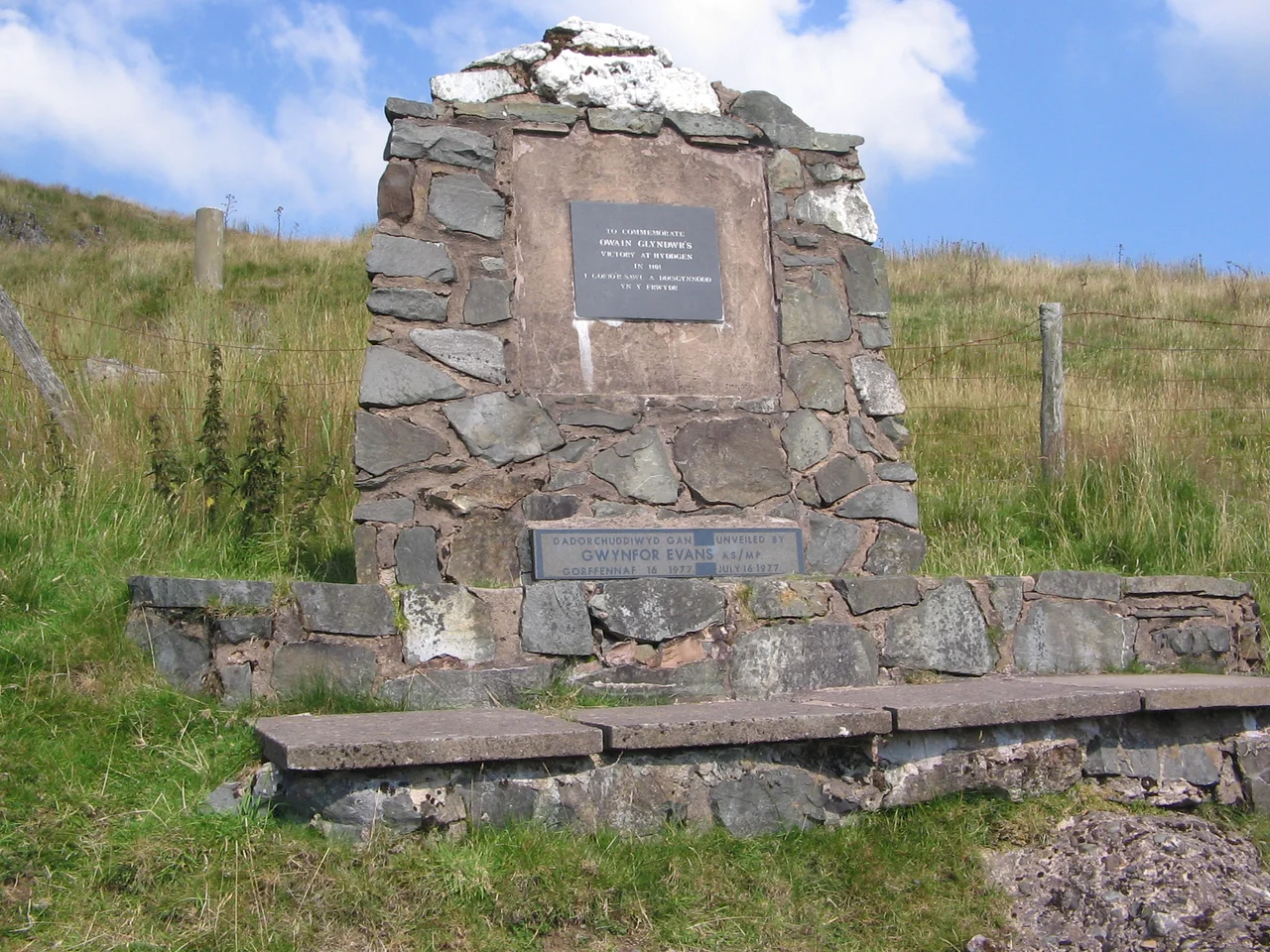
There is no battlefield visitor centre at Hyddgen. The site lies four miles east of the road and requires a steep walk in over wet ground. In 1977 a memorial stone was erected at the Nant y Moch reservoir dam, where the road from Talybont meets the lake. The stone was unveiled by Gwynfor Evans, then the president of Plaid Cymru and the first MP that Welsh nationalism had ever sent to Westminster. It commemorates both the battle and the men killed in it. The remoteness of the site means that the memorial does the symbolic work; most who come to Mynydd Hyddgen never reach the battlefield itself. They look at the lake and the surrounding hills and try to imagine a few hundred men beating an army several times their size, on this empty windswept ground, six hundred years before.
What Hyddgen Bought
The victory bought Glyndŵr eight more years of war, time enough to take much of Wales, to crown himself prince at Machynlleth in 1404, to negotiate with France, Scotland, and Ireland, to defeat the English again at Bryn Glas in 1402, and to come closer than anyone had since 1282 to creating an independent Welsh state. The rebellion eventually failed. Glyndŵr disappeared sometime after 1412 and was never captured, his place of death and burial unknown. But Hyddgen was the day the rebellion stopped being a series of skirmishes and became a sustained war. Without those few hundred Welsh archers on the slopes of Plynlimon in June 1401, Glyndŵr would have been a footnote rather than a national memory. The hill that gave them their position is still there, and the wind still blows across it.
From the Air
Located at 52.51N, 3.80W in the high uplands of Plynlimon, on the boundary between Ceredigion and Powys. From the air, look for the empty rolling hills west of the Nant y Moch reservoir, with Plynlimon itself (752m) just to the north-east marking the source of the Severn and Wye rivers. The Hyddgen valley is a narrow north-south depression with the small Hyddgen river running south to feed the reservoir. Nearest airports: Aberporth (EGFA) approximately 26nm south-west; Welshpool (EGCW) approximately 32nm east; Caernarfon (EGCK) approximately 45nm north. Recommended viewing altitude: 3,000-5,000 ft for the upland sweep. The Cambrian Mountains generate strong orographic cloud in west and south-west winds; visibility can deteriorate rapidly.
Nearby Stories
- West Wales 5.6 km away
- Talgarreg 9.8 km away
- Relief of Montgomery Castle 10 km away
- Cymer Abbey 14 km away
- Hay Castle 15 km away
- Battle of Maserfield 16 km away
- Battle of Orewin Bridge 17 km away
- Penrhyn Du Mines 20 km away