
Battle of Orewin Bridge
On the morning of 11 December 1282, Llywelyn ap Gruffudd, sovereign Prince of Wales, rode away from his army. He had perhaps eighteen men with him, some of them clergy. The Welsh host he had left behind, around seven thousand spearmen and a hundred and sixty cavalry, was drawn up on a hillside north of the Irfon River near a village called Cilmeri, watching for an English attack from the south across Orewin Bridge. Llywelyn had been promised a meeting with the Marcher lords. He had been told they would offer their homage. The promise was a trap. By dusk he was dead, run down in a wood at Aberedw, struck through with a lance by a man who did not know who he was. His head was carried to London. Wales, after eight hundred years as a network of independent kingdoms and seven generations of struggle, no longer had a prince of its own.
The Long War with Edward
Llywelyn had fought Edward I once already, in 1277, and lost. Edward had overrun north Wales, captured Anglesey, and forced humiliating terms. The five years that followed were strained: lawsuits, encroachments, and the slow alienation of the Welsh who lived in the lands now administered by English officials. The 1282 revolt began not with Llywelyn but with his brother Dafydd, who had sided with Edward in the previous war and now turned against him, capturing Hawarden Castle and killing the garrison. Llywelyn was almost forced into joining: as the senior prince of Gwynedd, he could not let his brother face the English king alone. He declared war on behalf of all Wales. Edward repeated his earlier strategy. Royal armies pushed into the north. Welsh victories at Llandeilo Fawr in the south, and at the disastrous English crossing of the Menai Strait at Moel-y-don in November, set Edward back several months. Llywelyn used the respite to ride into mid-Wales and rally the wavering Marcher lordships.
Promise of Homage
The English force in mid-Wales was under three of Edward's most loyal commanders - Roger l'Estrange, John Giffard, and Edmund Mortimer - reinforced by troops from Gruffydd ap Gwenwynwyn, a Welsh lord who hated Llywelyn. They had perhaps five thousand infantry and 1,300 heavy cavalry. Llywelyn's army was larger but lighter, dependent on the agility of his spearmen and the speed of his cavalry. On 11 December the Welsh held the high ground north of the Irfon. Edmund Mortimer sent word that some of the Marcher lords were prepared to switch sides. They wanted to meet Llywelyn personally to offer their homage. Llywelyn went. He took a small escort. Two surviving accounts disagree about exactly what happened next, but both agree that the meeting was a deception. As Llywelyn rode forward, the English forces attacked his main army from across the bridge; the chaos separated the prince from his troops.
A Wood at Aberedw
The more credible of the two surviving accounts - written by monks in eastern England who had contact with Llywelyn's exiled daughter Gwenllian - describes what followed. The Welsh army was engaged in fierce battle and a section of it routed. Llywelyn and his small group of retainers became separated from the main force. As dusk fell they were ambushed and chased into a wood near the village of Aberedw, four miles north of Builth. Llywelyn was surrounded. He was struck down by a lance, probably by a man named Stephen de Frankton. As he lay dying, he asked for a priest and revealed his identity. He was killed. His head was cut off and his body searched; a list of supposed conspirators, which may well have been faked, was found on him, along with his privy seal. The Welsh chroniclers do not describe his last words. The English ones reported only the surprise of finding that the man their soldier had killed was the prince of Wales.
The Head on the Tower
Llywelyn's head was carried to Edward I and then to London. It was crowned with ivy, in mockery of an old Welsh prophecy that said a Welsh king would one day be crowned in London. The head was displayed on a stake at the Tower of London for the next fifteen years, a deliberate piece of political theatre meant to remind both Welsh and English of who had won. His body was buried, probably at the Cistercian abbey of Cwmhir, although the exact site is uncertain. His infant daughter Gwenllian was taken to a Gilbertine priory at Sempringham in Lincolnshire, where she lived as a nun until her death in 1337, never permitted to return to Wales or to bear children of her own. The dynasty was extinguished by design. Welsh rule in Gwynedd, and with it any prospect of a Welsh state independent of England, ended on the slopes above the Irfon.
Cilmeri
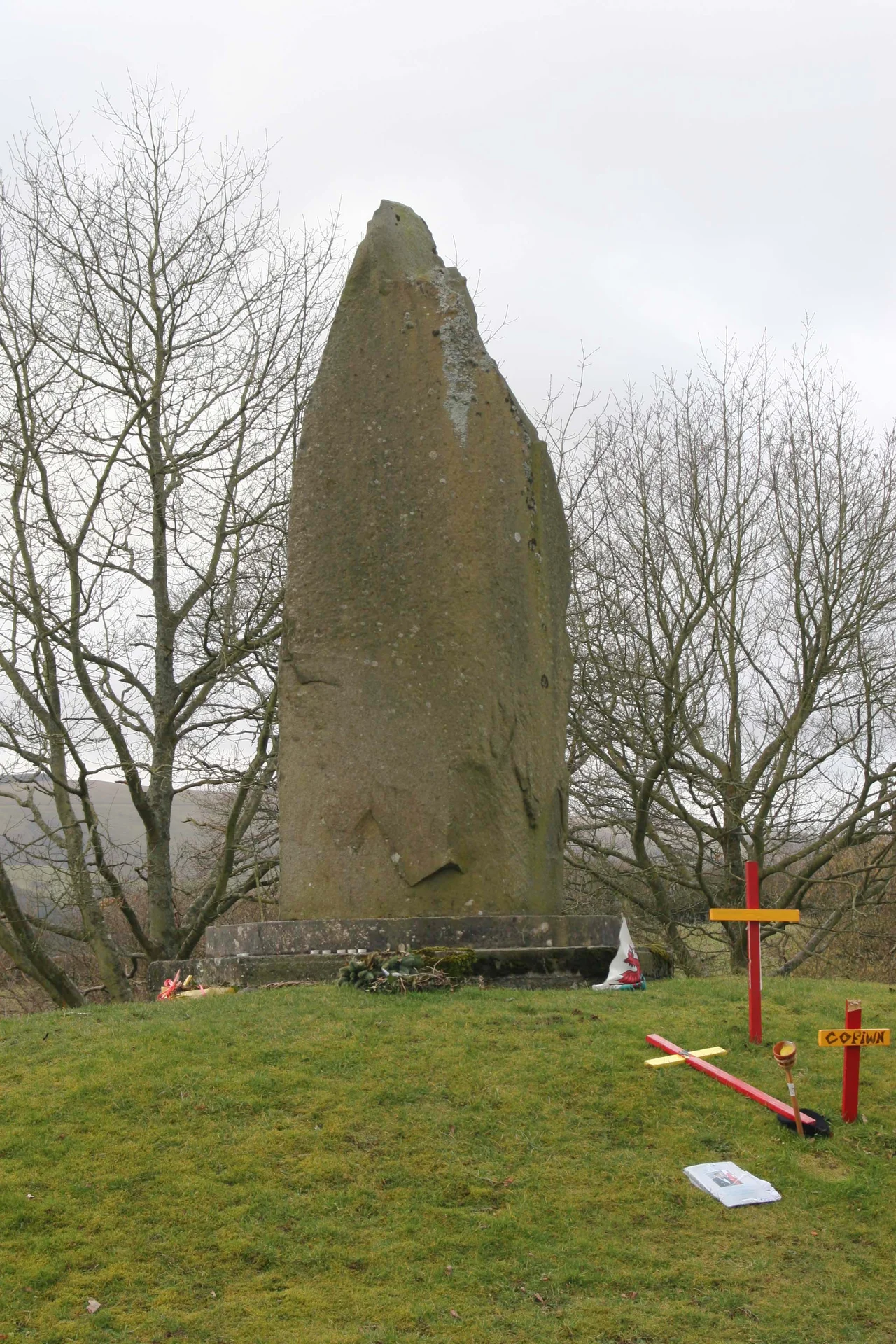
A monument stands today at Cilmeri, a few miles west of Builth Wells on the A483, marking the traditional site of Llywelyn's death. The stone, erected in 1956 and replaced with a larger memorial in 1984, is a tall rough block of granite quarried from Llywelyn's own Gwynedd and carried south. Each year on the anniversary, 11 December, hundreds of people gather to lay wreaths and read elegies in Welsh. The most famous of those elegies was composed in 1282 by Gruffudd ab yr Ynad Coch, who asked what had been lost: "Oh God, that the sea would cover the land. What good is it to leave us in this state of suffering?" The line is still recited at Cilmeri every December. The hill where his army stood is still there. The wood at Aberedw is still there. The head on the Tower is gone, but the political fact it announced - that Wales would not, for many centuries, govern itself - lasted in some form until the Senedd opened in Cardiff in 1999.
From the Air
Located at 52.15N, 3.46W in the broad valley of the Irfon River, just west of Builth Wells in central Powys. From the air, the battlefield is a quiet area of rolling pasture between the small village of Cilmeri and the wooded slopes leading up to Aberedw. The Irfon flows east here to join the Wye at Builth. Nearest airports: Welshpool (EGCW) approximately 30nm north; Hereford/Shobdon (EGBS) approximately 25nm east; Pembrey (EGFP) approximately 50nm south-west. Recommended viewing altitude: 2,000-3,500 ft for the river valley and surrounding hills. The Mid Wales weather can be very localised; valley fog forms easily in autumn and winter, particularly along the Wye.
Nearby Stories
- Carreg Cennen Castle 4.7 km away
- Monmouth 8.1 km away
- Museum of Cider 9.2 km away
- The South Wales Valleys 9.2 km away
- Cambrian Mountains 12 km away
- National Library of Wales 14 km away
- Talley Abbey 18 km away
- Caratacus' last battle 19 km away