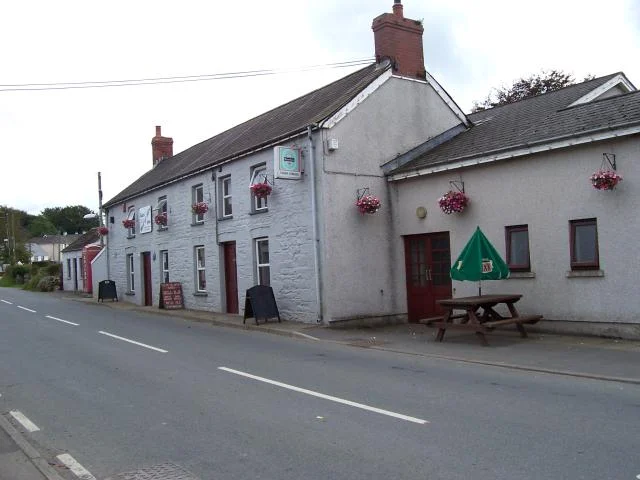

Talgarreg
Dewi Emrys won the Chair at the National Eisteddfod four times. Nobody else has ever done it, before or since. In 1941, in his sixtieth year, he moved to a small cottage called Y Bwthyn in the village of Talgarreg, to live with his daughter Dwynwen. He spent his last eleven years here, writing, judging, presiding over the slow drift of village life, and when he died in Aberystwyth in 1952 they brought him back across the hills and buried him in Capel Pisgah cemetery. Walk the lanes around Talgarreg and you are walking the parish of a remarkable cluster of Welsh-language poets, more of them than any village this size has any statistical right to claim.
A Village of Bards
Donald Evans, who was born here in 1940, won both the Chair and the Crown at the same National Eisteddfod twice - what Welsh poets call the double-double. Only three poets in history have done it, and one of them grew up walking these lanes. T. Llew Jones, the prolific writer and beloved childrens novelist, taught at Talgarreg Primary School. Sarnicol, the schoolmaster-poet Thomas Jacob Thomas, was born in the village in 1873. Rees Jones, who wrote as Amnon in the early 19th century, came from the upper Clettwr valley nearby. Gillian Clarke, the National Poet of Wales from 2008 to 2016, lives in Talgarreg today. Cynog Dafis, who served as a Plaid Cymru MP for Ceredigion, was a resident. Whatever it is about this junction of the B4459 between New Quay and Llandysul, it has produced an extraordinary concentration of people who write in Welsh, in verse, for an audience that still hears the difference between strict-metre cynghanedd and loose lines.
The Welsh of Daily Life
Talgarreg is still a Welsh-speaking village. That sentence sounds simple and is not. Across most of rural Wales the Welsh language has been ebbing for generations, eroded by in-migration, by the gravitational pull of English-language media, by economic patterns that draw young people to cities. Talgarreg is one of the places where the tide has not gone out. The primary school, Ysgol Gymunedol Talgarreg, opened in 1877 and has educated children through the medium of Welsh ever since; it is twinned with Skol Diwan in Guingamp, the Breton-language school in northern France. Capel Pisgah, founded in 1820-21, still holds Welsh services. The Cylch Meithrin nursery, the Memorial Hall committee, the Merched y Wawr branch founded in 1968, the Young Farmers Clubs of Pontsian and Caerwedros - the texture of community life happens in Welsh, organically, the way breathing happens.
The Memorial Hall and What Communities Build
Neuadd Goffa Talgarreg, the Memorial Hall, opened on 11 July 1923. It was built in memory of the boys and men of the parish who did not come back from the First World War. A century later it is still the hub of village life: coffee mornings, plays, christening teas, the occasional wedding feast, the yoga class on Wednesdays. The committee that runs it is drawn from the village's organisations, and its members take turns cleaning the hall, monthly, by rota. Talgarreg's annual sports day - Mabolgampau - has been held since 1956, originally with a carnival of floats from the surrounding hamlets of Pantcoch, Pisgah and Bwlchyfadfa, now in the school playground with races including the local oddity Ras Sion Cwilt, named for a legendary 18th-century smuggler. The Vintage Society meets the last Thursday of the month in the Glan-yr-Afon Arms, the village pub, where they organise an annual show of old working machinery. None of this is heritage in the museum sense. It is what happens when a small place decides to keep being itself.
Eirwyn Pontshan and the Comic Tradition
If the poets give Talgarreg its solemn weight, Eirwyn Pontshan - born Gwilym Eirwyn Jones, in the village in 1922 - gave it the comedy. He was a carpenter by trade and an entertainer by inclination, a Welsh nationalist who travelled the country telling stories and singing in pubs and chapels, refusing to translate, refusing to apologise. He came back to Talgarreg in his later years and died in the village in 1994. The combination is somehow exactly right for this place: the bardic chair on one wall and the comic ballad on the other, the cylch meithrin in the morning and the vintage tractor show in the afternoon, the Clettwr River running quietly through it all on its way down to the Teifi. Talgarreg is small. It is also, in a way that resists easy explanation, quietly remarkable.
From the Air
Located at 52.13N, 4.30W, in the hills of southern Ceredigion roughly halfway between New Quay and Llandysul. The B4459 junction at the village centre is a useful landmark in otherwise open agricultural country. Nearest aerodrome is Haverfordwest (EGFE) about 30 nm south-southwest; Swansea (EGFH) and Pembrey (EGFP) lie further south on the South Wales coast.
Nearby Stories
- RAF Haverfordwest 3.7 km away
- Great Western Railway in West Wales 7.7 km away
- West Wales 9.9 km away
- Fishguard Lifeboat Station 13 km away
- Battle of Mynydd Hyddgen 15 km away
- Strata Florida Abbey 18 km away
- Neath and Tennant Canal 21 km away
- HMS Tyler 44 km away