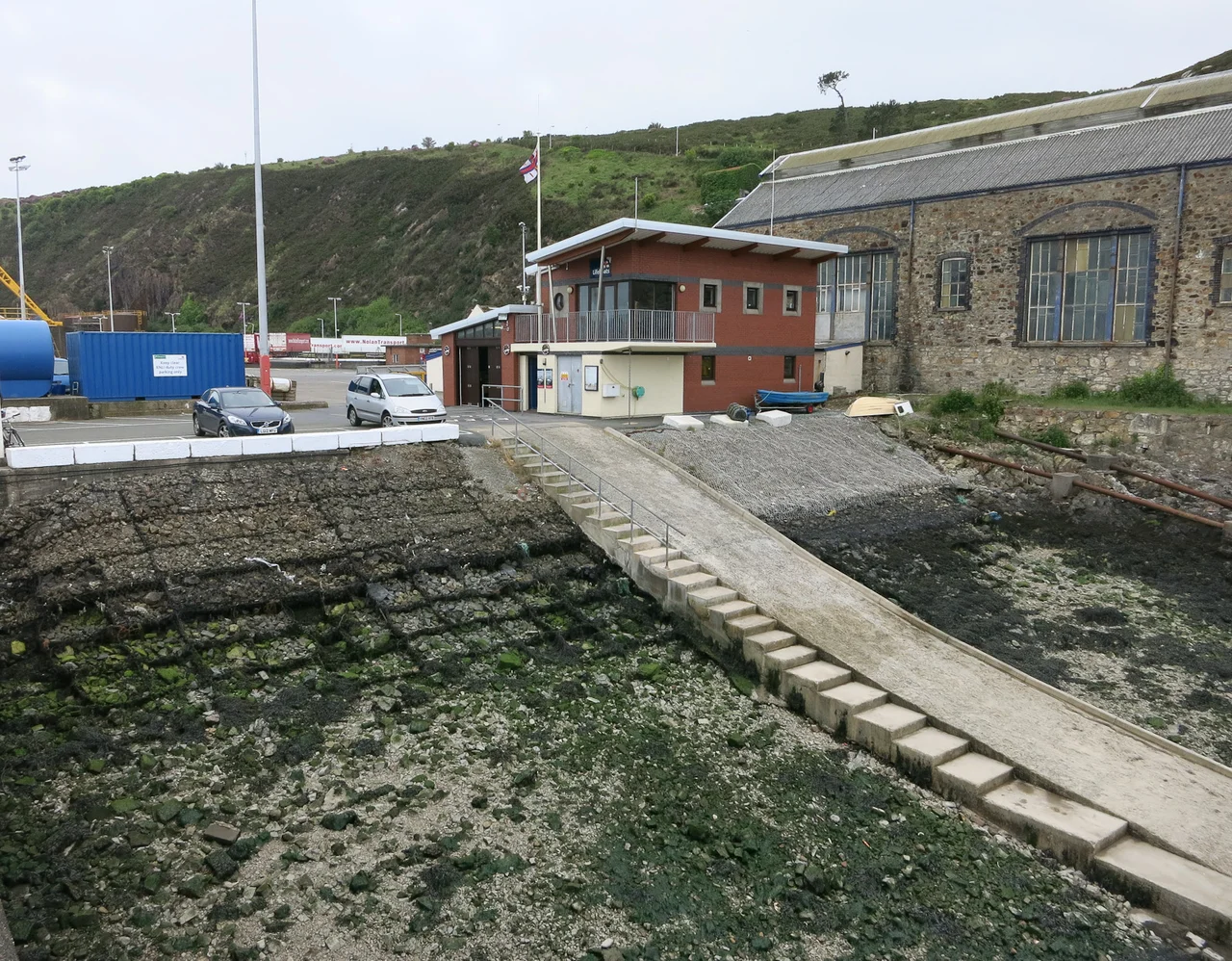

Fishguard Lifeboat Station
Lieutenant Thomas Evans of the Royal Navy paid for the first Fishguard lifeboat out of his own pocket. He was Lloyd's of London's agent in town, the man responsible for shipwrecks and salvage along this stretch of the Pembrokeshire coast, and in 1822 he decided that responsibility was not really enough. He built a boat. He took it out himself when ships went down. By 1844 he had spent five hundred pounds of his own money on construction and maintenance, while the Royal National Institution for the Preservation of Life from Shipwreck had once awarded the boat's crew a total of ten pounds. They gave him a special silver medal, double gilt with a gold swivel ring, for what they called his long continuing exertions in the cause of humanity. He kept going.
The Sister Rescue, 1846
Four years before the RNLI took over the station, two sisters named Martha and Margaret Llewellyn waded into the surf at Fishguard on 22 October 1846. The smack Margaret of Barmouth was breaking up offshore, and three men were drowning in water shallow enough to reach. The sisters did. They pulled all three out. The Royal National Institution awarded both of them silver medals in 1847, alongside John Acraman, the schooner master John Evans, William Jenkins, and William Rees, all silver medals for separate rescues in the same brief window of the 1840s. Six silver medals in less than a decade. The coast around Fishguard was a hard place to be a sailor.
The Official Station
On 7 December 1854 the RNLI's committee resolved to send a thirty-foot self-righting lifeboat of Mr Peake's new design to Fishguard, along with funds for a boathouse. A local committee chaired by the Reverend C. H. Barham of Trecwn had raised 193 pounds, enough to be formally accepted as a branch. The boat arrived in August 1855, carried first by the South Wales Railway and then the Great Western to Haverfordwest before being hauled overland to Fishguard. A No. 2 station opened in 1869 with a larger twelve-oared boat, funded by Captain Saumarez Fraser, RN, through a public appeal in Worcester, where the boat was paraded through the streets and named Fraser before being launched on demonstration in the River Severn. The big nights came. On 16 November 1882, the Fishguard lifeboat attended fifteen separate vessels in a single storm and saved 46 lives. In May 1874 the crew received 27 pounds for a single month's work that included rescuing 17 sailors from four different ships.
The Gold Medal Night
Twenty-eight medals have been awarded to Fishguard crewmen across two centuries: eighteen silver, nine bronze, and one gold. The gold went to Coxswain John Howells in 1921 for what became known as the Gold Medal Service. Three other crew members received silver that same year; nine others received bronze, a clean sweep of awards from a single rescue. In February 1946, the lifeboat White Star spent more than twenty-four hours at sea in severe weather standing by a broken-down submarine, helping rescue her crew. The dead are remembered in the station's roll of honour, the names of men who went out in the same boats and did not come back. Every lifeboat station in Britain keeps a list like this. Fishguard's is in the boathouse on the quay.
Blue Peter VII
In November 1993 the BBC children's programme Blue Peter launched its Pieces of Eight appeal to fund six new inshore lifeboats around the British coast. Schoolchildren collected aluminium ring-pulls, raised over 1.4 million pounds, and overshot the target so dramatically that the RNLI was able to fund an all-weather boat as well. The new lifeboat arrived at Fishguard in 1994, a Trent-class designed for offshore work in heavy seas. On 17 June 1995, in front of a crowd that filled the breakwater, the Blue Peter presenters carried out the naming ceremony. The boat is 14-03 Blue Peter VII (ON 1198), and she is still on station. Beside her, the inshore lifeboat Edward Arthur Richardson has been on call since 2015. They go when the call comes.
From the Air
Fishguard Lifeboat Station sits at 52.01 degrees north, 4.98 degrees west, at the foot of the North Breakwater inside Fishguard Harbour. From altitude the station shows as a small building on the quay between the ferry terminal and the outer breakwater. Cardigan Bay opens to the north and east; the open Irish Sea lies beyond Strumble Head to the west. Haverfordwest (EGFE) lies fifteen miles south; Swansea (EGFH) about fifty miles east. The all-weather lifeboat can be at sea within minutes of an alert and operates throughout Cardigan Bay and the western approaches.
Nearby Stories
- RAF Angle 0.9 km away
- Cardigan Bay Special Area of Conservation 5.4 km away
- Abercych 11 km away
- Cantre'r Gwaelod 12 km away
- Burry Port Lifeboat Station 22 km away
- Johnstown Castle 61 km away
- Hook Lighthouse 92 km away
- 1979 Fastnet Race 157 km away