.JPG)
Abercych
In the First Branch of the Mabinogi, Pwyll Prince of Dyfed goes hunting in the valley of the Cuch and meets a stranger whose hounds are not the white-and-red of any earthly pack. The stranger is Arawn, king of Annwn, the Welsh otherworld. The hunt takes place exactly here, in the narrow wooded valley north of the Preseli Hills where the Afon Cych meets the Teifi. Abercych today is a single lane of fewer than a hundred houses, two pubs, two chapels, and a working sawmill, but local people will still tell you, quietly and without entirely committing to belief, that the river up the valley has not lost its strangeness.
Mouth of the Cych
The name says exactly what the village is. Aber, in Welsh, means the mouth or confluence of a river, and the Afon Cych empties into the Teifi just downstream of where the houses begin. Abercych sits at the tripoint where Pembrokeshire, Carmarthenshire, and Ceredigion meet within the space of a few hundred metres. The settlement is linear, strung along a small lane on the western slopes of the Cuch valley, and it grew up from a string of even smaller places: Pont Hercws, Forge Cych, Penrhiw, Pont Treseli, and Abercych itself. There were about thirty houses here in the 1840s, and on the older Ordnance Survey maps you can still see the original cluster names like beads on a thread. The earliest recorded settlement on the site was a forge, long since vanished into the timber and the rain.
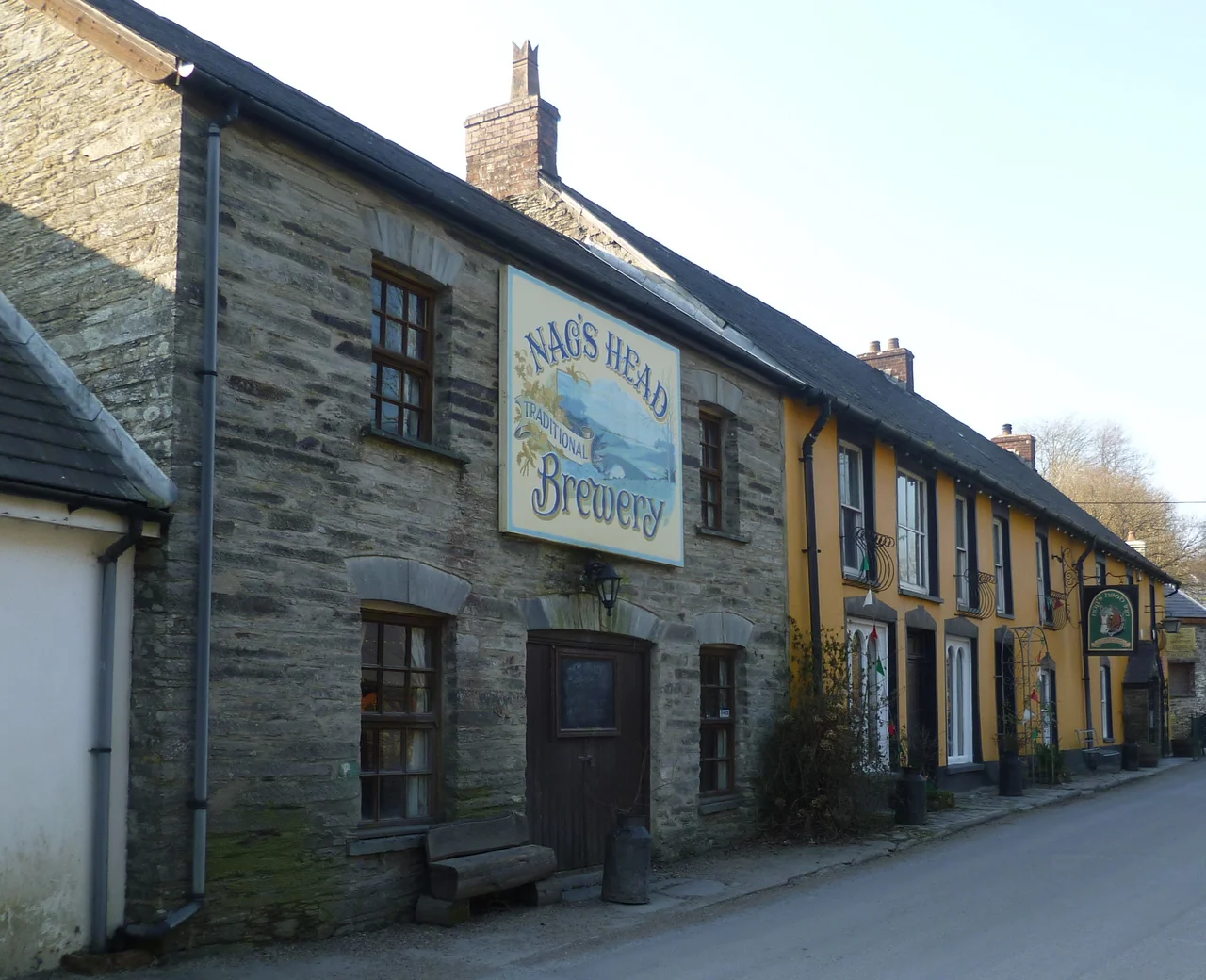
The Nag's Head
Two pubs serve a village that on paper barely justifies one: The Penrhiw Inn and The Nag's Head. The Nag's Head was for years home to a microbrewery that produced its own ales for the bar, and the Guardian once named it among the top ten pubs in Pembrokeshire, an unlikely distinction for a place at the very edge of the county. The pub sits beside a stone footbridge over the Cych and serves food on a terrace that listens to the river. The village hall, half a minute's walk away, hosts Manordeifi Community Council meetings every other month, the usual rituals of rural local government conducted in a building decorated for whatever wedding or party happened most recently.
Clynfyw and the Bowen Family
On the hillside above the village stands Clynfyw, a 16th-century mansion rebuilt in the 18th. Its estate records, going back to 1542, fill several shelves at the National Library of Wales in Aberystwyth. Since the 1980s, Clynfyw has been run as a care farm, a Community Interest Company offering work and accommodation to adults with learning disabilities and mental health needs. Up to forty day-students join eight live-in staff on a working farm where the labour is real, the produce is sold, and the rhythm of the seasons sets the timetable. In 2020, manager Jim Bowen, whose family had run the farm since the 18th century, accepted a Queen's Award for Enterprise from the then Prince of Wales, the second such award the farm had received. The recognition was for sustainable development, an old word for a very old idea: that a place can support its people, that work has dignity, and that small farms can do good work.
Two Chapels
The village has no parish church; for that you go down the lane to Manordeifi or up to St Dogwell. What Abercych has instead is two Nonconformist chapels, the standard tribal pairing of Welsh rural worship. Ramoth Baptist Chapel was built in 1827; Bryn Sion Independent Chapel, four years later in 1831. They served slightly different doctrinal communities of farmers and craftsmen in a village of fewer than three hundred people, and both still stand, modest stone boxes with deep windows and an austere geometry that hides, inside, the warmth of pews polished by generations of Sunday morning chapel-goers. The Welsh-language revival of the 19th century left its fingerprint in stone in nearly every village like this across south-west Wales.
Annwn
And then there is the river. The Cuch is small, fast, and shaded by oak and hazel, and in the First Branch of the Mabinogi, which was set down in writing in the 11th or 12th century from much older oral tales, this exact valley is where Pwyll of Dyfed meets the king of the otherworld. The mistake Pwyll makes, taking a stag from Arawn's hounds, costs him a year of disguised kingship in Annwn and a complicated marriage afterwards. Local folklore holds that several places on the upper Cych remain doorways to the other world, even today. You will not find them marked on maps. An annual contemporary dance festival has run in the village since 2013, which is perhaps the modern equivalent of stepping through the veil. A small village, an old river, and a story that has been told here for longer than anyone has counted.
From the Air
Located at 52.04 degrees north, 4.55 degrees west in the wooded valley of the Afon Cych, just north of the Pembrokeshire-Carmarthenshire-Ceredigion tripoint. Cruise altitude 2,500-4,000 feet shows the Teifi snaking westward toward Cardigan and the Cuch joining from the south. The MoD Aberporth danger area lies to the northwest; check NOTAMs. Nearest civil airport is Haverfordwest (EGFE); Swansea (EGFH) further southeast.
Nearby Stories
- RAF Haverfordwest 3.7 km away
- Great Western Railway in West Wales 7.7 km away
- West Wales 9.9 km away
- Fishguard Lifeboat Station 13 km away
- Battle of Mynydd Hyddgen 15 km away
- Strata Florida Abbey 18 km away
- Neath and Tennant Canal 21 km away
- HMS Tyler 44 km away