_(geograph_6874177).jpg)
RAF Haverfordwest
The first time the airfield was switched on, it blacked out the town. The newly-laid runways and hangars at Withybush had been wired into the Haverfordwest civilian power station, and the moment full electrical load hit the grid in late 1942, the whole place - both town and airfield - went dark. The engineers shrugged, ordered an oil-fired generator, and got on with the war. RAF Haverfordwest was always a bit improvised. It opened before it was finished, took twice the aircraft it was designed for, and trained crews who would die in the Bay of Biscay hunting U-boats. Then in 1945 it closed, and the fields turned mostly back into farms.
An Airfield Built in a Hurry
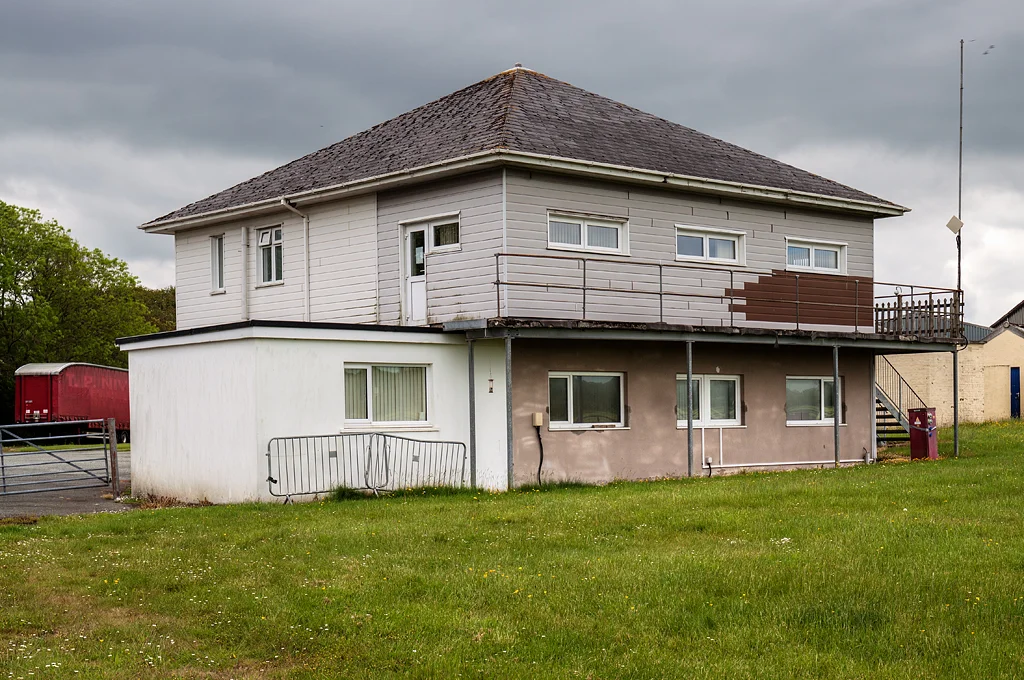
In March 1941, Coastal Command needed somewhere new for bomber crew training. They settled on a flat patch between the villages of Rudbaxton and Crundale, two miles north of Haverfordwest. The land was good - level, hedgerows for boundaries, no major obstacles. The construction was slow. Materials were scarce; priorities elsewhere kept shifting. By the time the station opened on 10 November 1942, only the control tower and the runways were finished. The first four aircraft from No. 3 (Coastal) Operational Training Unit arrived on 30 November and had to refuel from civilian road tankers making daily visits, because the airfield's own fuel infrastructure wasn't ready. Three runways laid out in a triangle - 5,100 feet, 3,780 feet, and 3,600 feet - made up the main flying surface, with thirty-two dispersal pans connected by a perimeter track. Two T2 hangars served maintenance. It was a small base, not designed for the volumes of aircraft and men it would soon have to handle.
Hunting From the Coast
The work at Haverfordwest was deadly serious. RAF Coastal Command had the job of finding U-boats and protecting Allied convoys, and the Atlantic war was being lost as 1942 turned into 1943. No. 3 (C) OTU operated Vickers Wellingtons, Avro Ansons, Armstrong Whitworth Whitleys, and Vickers Warwicks - the workhorses of long-range reconnaissance and air-sea rescue. Crews learned to fly low over grey water for hours at a time, watching for the white feather of a periscope wake. In October 1943 a Polish Flight arrived, flying Wellingtons. The accents on the radio at Withybush were Welsh, English, Scottish, Australian, Canadian, Polish - the war condensed into a single circuit pattern. No. 7 (C) OTU moved in from RAF Limavady in Northern Ireland in January 1944 with the same Wellington-and-Anson mix and added Westland Lysanders, Miles Magisters, and Tiger Moths for instruction. Some crews trained here flew operationally from RAF St Davids fifteen miles to the west and never came back.
Cameras Over the Preselis
In January 1945 a completely different kind of unit arrived: No. 8 (Coastal) Operational Training Unit, fresh from RAF Dyce near Aberdeen, equipped with de Havilland Mosquitos and Supermarine Spitfires. These were photo-reconnaissance trainees, learning to fly very fast and very high - or very fast and very low - with cameras mounted in their fuselages. The Preseli Mountains north of Haverfordwest became their low-flying training area, the rolling Welsh hills a stand-in for the European terrain the cameras would soon photograph. Within a few weeks the base was hopelessly overcrowded; on 27 February 1945 about thirty Spitfires and Mosquitos were moved across to RAF Brawdy because there was simply nowhere to park them at Withybush. The unit also conducted an aerial survey of the British Isles - mapping the country from above for postwar use. In June 1945 the Mosquitos and Spitfires departed for RAF Mount Farm. The war was already over.
Aircrew Holding
By the summer of 1945 the British Commonwealth Air Training Plan had trained more pilots and aircrew than the postwar RAF could absorb. They needed somewhere to wait. No. 20 Air Crew Holding Unit was formed at RAF Haverfordwest on 18 June 1945, followed by No. 21 in August. Young Canadians, Australians, New Zealanders, South Africans, and Britons - men who had volunteered for the most dangerous work in the war and had survived their training and the months at operational squadrons - now sat in barracks in Pembrokeshire waiting for paperwork. Both holding units shut down on 15 November 1945. The men went home. The airfield went quiet.
What Came After
RAF Haverfordwest never reopened as a military base. The runways, control tower, and most of the hardstands survived because they were already there - and someone realised that civilian Wales could use a regional airport. Today the site operates as Haverfordwest Airport, a public-use general aviation aerodrome. Light aircraft and helicopters use the same triangulated runways the Wellingtons used. The control tower has gained a slate roof but keeps its original concrete balcony and railings. The Coastal Command crews who trained here are honoured at the Pembroke Dock Heritage Centre and on memorials across Pembrokeshire. The Polish Flight, the photo-reconnaissance pilots learning to skim the Preseli ridgelines, the holding units full of men who never quite went to war - all of them passed through this small triangle of fields. They left only the runways behind.
From the Air
RAF Haverfordwest, now Haverfordwest Aerodrome (EGFE), lies at 51.83 N, 4.96 W, about two miles north of Haverfordwest town, in the community of Rudbaxton. From the air, the wartime triangular runway pattern is still visible - three intersecting strips with the original perimeter track and dispersal hardstands forming a recognisable WWII airfield footprint. Runway 04/22 is the main civilian runway today. The site sits on rolling Pembrokeshire farmland; the Preseli Mountains are visible to the north on clear days. Best aerial viewing 2,000-6,000 feet. Active general aviation - check NOTAMs and contact Haverfordwest Radio before transiting. Nearest other airports: EGFH (Swansea) 60 nm east, EGOV (Valley) 110 nm north.
Nearby Stories
- Abercych 1.3 km away
- Pendine Sands 6.4 km away
- HMS H47 20 km away
- HMHS Glenart Castle 43 km away
- Ilfracombe Lifeboat Station 45 km away
- Johnstown Castle 67 km away
- Hook Lighthouse 98 km away
- 1979 Fastnet Race 142 km away