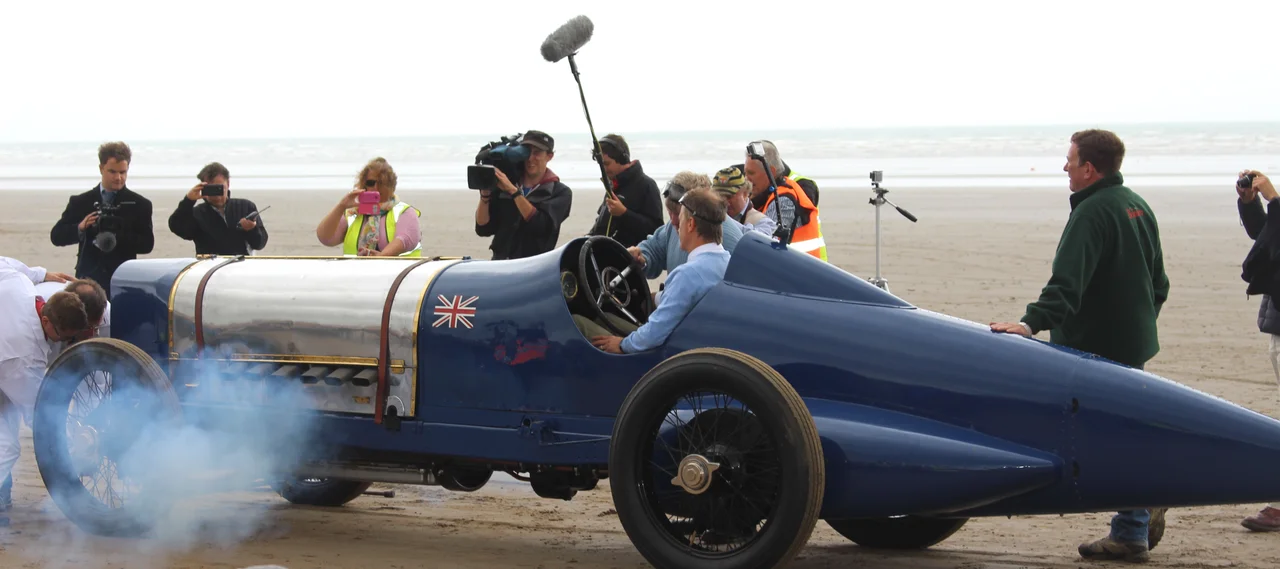

Pendine Sands
At low tide the beach reveals itself like an unrolled scroll, seven miles of sand so firm and so flat that, in the right light, you can see the curve of the earth bending away toward Gilman Point. Motor Cycle magazine called Pendine 'the finest natural speedway imaginable,' and in the 1920s the men who hunted the land speed record agreed. They came here because the public roads of Britain had run out of room for their ambitions, and the broad shelf of Carmarthen Bay offered something no racetrack could match: a measured mile straight enough to swallow 170 miles per hour, with sand soft enough at the edges to forgive a mistake. Most of the time, anyway.
The Finest Natural Speedway
Pendine had been hosting motorcycle races since the early 1900s, and from 1922 the annual Welsh TT brought riders to the bay. By the middle of the decade, the beach had become something stranger: the temporary capital of an arms race fought in tenths of a mile per hour. Malcolm Campbell arrived first. On 25 September 1924, he opened the throttle of his aero-engined Sunbeam 350HP, a car he had already named Blue Bird, and pushed the world land speed record to 146.16 mph. Over the next three years, five record-breaking runs were made on this sand. Campbell came back twice. A Welshman from nearby Wrexham, John Godfrey Parry-Thomas, came back twice as well. The needle on the world record climbed past 150, past 170, past 174 mph. Each man understood that the next push might be the last.
Babs and the Last Run
Parry-Thomas was an engineer first and a driver second, a Cambridge-trained inventor who had bought a derelict Higham Special from the estate of the late Count Louis Zborowski and rebuilt it himself. He renamed the car Babs. In April 1926 he drove her to 171.02 mph, the fastest a wheeled vehicle had ever travelled on land. Campbell took the title back in February 1927. On 3 March, Parry-Thomas brought Babs back to Pendine to try again. Travelling at around 170 mph on his final run, the car lost control, rolled, and slid for hundreds of yards. He did not survive. He was the first driver killed in pursuit of the land speed record. For decades the popular story held that Babs's exposed drive chain had snapped and struck him; later examination of the car cast doubt on that theory, and the truth of those final seconds may never be fully known. What is certain is that a careful man, a brilliant engineer, died trying to do something the rest of the world only watched.
The Long Quiet
After Parry-Thomas died, Babs was buried in the dunes near where she had rolled, at his family's request. The sand kept her for forty-two years. In 1969 a Welsh engineering lecturer named Owen Wyn Owen, who had carried the story with him since boyhood, won permission to dig her up. He recovered the car piece by piece, took her home, and spent fifteen years restoring her. Babs runs again now, and is sometimes brought out to Pendine for the anniversaries. In June 2000 Donald Wales, Campbell's grandson, set a UK electric land speed record here in Blue Bird Electric 2. In 2015, on the 90th anniversary of his grandfather's first record, Wales drove the restored Sunbeam down the same beach. The same year the actor Idris Elba took a Bentley Continental GT Speed to 180.361 mph along the strand, breaking the historic 'flying mile' mark Campbell himself had set.
Sand, Shells, and Live Ordnance
The Ministry of Defence acquired Pendine during the Second World War as a firing range, and they have never given it back. Signs along the dunes warn of unexploded munitions. Weekdays, part of the beach closes when the range is hot; you can sometimes hear the distant thud of testing carry across the bay. Between 2004 and 2010 the MOD banned vehicles from the sands altogether on safety grounds, then relented. The Pendine Land Speed Racing Club returned in 2013. So did the Vintage Hot Rod Association, with eighty pre-1949 cars timed flat out along the strand. In 2018 a Guernsey businessman named Zef Eisenberg pushed a supercharged Suzuki Hayabusa to 201.5 mph, the first time anyone had broken 200 mph at Pendine. The following year he took a modified Porsche 911 to 210.332 mph. Aardman Animations once turned the whole beach into a stop-motion film set, photographed on a Nokia N8 from a cherry picker, and called the result 'Gulp.' Pendine still attracts people who want to do something on this sand that cannot be done anywhere else.
What the Tide Knows
Walk the beach at dawn, when the tide has just turned and the sand is still mirror-smooth, and Pendine is one of the quietest places on the Welsh coast. Gulls. A few dog walkers near the village. The faint outline of Worm's Head on the eastern horizon when visibility holds. It is almost impossible to picture Campbell's Blue Bird tearing past at three miles a minute, or the long furrow Babs cut on her final run. The MOD owns the range, but the sea owns the surface, and twice a day it erases everything. Whatever was written here yesterday, in tire tracks or grief or triumph, is gone by morning.
From the Air
Pendine Sands sits at 51.7325°N, 4.4975°W on the north shore of Carmarthen Bay in southwest Wales. The seven-mile strand runs roughly east-west between Gilman Point and Laugharne Sands, with the village of Pendine at the western end. From cruising altitude in clear weather the broad pale crescent of the beach stands out sharply against the dark estuary mud and the green Carmarthenshire hills behind. Nearest civil airfields are Pembrey (EGFP) about 12 nm to the east on the same coastline, Swansea (EGFH) roughly 25 nm east, and Haverfordwest (EGFE) about 25 nm west. The MOD firing range is active most weekdays; check NOTAMs before any low-level transit of the bay.
Nearby Stories
- Teifi Valley Railway 1.2 km away
- Haverfordwest 5.1 km away
- Mumbles Lifeboat Disaster 8.1 km away
- Neath and Tennant Canal 12 km away
- Strata Florida Abbey 27 km away
- HMS H47 31 km away
- Ilfracombe Lifeboat Station 38 km away
- HMHS Glenart Castle 44 km away