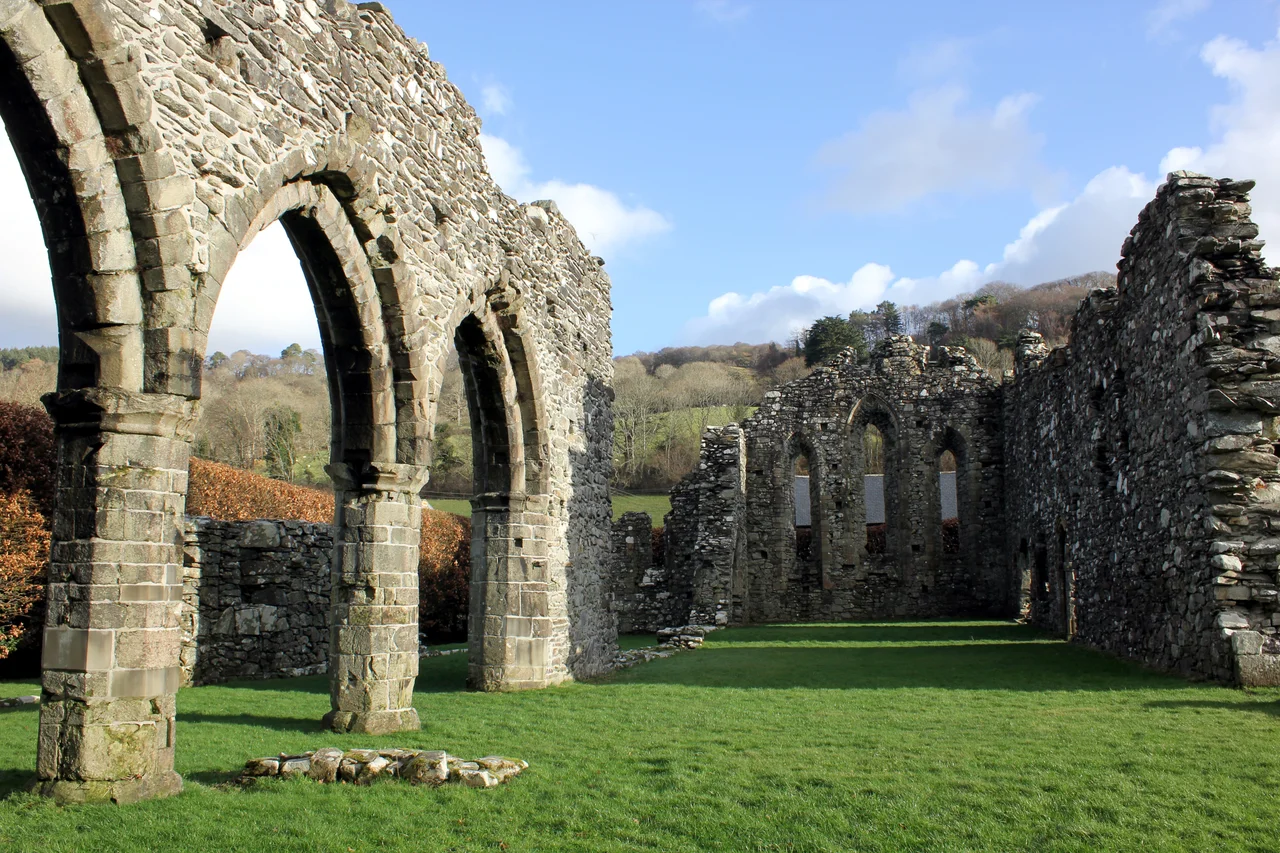

Cymer Abbey
When the Tudor commissioners arrived in March 1537 to dissolve Cymer Abbey, the monks took their finest treasure - a silver-gilt chalice and paten, made in the 13th century when the abbey was new - and buried it. They hid it under a stone at a place called Cwm-y-mynach, the monk's valley, in the hills above Dolgellau. They were not coming back. England's break with Rome was final, the monasteries were being dissolved across the kingdom, and the small community at Cymer was about to be scattered. Someone meant to retrieve the chalice when the storm passed. Nobody did. It lay under that stone for 361 years until somebody found it again in 1898. It is in the National Museum of Wales in Cardiff now. The abbey it came from is in ruins on the bank of the Mawddach, and very few people who pass it know that the meeting of the waters once raised warhorses for the last Welsh prince.
Meeting of the Waters
Kymer deu dyfyr, the meeting of the waters: that was Cymer's full Welsh title. The abbey was sited just above the confluence of the River Wnion with the River Mawddach, at the lowest ford across the Mawddach, in a fold of country between Dolgellau and Llanelltyd in what was then Merionethshire. A Cistercian community was founded here in 1189 under the patronage of Maredudd ap Cynan ab Owain Gwynedd, Lord of Merioneth, and his brother Gruffudd, prince of North Wales. Both were grandsons of Owain Gwynedd, the great 12th-century Welsh prince. The new house was a daughter foundation of Abbeycwmhir in Powys, dedicated to the Virgin Mary, and it followed the standard Cistercian pattern: white-robed monks, manual labour, sheep, isolation from worldly affairs.
Horses for Llywelyn
Like other Welsh Cistercian houses, Cymer farmed sheep on the surrounding mountains and bred horses on its lower meadows. The horses mattered. In the early 13th century the abbey was supplying mounts to Llywelyn the Great, the Welsh prince who would marry King John's daughter Joan and dominate Welsh politics for a generation. Llywelyn gave Cymer mining rights in 1209 in return. The abbey land was largely mountainous and difficult to farm. Its annual income in 1291 was only twenty-eight pounds, eight shillings, and threepence - small for a Cistercian house. Cymer never built the central tower that was the standard sign of a prosperous Cistercian abbey. There was simply never enough money. Then in 1275 and 1279 the abbey served as a base for the troops of Llywelyn ap Gruffudd, the last native Prince of Wales, in his wars against Edward I. In 1283, after Edward had finally broken Welsh resistance, the king occupied Cymer himself. A year later he paid the abbey eighty pounds in compensation for war damage, an unusually graceful gesture from a conquering king.
Five Monks and a Dissolution
By 1388 only five monks remained at Cymer. The records suggest a decline in observance, though what that meant in practice is hard to say at this distance. The Welsh climate was getting colder in the 14th century, the abbey's high pastures were marginal, and recruitment was difficult. When the Tudor survey of 1535 valued the house at just over fifty-one pounds a year, it was small enough to be swept up in the first wave of dissolutions of the smaller monasteries. The end came in March 1537. The monks dispersed. The lead was stripped from the roof. Local builders carried away the dressed sandstone over the years that followed, and the buildings reverted to rubble. The abbot's house survived, much remodelled, as a farmhouse - it still stands beside the abbey ruins today. The plain walls of the church remain to about nave-arch height. There were never any transepts; the choir and presbytery were tucked into the eastern end of the nave, an unusually simple Cistercian plan that reflected the abbey's poverty as much as its piety.
The Chalice Returns
What survives above ground is not much: a roofless nave with its arches, a stub of west tower, the foundations of cloister and chapter house to the south, and the converted abbot's house with its slate roof and white-washed walls. The remains are in the care of Cadw, the Welsh historic monuments body, and open to visitors most days. What survives below ground turned out to be more remarkable. In 1898, somewhere in the hills of Cwm-y-mynach, the chalice and paten the monks had buried in 1537 were rediscovered. The chalice is silver-gilt, exquisitely worked, with engraved decoration around the foot, a 13th-century piece of Welsh ecclesiastical metalwork of the very highest quality. It now sits in a case at the National Museum of Wales in Cardiff. Stand among the ruins on the bank of the Mawddach today and the great valley spreads west toward Cardigan Bay, the Cambrian peaks rise to the south, and somewhere in the hills above is the stone under which a sacred vessel waited out the Reformation and most of the British Empire before anyone found it again.
From the Air
Cymer Abbey lies at 52.76 degrees N, 3.90 degrees W on the banks of the River Mawddach just north of Llanelltyd village and 1 nm north of Dolgellau in Snowdonia. The ruins sit at roughly 50 ft elevation in the river valley with the Cadair Idris massif rising sharply to the south and the Mawddach estuary opening to the west. Best viewed at 1,000-2,000 ft AGL. The site is small - look for the ruined nave with adjoining converted farmhouse beside the river. Caernarfon (EGCK) is the nearest major airfield, about 25 nm north. Welshpool (EGCW) lies to the east, Aberporth (EGFA) to the south on the coast.
Nearby Stories
- Llanberis Pass 0.8 km away
- Aberdyfi 1.6 km away
- Plas yn Rhiw 3.3 km away
- HMS H5 8.7 km away
- Denbigh Castle and Town Walls 12 km away
- Cambrian Mountains 16 km away
- Battle of Maes Moydog 23 km away
- HMS Whirlwind (R87) 32 km away