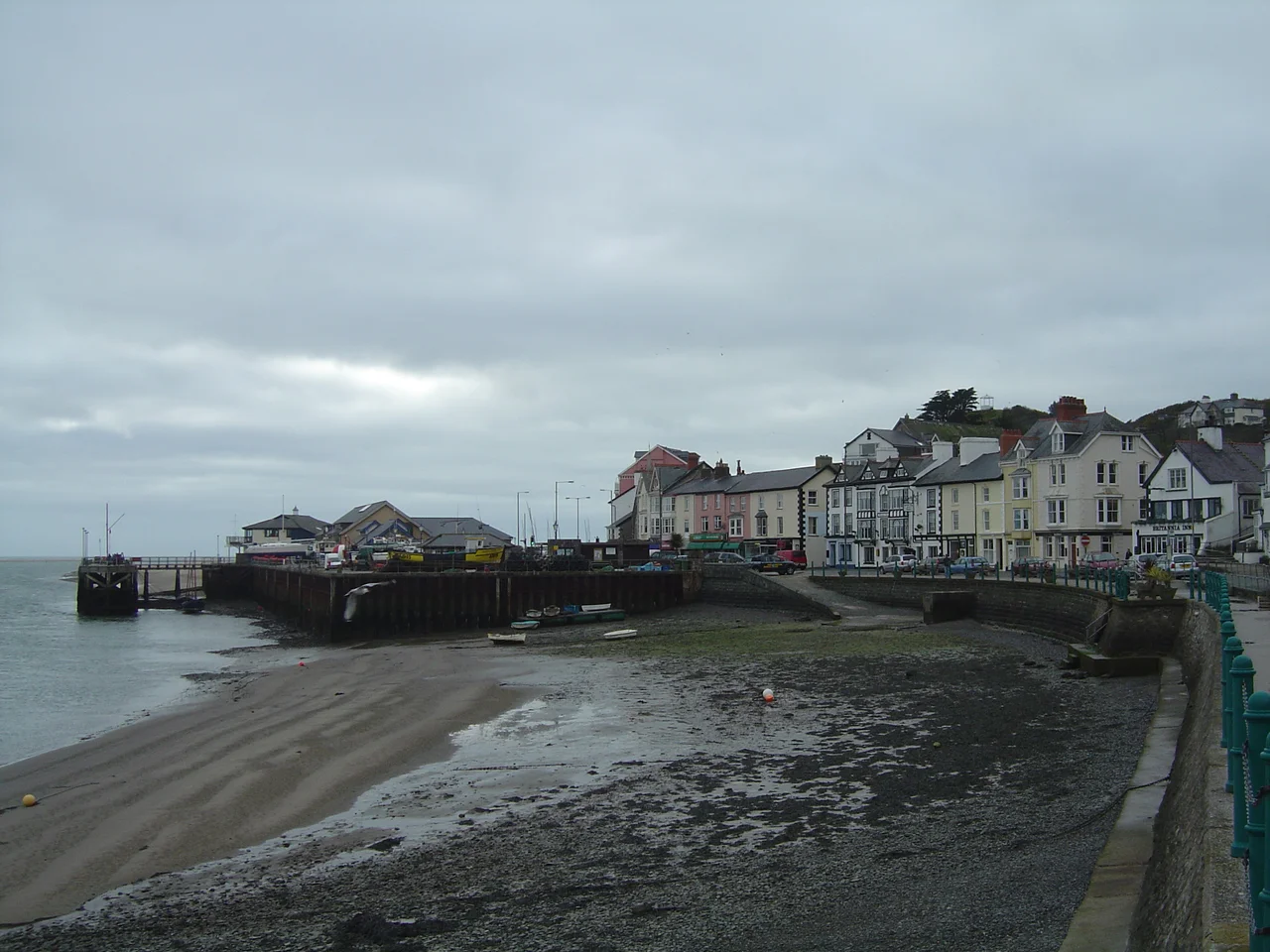

Aberdyfi
Listen carefully, the song says, and you can hear the bells of the drowned cantref ringing under the waves. Cantre'r Gwaelod, the Welsh legend goes, was a fertile lowland that lay where Cardigan Bay is now — sixteen cities, protected by sea walls and sluice gates, lost when a careless gatekeeper failed to close the gates against a storm. The bells of Aberdovey, says the song, can still be heard at low tide on the beach at Aberdyfi. The song is not actually a folk-song. Charles Dibdin wrote it for an English opera in 1785. But it is now so embedded in Welsh life that John Ceiriog Hughes added Welsh words in the nineteenth century, and in 1936 the church above the village had a chime of ten bells tuned in A flat installed specifically so that they could play it. The bells in St Peter's tower ring the tune over the harbour. The bells of Cantre'r Gwaelod ring, supposedly, in the bay.
Shipyards in the River
Founded by shipbuilding, the article says, and so it was. In the nineteenth century Aberdyfi was at the peak of its life as a port — slate and oak bark were the major exports, livestock from Ireland the main import, and the seven shipyards in Penhelig at the eastern end of the village turned out 45 sailing ships between 1840 and 1880. A jetty went in in 1887, with railway sidings connecting it directly to the wharves and the main line. The Aberdyfi & Waterford Steamship Company plied a regular service to Ireland. Local men sailed out of Liverpool on voyages that ran around the world; one of the last working ships in the Liverpool–Aberdyfi trade was scuttled with no loss of life by a German submarine in 1917. The shipyards are gone, the inns are still there — the Dovey Hotel, the Britannia, the Penhelig Arms, all of them eighteenth-century or earlier. Copper was mined in what is now Copperhill Street; lead was mined in Penhelig. None of those workings are still active. The village, surrounded by steep green hills and sheep farms, lives now as a seaside resort, with 43.3% of its houses serving as holiday homes.
Outward Bound
In 1941, in the middle of the Second World War, the educationalist Kurt Hahn and the shipping line owner Lawrence Holt founded the first Outward Bound Sea School in Aberdyfi. The school was a response to a problem the Merchant Navy had identified: young sailors with full training were dying in lifeboats during the Battle of the Atlantic at rates older sailors with less formal training did not. Hahn, a German émigré who had founded Gordonstoun in Scotland, believed the difference was character — that young people needed to be put deliberately under physical and emotional challenge in order to learn what they could endure. The Aberdyfi school taught sailing, hill-walking, rescue, expedition. Outward Bound, the international movement, is descended from it. The sea-shanty singer and musician Stan Hugill (1906–1992) worked at the Aberdyfi Outward Bound centre from 1950 to 1975, and lived in the village; if you have ever heard a recording of an authentic English sea-shanty, the chances are it came through Stan Hugill's voice.
The Quietly Famous Residents
Aberdyfi has a remarkable number of well-known residents past and present for a village of fewer than nine hundred people. James Atkin, Lord Atkin of Aberdovey (1867–1944), gave the leading judgement in Donoghue v Stevenson (1932) — the snail-in-the-bottle case — that founded the modern law of negligence in the United Kingdom. John T. Houghton (1931–2020), the climatologist who co-chaired the Intergovernmental Panel on Climate Change in its formative years, lived here. Simon Jenkins, the journalist, editor of the Times, and former chairman of the National Trust, has a house in the village. Kenneth O. Morgan, the great historian of Wales and Baron Morgan of Aberdyfi, lives here. And then there is the Led Zeppelin connection. Jimmy Page and Robert Plant retreated in May 1970 to Bron-Yr-Aur, a small cottage a few miles up the Dyfi valley with no running water and no electricity, where they wrote much of what became Led Zeppelin III and elements of subsequent albums. The cottage is private; the song 'Bron-Y-Aur Stomp' carries its name, slightly misspelled, into rock history.
Princes and Spanish Sailors
Aberdyfi sits on the boundary between the old kingdoms of Gwynedd in the north and Deheubarth in the south, and that made it a natural meeting place. Welsh princes held conferences here in 540, 1140, and most famously in 1216 — the Council of Aberdyfi, called by Llywelyn the Great, at which the rulers of the smaller Welsh kingdoms acknowledged him as overlord and effectively created a single Welsh political authority for the first time. In 1597, during the third Spanish Armada, a Spanish ship called the Bear of Amsterdam missed her objective at Milford Haven and was driven into the Dyfi estuary by the wind. She sat there for ten days, unable to leave because of the weather and unable to be boarded because there were no suitable boats. Eventually she sailed back out and went home. The hill in the centre of the village, Pen-y-Bryn, is said to have held a fortification in the 1150s that was soon destroyed; that may be the truth, or it may be one of those convenient bits of folklore that small Welsh hills attract. Either way, the village now grows up around the hill, climbing the steep slopes towards the sheep farms behind.
Lifeboat, Beach, Golf
The first Aberdyfi lifeboat was bought by local subscription in 1837. The Royal National Lifeboat Institution took the station over in 1853. The current boat is an Atlantic 75, launched on a tractor from the boathouse beside the jetty, averaging about 25 emergency launches a year — a high count for a village of this size, partly because the estuary draws windsurfers, kitesurfers, and sailors in numbers that exceed local boatcraft, and partly because the bar at the mouth of the Dyfi can be treacherous. The Aberdovey Golf Club, founded in 1892, is one of the best-loved links courses in Britain — Bernard Darwin, the great golf writer and grandson of Charles Darwin, was a long-standing member and wrote about the course so lyrically that he made it famous well beyond Wales. In 1895 it hosted the first Welsh Golfing Union Championship. Ian Woosnam and Peter Baker are among its modern members. Down on the seafront, the bronze Time and Tide Bell installed in 2011 under the pier rings when the tide is high, a sculptural homage to the song that has linked this village to the bells of Cantre'r Gwaelod for two and a half centuries.
Flight Context
Aberdyfi sits at 52.544°N, 4.044°W, on the northern shore of the Dyfi estuary at the southwestern corner of Gwynedd. The village climbs steep green hills directly from the seafront, with the Snowdonia National Park immediately behind. From the air the defining feature is the estuary itself — wide tidal sand flats stretching inland past Aberdyfi to Pennal, with the Ynyslas Sand Dunes National Nature Reserve on the south shore opposite. The Aberystwyth coast is 15 km south across the bay. Caernarfon Airport (ICAO EGCK, no IFR) lies 70 km north; Welshpool (EGCW) lies 60 km east; the nearest larger airfield is RAF Valley (EGOV) 80 km northwest. Low-altitude transits along the coast (1,500–3,000 ft AGL) give the best view of the estuary, the village, and the rapidly rising mountain country behind.
From the Air
Coordinates 52.544°N, 4.044°W (Aberdyfi village, northern shore of the Dyfi estuary, southwestern Gwynedd). Recommended viewing altitude 1,500–3,000 ft AGL for the best view of the estuary and village. Nearest active airfield Caernarfon (EGCK) 70 km north; RAF Valley (EGOV) 80 km northwest. Visible landmarks: the wide tidal sand flats of the Dyfi estuary, the Ynyslas Sand Dunes opposite, the village climbing the steep north shore, and the Snowdonia mountains immediately behind to the north.
Nearby Stories
- Cambrian Mountains 6.1 km away
- Battle of Orewin Bridge 7.1 km away
- Church of the Holy Cross, Mwnt 9.1 km away
- Cymer Abbey 10 km away
- Plas yn Rhiw 10 km away
- Talgarreg 19 km away
- HMS Whirlwind (R87) 23 km away
- Battle of Oswestry 34 km away