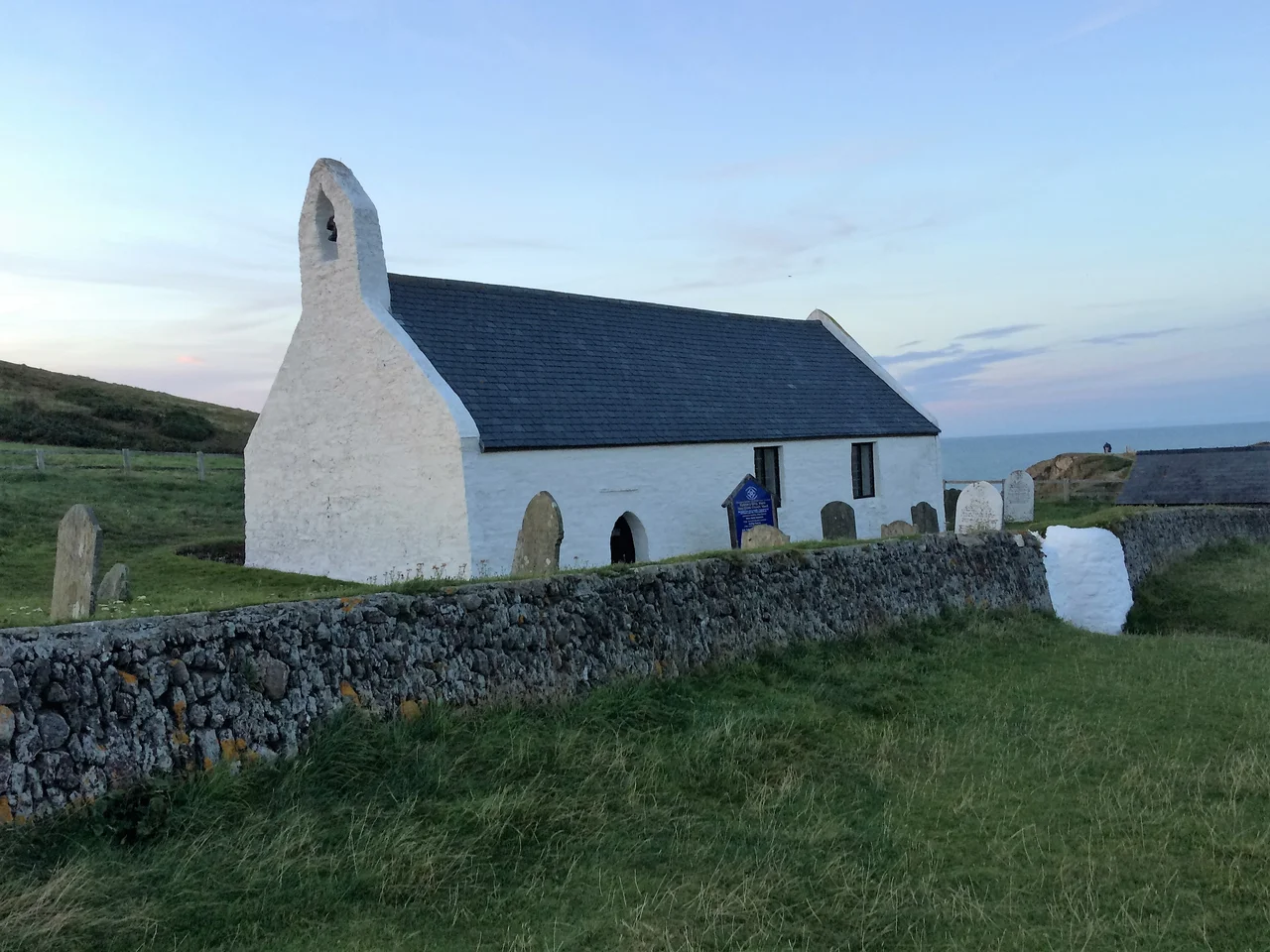

Church of the Holy Cross, Mwnt
It is one of the smallest Grade I listed buildings in Wales — a whitewashed rectangle of rubble walls under a slate roof, perched on the cliff above the cove at Mwnt with the long Atlantic emptying out to the west. There is no village around it. There is no road that leads to it as a destination. Pilgrims and sailors and fishermen knew the place for centuries. Tourists discover it in summer and stop their cars on the lane above and walk down the grass slope, and the wind hits them, and the building looks like nothing so much as a small white animal crouched against the gale.
Sailors' Chapel
The Church of the Holy Cross is what medieval Welsh historians call a chapel of ease — a small church built for those who could not easily reach a parish church, in this case the parish of Llangoedmor inland. Mwnt's chapel served the fishermen who worked Cardigan Bay and the coastal travellers who passed along this exposed shore. It was also a waypoint on the pilgrim route to St Davids, the great Welsh shrine on the south-western tip of Pembrokeshire. The site is said to have been used since the Age of the Saints — the 5th and 6th centuries, when missionaries from Ireland and the Celtic west established small religious sites all along this coast. The present building dates probably from the 13th century, though the tradition of worship here is much older.
The Preseli Font
Inside, the most striking object is the 12th- or 13th-century baptismal font, carved from Preseli stone — the same bluestone that was hauled, somehow, two hundred and forty miles east in the Neolithic period to form the inner ring of Stonehenge. The Preseli Hills rise just to the south of Mwnt; the font's stone came from quarries that are still visible on those hills. A child baptised at Mwnt was being dipped in water that sat in rock geologically older than human civilisation. The hexagonal pulpit is later — Victorian, when the church was restored in 1853. Storm damage in 1917 prompted a second restoration. A 1912 photograph shows the south windows in slightly different positions than the present arrangement, a small reminder that even the apparently changeless changes.
December 2021
Then in December 2021 came something the small white church had probably not seen in seven hundred years: deliberate vandalism. Windows were broken; the interior was damaged; the local community was, in the word the newspapers used, devastated. What happened next surprised even the people who started it. An online appeal aimed to raise twenty thousand pounds for repairs. Within days, donations had flooded in from across the British Isles and beyond — visitors who had been to Mwnt on holiday, descendants of local families now scattered across the world, strangers who simply could not bear the idea of the cove without its church. The target was hit. The repairs were done. The church reopened, the windows mended, the walls whitewashed again.
Interior of Whitewash
What survives inside is a single chamber with deep-set windows that throw warm rectangles of light across slate floors. The walls are plastered, the roof is an unusual type that small Welsh chapels often have — a low-pitched timber structure that seems too modest for the listing grade. The hexagonal Victorian pulpit sits beside a font from the Welsh middle ages. The contrast is the point: this is a place that has been continuously useful for hundreds of years by being small, plain, and exactly the right size for the people who needed it. Monumental inscriptions from the small churchyard outside are held by Dyfed Family History Society, and they tell their own quiet story of fishermen, farmers, women who lived through both world wars, and children who did not.
The Walk to the Door
From the National Trust car park on the lane above, the path drops down through grass towards the church and on to the beach. Foel y Mwnt, the conical hill that gives the place its name, rises behind. The Wales Coast Path runs through; walkers come around the headland with the wind in their faces and see the white church first, almost lost against the grey of the sea below, and then the cove, and then the long northward sweep of Cardigan Bay towards Aberystwyth. Dolphins surface in the bay in summer, sometimes within sight of the church door. A pilgrim from the 14th century would understand entirely what is happening here. The walk has not changed. The view has not changed. The whitewash has been redone a few hundred times. But the church is the church, and the path is the path.
From the Air
The Church of the Holy Cross at Mwnt sits at 52.14 degrees north, 4.64 degrees west, on the Ceredigion coast about 4.5 miles north of Cardigan. From the air the church is a tiny white rectangle on the green cliff top, almost lost in the landscape until you spot the distinctive conical hill of Foel y Mwnt (76 m / 249 ft) rising immediately behind. Traeth-y-Mwnt beach lies just below the cliff to the west. The National Trust car park on the inland side is a useful reference. Best viewed at 1,000-1,500 feet AGL on a coastal pass. Nearest airfield is Haverfordwest (EGFE), about 25 nm south; Aberporth lies 5 nm east-northeast. Cardigan Bay weather can shift quickly.
Nearby Stories
- HMS H47 4.6 km away
- National Botanic Garden of Wales 5 km away
- Narberth 6.3 km away
- Aberystwyth Lifeboat Station 9.3 km away
- Skomer 13 km away
- Diamond (1823 ship) 21 km away
- Talley Abbey 22 km away
- HMS Tyler 32 km away