
National Botanic Garden of Wales
When fire took Middleton Hall in 1931, it took everything. The walls were left standing, blackened, with globules of molten lead from the melted roof clinging to them - tiny silver beads where the gutters and the flashings and the cisterns had run down the stonework while everything burned. The mansion had been the masterpiece of Samuel Pepys Cockerell, designed and built between 1793 and 1795 for Sir William Paxton, a man who had bought the estate for £40,000 specifically so he could turn it into a water park. Twenty years after the fire, the walls came down. The land became a place where young farmers tried out their careers. And then in 2000, on the same footprint, the largest single-span glasshouse in the world opened to the public.
William Paxton's Water Park
Paxton was rich in the way some Georgian gentlemen were rich - large hands, large schemes, money enough to think on the scale of a small landscape. The Middletons had built a mansion at Llanarthney in the early seventeenth century. In 1789 Paxton bought the whole estate. He turned the old hall into a farm, hired Cockerell to design him a new one, and set about engineering water. Spring water was stored in elevated reservoirs that fed a lead cistern on the mansion's roof, so the household could enjoy piped running water - and water closets, the absolute latest in domestic luxury. Around the park, water ran through dams, sluices, bridges, and cascades, threading interconnecting lakes and ponds. In 1806 Paxton commissioned Cockerell again, this time to design a Neo-Gothic folly on a hilltop nearby, in honour of Lord Nelson. It was completed in 1809. Paxton's Tower still stands today, now in the care of the National Trust, visible from the garden across miles of the Tywi valley.
The Inheritors
Paxton died in 1824. The estate by then ran to 2,650 acres. It was sold to Edward Hamlin Adams, a West India merchant born in Jamaica, for £54,700. Adams cared nothing for the water park and let the bath houses fall into disrepair. In 1842 the estate passed to his eccentric son, also Edward, who immediately Welshified his surname to Abadam. By the testimony of his own estate manager he was a difficult man, indifferent to country pursuits and uncongenial company. But his youngest daughter Alice grew into a leading suffragist - a Welsh woman of conviction who campaigned for the vote and is now honoured by a blue plaque, unveiled in 2018 in the gardens of what had been her childhood home. The estate passed through hands twice more, to the Hughes family and then to a Colonel Jones, before the 1931 fire ended its career as a country house.
The Glasshouse on the Foundations
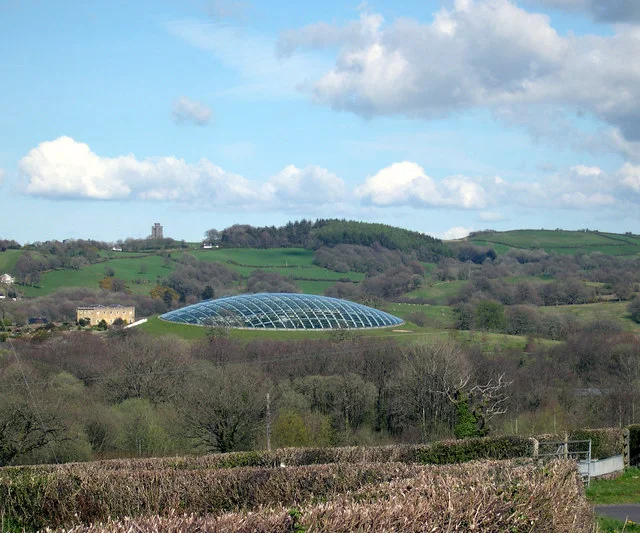
In 1978 some local walkers, picking through the ruined estate, decided to try and revive it. The little fundraising they managed led to the rediscovery of several lost features - the cascades, fragments of Paxton's water network, the line of the great view east toward the folly. The decisive moment came when the UK Millennium Fund agreed to help underwrite a national botanic garden on the site. The centrepiece - constructed virtually on the foundations of Cockerell's vanished mansion - would be a glasshouse designed by Foster and Partners. It opened with the garden on 24 May 2000. The building is an ellipse 110 metres long and 60 metres wide, its roof curving in a single elegant sweep. There are no internal supports. 785 panes of glass form the skin. Inside, plants from the world's six Mediterranean climate regions - Chile, Western Australia, South Africa, California, the Canary Islands, and the Mediterranean basin itself - grow in zones that share a climate but not a continent.
Trouble, Survival, the Steady State
Charles, Prince of Wales, officially opened the garden on 21 July 2000. By 2003 it was in serious financial trouble - botanical gardens are expensive to run, and visitor income alone rarely covers the bills. In 2004 a rescue package from the Welsh Assembly Government, Carmarthenshire County Council, and the Millennium Commission stabilised it. Since then the garden has steadily found its footing. A tropical glasshouse designed by Welsh architect John Belle opened in 2007, extending the botanical classification displays. In 2015 a large collection of Welsh apple varieties was planted, with a Welsh pomona - an annotated survey of the varieties - in preparation. By 2019 the garden was drawing 160,000 visitors a year, with three quarters of its income self-generated. The 568-acre site now includes the Waun Las national nature reserve, 150 hectares of wildflower meadows and pastures grazed in the old way. Among the garden's rare plants is the whitebeam Sorbus leyana, a critically endangered tree found only in a few South Wales locations.
From the Air
Fly into the Tywi valley from the south and the glasshouse appears as a low, gleaming ellipse on the slope - a perfect glass dish set into the green of Carmarthenshire. To the south-east, on a steep hilltop about a mile and a half away, the silhouette of Paxton's Tower stands clear: three pointed turrets, the original Neo-Gothic eye-catcher for which the mansion's east front was designed. Between them, the restored water park threads the lower slopes - lakes, cascades, the ghost-lines of Paxton's hydraulic ambition. The garden makes more sense from a few thousand feet than it does from inside it. You see what Paxton saw: a landscape painting waiting to be inhabited, with an architectural folly at one end and the house at the other, and the trees doing the work between.
From the Air
Located at 51.838N, 4.152W in the lower Tywi valley near Llanarthney, Carmarthenshire. Nearest airports are Pembrey (closed, but visible) and Swansea (EGFH, about 22 nautical miles south-southeast); Cardiff (EGFF) is about 50 nautical miles east. Best viewed at 2,000-4,000 feet AGL on clear days, ideally from the south for the glasshouse-to-folly visual line. The Great Glasshouse is unmistakable as a low elliptical glass dome on a south-facing slope; Paxton's Tower stands prominently on a hilltop about 1.5 nautical miles south-east. The Tywi river meanders below in the valley floor.
Nearby Stories
- Manordeifi 2.3 km away
- Amroth Castle 6.8 km away
- Llandow Air Disaster 8.2 km away
- Pont-y-Cafnau 8.4 km away
- Battle of Orewin Bridge 14 km away
- Craig Gwrtheyrn 17 km away
- Mumbles Lifeboat Disaster 20 km away
- Lundy 38 km away