
Manordeifi
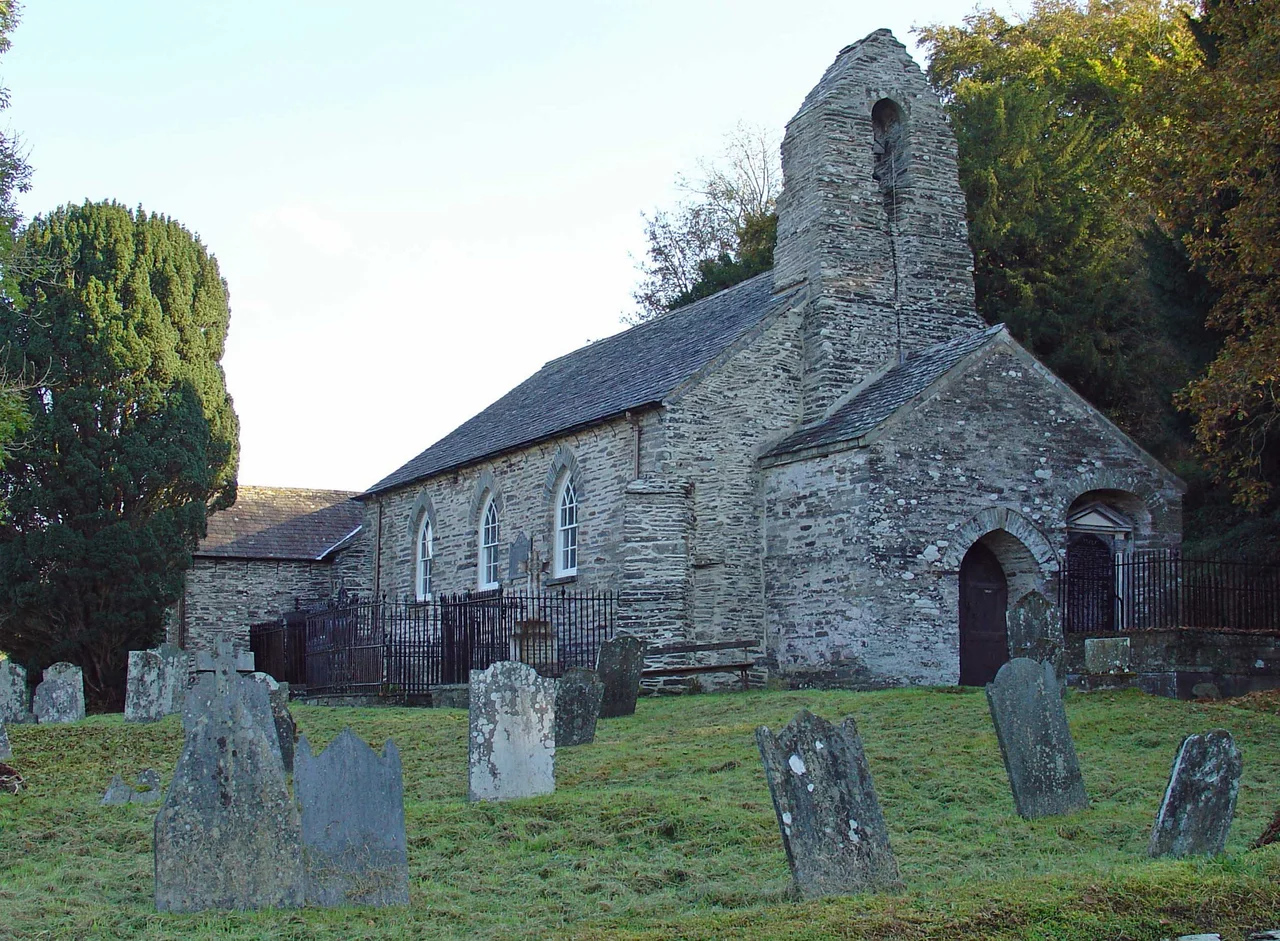
On the floor of the porch of an old church in Pembrokeshire hangs a coracle. It is not decorative. The 13th- and 14th-century church of Manordeifi sits on the edge of the River Teifi's floodplain, and when the water rose — as it has done for as long as anyone has lived here — the small leather-and-wicker boat was the parishioners' escape route. By the 19th century the floods had won. A new church was built up on the hill, and the old church on the riverbank was abandoned. The coracle is still in the porch.
Manerdve, 1578
Manordeifi is recorded as Manerdve on a 1578 parish map of Pembrokeshire — one of those names that has been worn into its modern shape by four hundred and fifty years of Welsh and English mouths. The parish lies in the hundred of Cilgerran, in the north-east corner of Pembrokeshire, with the River Teifi forming its northern boundary. In addition to the old village core, the parish includes the villages of Abercych and Newchapel and a scattering of farmsteads across rolling country. Forty-eight buildings and structures in the parish are listed, including the old church, the new church, and four substantial mansions. The population was 745 in 1801, climbed to 956 by mid-century, and has been falling steadily since — 402 by 1981. The percentage of Welsh speakers tracks the same arc downward: 87 per cent in 1891, 94 per cent in 1931, 74 per cent by 1971.
The Old Church
Manordeifi's old parish church, abandoned for active worship in the 19th century, sits in a quiet meadow beside the river. The Friends of Friendless Churches now care for it. Inside is a chamber little altered since the medieval period, with box pews, a wooden gallery, a font that is probably 12th century, and a tower base that may have served as a place of refuge during raids. The coracle hangs above the inner door. Why exactly the church was built here, on a known floodplain, is a question that returns naturally to anyone who visits — and the answer is probably simply that this was where the village was when the church was built. The river had less of a habit of flooding before upland deforestation made it a worse neighbour. The new parish church, built on the hill in the late 19th century, is dry and unremarkable. The old church, beautiful and damp, is what people drive miles to see.
Ffynone
Of the mansions in the parish, the most architecturally important is Ffynone, near Boncath. The estate had belonged to the Morgan family until Captain Stephen Colby bought it in 1752, and the country house at its centre was designed by John Nash — the same Nash who would later remake the centre of London under the patronage of the Prince Regent — and was completed in 1799. It is Grade I listed. In 1902 John Vaughan Colby's wife commissioned Inigo Thomas, an architect and one of the most important garden designers of his generation, to improve the house and lay out terraced gardens around it. John Vaughan died in 1919 leaving no sons, and the estate passed to his daughter Aline, who had married Captain Cecil John Herbert Spence-Jones, son of the Dean of Gloucester, in 1908. The marriage made the papers: a notable society wedding with no guests and no reception, owing to the bride's mother's poor health. Spence took the additional surname Colby by royal licence in 1920 and sold the estate seven years later.
The Lloyd Georges
Ffynone changed hands several times across the twentieth century and was bought, restored, and lived in from 1987 onwards by Owen Lloyd George, 3rd Earl Lloyd-George of Dwyfor — the grandson of David Lloyd George, the Welsh prime minister who led Britain out of the First World War. The house and its twenty acres of woodland remained in the Lloyd George family until 2021, when it was sold after the earl's death. Castell Malgwyn, another of the parish's mansions, sat on the south bank of the Teifi opposite Llechryd. Clynfyw and Pentre completed the four. For a small Pembrokeshire parish, the concentration of substantial country houses was unusual — a reflection of the land's quiet prosperity in the 18th and 19th centuries, when bankers, merchants, and naval officers were buying Welsh estates for the views and the shooting.
Old and New
Today Manordeifi is part of the Cilgerran electoral ward for the purposes of Pembrokeshire County Council elections, and has its own community council. The population is small. The old church beside the river is opened by volunteers and visited mostly by people who go out of their way to find it. The Teifi rises and falls with the seasons, sometimes spilling across the meadow and surrounding the church with brown water, the way it has always done. The coracle still hangs in the porch. Anyone who wonders why it is there will, sooner or later, witness the answer.
From the Air
Manordeifi lies at 52.05 degrees north, 4.58 degrees west, on the south bank of the River Teifi about 10 nm east of Cardigan in the north-east corner of Pembrokeshire. From the air the parish is rolling green farmland cut by the Teifi valley; the old parish church sits in an isolated meadow on the river's edge, while the village of Abercych lies just to the east. The mansion of Ffynone is hidden in woodland a mile south of the river. Best viewed at 1,500-2,500 feet AGL following the Teifi valley. Nearest airfield is Haverfordwest (EGFE), about 15 nm south. Surrounding country features no significant high terrain; sea fog from Cardigan Bay can reach this far inland on cool mornings.
Nearby Stories
- HMS H47 4.6 km away
- National Botanic Garden of Wales 5 km away
- Narberth 6.3 km away
- Aberystwyth Lifeboat Station 9.3 km away
- Skomer 13 km away
- Diamond (1823 ship) 21 km away
- Talley Abbey 22 km away
- HMS Tyler 32 km away