.jpg)
Amroth Castle
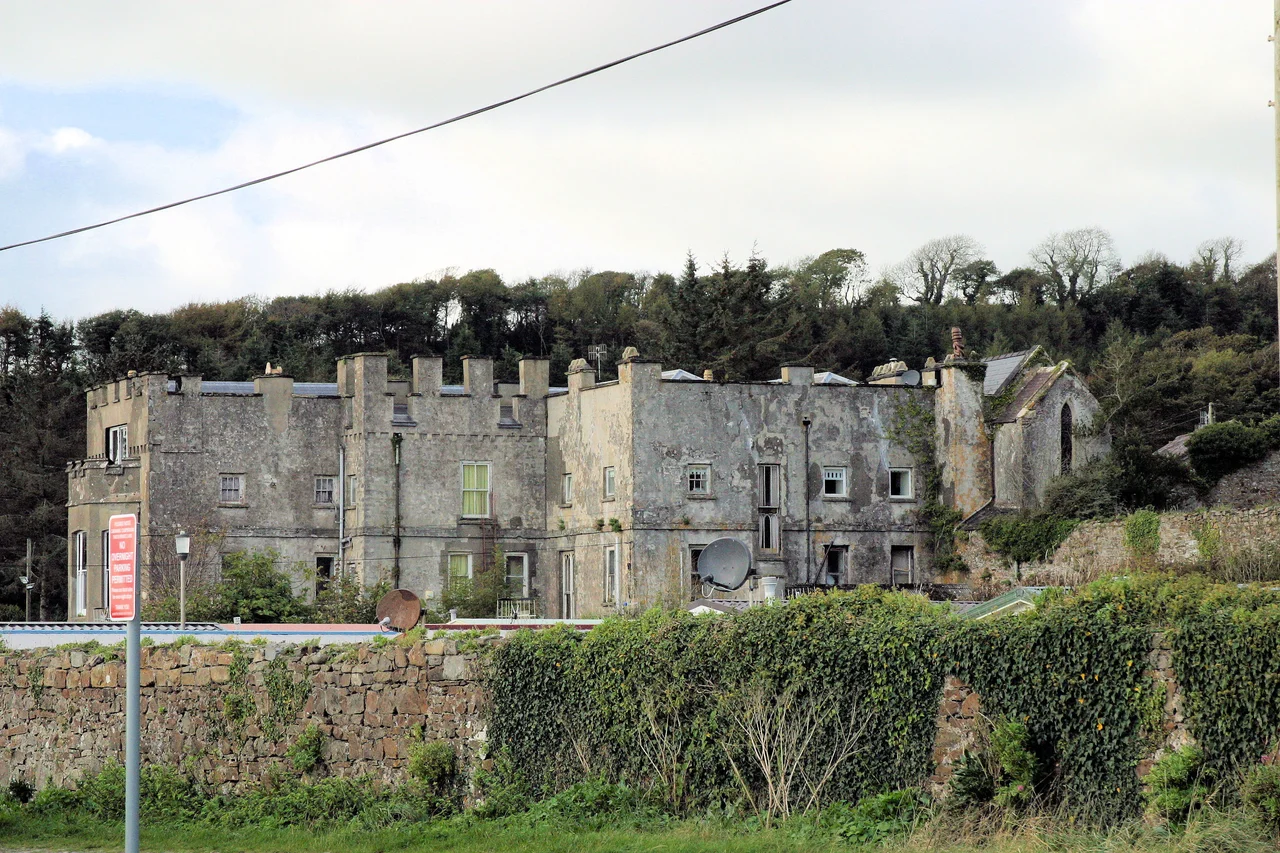
The man who owned this castle bought the White Star Line in 1927 - the same shipping company whose flagship had gone down with 1,500 souls fifteen years earlier. Owen Colby Philipps lived at Amroth Castle for twenty-two years before he took his Welsh peerage as Baron Kylsant of Carmarthen and Amroth, and his career ended not at sea but in a courtroom, convicted in 1931 of misleading shareholders. The castle above Carmarthen Bay, with its mock battlements and gatehouse facing the Pembrokeshire coast road, holds none of that drama in its stones. It looks, instead, like exactly what it is: a country house dressed as something older.
Castle by Suggestion
Amroth Castle is not really a castle. The present building is an 18th-century country house, extensively rebuilt in the 19th, designed in the style of a fortress that may have stood here once - a small stone castle from the 12th century, possibly, though even that is uncertain. The mock battlements and the much-restored gatehouse perform the idea of medieval defense without ever having had to provide it. Surrounding the building is a high wall with an entrance archway at the south-western corner. Some 15th-century elements survive within the structure, embedded in later masonry like fossils in sandstone. In 1690, the antiquary Richard Fenton noted, John Elliott of Eareweare - the local name for the estate - paid tax on five hearths. The records run thin before that. What remains is a building that has always wanted to look older than it is.
The Asylum Years
The story takes its strangest turn in the 1850s, when the castle served as a lunatic asylum. The phrase belongs to its era - the Victorian institutional vocabulary for places where families sent relatives whose minds were considered unmanageable. Conditions at such asylums varied wildly. Some were earnest reform projects; others were warehouses. We know little about who was kept here, or in what state. By the 1880s the castle had been converted back to a private house, and the asylum chapter was quietly closed. Colonel Ackland had acquired the property in 1790 and made alterations. The Fussell family held it in 1861. Each owner left their additions, their renovations, their bills - and the building absorbed them all, presenting the same castellated face to the coast road.
The Shipping Magnate
Owen Colby Philipps bought Amroth Castle in 1898 and lived there until 1920. He was, by any measure, an extraordinary figure - born in Pembrokeshire, he built a shipping empire through the Royal Mail Steam Packet Company and eventually acquired the White Star Line itself in 1927. The title Baron Kylsant of Carmarthen and Amroth was conferred in 1923. The fall came in 1931: convicted of misleading investors through an accounting prospectus that hid losses, Philipps served twelve months in prison. By then the castle was no longer his concern. It had passed to his daughter Nesta, who had married George Coventry, grandson of the 9th Earl of Coventry. The couple moved out in 1930 when George inherited the Coventry title and estates. After that, the castle became a farmhouse.
Holiday Park
Today the castle's ruinous remains are a Grade I listed building, but the grounds have taken on a different life. The estate now operates as a holiday park - caravans, family bookings, the Welsh coast within walking distance. The lawn that once received Edwardian shipping magnates now receives families with beach bags and dogs. The gatehouse still stands. The high wall still encloses. The mock battlements still try to look medieval, and from a certain angle, in a certain light, they almost succeed. Carmarthen Bay glints below. The Pembrokeshire Coast Path begins half a mile west, and the long sandy beach at Amroth stretches as it has for centuries - longer than the castle, older than any of its owners, indifferent to all of them.
From the Air
Amroth Castle sits at 51.73°N, 4.65°W on the north side of the coast road, half a mile east of Amroth village and five miles northeast of Tenby. Visible from low cruising altitudes (3,000-5,000 ft) as a small castellated structure with high enclosing wall, set against the curve of Carmarthen Bay. Nearest airports: Haverfordwest (EGFE) about 18 nm west, Swansea (EGFH) about 30 nm east, Pembrey (EGFP) about 20 nm east-southeast.
Nearby Stories
- St Andrew's Church, Bayvil 1.6 km away
- Skomer 3.7 km away
- National Botanic Garden of Wales 9 km away
- HMS H47 13 km away
- Mumbles Lifeboat Disaster 32 km away
- Strata Florida Abbey 38 km away
- Lighthouses on Lundy 38 km away
- Tehidy Country Park 140 km away