.jpg)
Battle of Oswestry
At two in the afternoon on 22 June 1644, the spies who had been watching Oswestry's walls reported that the Royalist governor had ridden out earlier that day with Parliamentary prisoners, heading for Shrewsbury. The garrison was thinner than usual. Lord Denbigh's Parliamentarians, who had been waiting nearby, moved at once. By the next morning the walled border town and its castle - the Royalist staging point that controlled communications between Wales, Chester and Shrewsbury - had changed sides. It was a short fight, smartly run, and it broke the Royalist hold on the Welsh Marches.
A Border Garrison
In February 1644, Prince Rupert had moved to Wales to take up the post of President of Wales for King Charles I. By May he was gone again, marching to Lancashire with most of his forces and leaving Colonel Edward Lloyd holding Oswestry with a small garrison. The town's strategic value was disproportionate to its size. It commanded the main route between Royalist Chester and Royalist Shrewsbury, sat on the English-Welsh border at a politically delicate position, and controlled Welsh recruiting for the king's army. Holding Oswestry meant holding the Marches. Losing it meant losing the line of communication between the two great Royalist strongholds of the region.
The Parliamentarian Plan
Lord Denbigh (Basil Feilding, 2nd Earl of Denbigh) commanded Parliament's forces in the West Midlands, working with Colonel Thomas Mytton, the local Parliamentarian commander. Their intelligence network in Oswestry was good enough to tell them when the garrison's strength was at its weakest. On 22 June, with Governor Lloyd absent escorting prisoners to Shrewsbury, they struck. The Parliamentarian cavalry was deployed in the rear of the attacking column - both to cover the retreat if needed and to intercept any relief force that might arrive from Shrewsbury. The foot were committed to the assault: two hundred infantry, advancing on a walled border town that should, on paper, have been hard to take quickly.
St Oswald's and the Gate
The attack opened with the seizure of St Oswald's church, which stood outside the town walls and had been fortified as an outwork. Once it fell, the Parliamentarians brought up cannon and concentrated their fire on the town's main gate. It collapsed under the bombardment. The defenders, outnumbered and outflanked, withdrew into Oswestry Castle itself. The Parliamentarians flooded the town. Through the rest of that afternoon and night, the garrison was hemmed in. By the following morning, 23 June, terms had been negotiated and the Royalists surrendered. Lord Denbigh wasted no time: he handed the town over to Colonel Mytton to garrison, and set off in pursuit of Prince Rupert, whose larger campaign was the real prize.
The Relief That Failed
The loss of Oswestry cut the Royalist supply line between Chester and Shrewsbury. Sir Fulke Huncke, the Royalist commander at Shrewsbury, felt obliged to try to retake the town. He marched out with 2,000 infantry and 600 cavalry - a serious force. Lord Denbigh, who had by then reached Cheshire, sent Sir Thomas Myddelton back with a body of cavalry to support Mytton at Oswestry. The two cavalry forces met on 2 July at Whittington, three miles east of Oswestry. The Royalists, commanded by Colonel Marrow, were routed. Without his cavalry, Huncke could not press the infantry attack against a garrisoned town. He turned back to Shrewsbury. Oswestry stayed in Parliamentarian hands.
The Walls Come Down
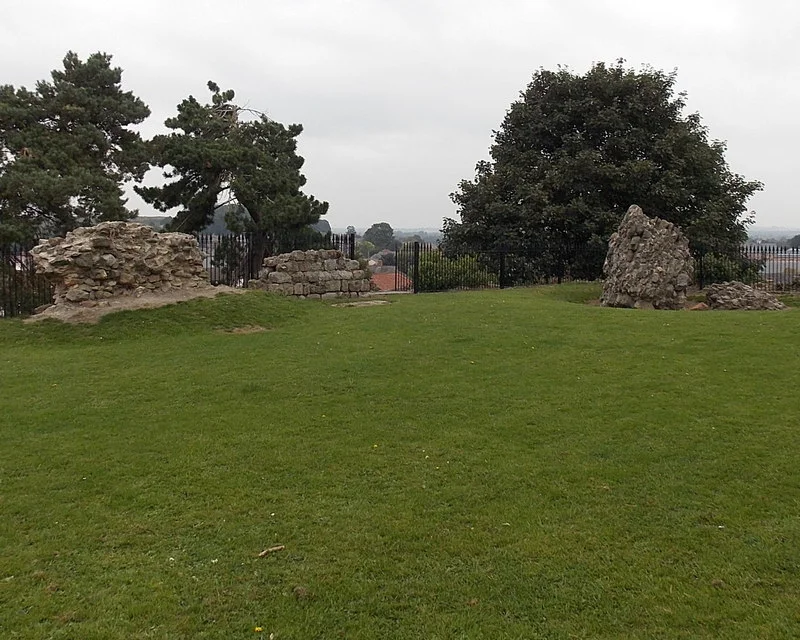
The Parliamentarians did not intend to hold Oswestry as a fortified town indefinitely. Walls were expensive to maintain and dangerous to leave standing if the war turned again - a Royalist counter-attack might find them as useful as their original builders had. The town's medieval walls were progressively pulled down, leaving only the Newgate Pillar standing today as a fragment of what had been a fortified medieval circuit. The castle itself was held a while longer, then 'slighted' - deliberately demolished to render it indefensible - and by 1650 it was a pile of rocks. What remains of Oswestry Castle today is the motte and a few stones. The town moved on; the church of St Oswald, which had been the opening prize on that June afternoon in 1644, still stands beside the modern town centre.
From the Air
The site of the battle is the town of Oswestry itself, at roughly 52.86 degrees north, 3.06 degrees west. From the air St Oswald's Church is a recognisable landmark, and the line of the medieval town - now without its walls - is still legible in the street pattern. Old Oswestry, the Iron Age hill fort on the northern edge of the town, is the dominant aerial feature in the area. Cruise at 2,500-4,000 feet for the best perspective. Shawbury (EGOS) lies about 18 nautical miles south-east. The Welsh border runs only a few miles west.
Nearby Stories
- Crewe Works 1.6 km away
- Dudmaston Hall 9 km away
- Battle of Blore Heath 10 km away
- King's School, Chester 11 km away
- Caratacus' last battle 15 km away
- Llanrwst 19 km away
- Battle of Mynydd Hyddgen 20 km away
- Ysbyty Ifan 26 km away