
King's School, Chester
Henry VIII dissolved the Benedictine abbey at Chester in 1540, scattered the monks, seized the lands, and then turned around and used the empty refectory as a school. The arrangement was practical. Boys still needed to learn Latin, the cathedral still needed choristers, and the old monastic dining hall had a fine vaulted ceiling and good light. The King's School operated in that refectory for four hundred years before moving to a new site on the Wrexham Road in 1960. Its motto was given by a Victorian Dean: Rex dedit, benedicat Deus. The King gave it, may God bless it.
The King's Schools
Henry VIII established or re-endowed seven King's Schools after the Dissolution of the Monasteries between 1541 and 1547, including Canterbury, Worcester, Gloucester, Peterborough, Ely, Rochester, and Chester. The pattern was the same in each case: a religious foundation attached to a cathedral or former abbey, with a brief to teach grammar to potential ordinands and provide choristers for the daily services. Chester's school was reconstituted in 1541 as a joint church-and-state enterprise. The statutes that constituted it also specified the training and education of choristers for Chester Cathedral, an arrangement that ran in parallel for several hundred years. The connection between the school and the cathedral choir was not severed; it was woven into the founding document.
Four Centuries in the Refectory
The boys came in through the cloister door each morning and worked at long tables in a hall built for monks. The setup was not romantic; it was functional. The refectory was warm, dry, large, and free, which mattered to a foundation that had to make Tudor revenue stretch. The school remained there until 1960, when it moved to its present site on Wrexham Road on the southwestern outskirts of Chester. The move ended four hundred years of continuous occupation, longer than the abbey had used the same building before the Dissolution. The Wrexham Road campus includes a sixth-form centre, the Wickson Library, the Vanbrugh Theatre, the Tim Turvey Music School, a swimming pool, sports pitches both grass and all-weather, and a boat house on the River Dee for the school rowing club.
The Rowing Club
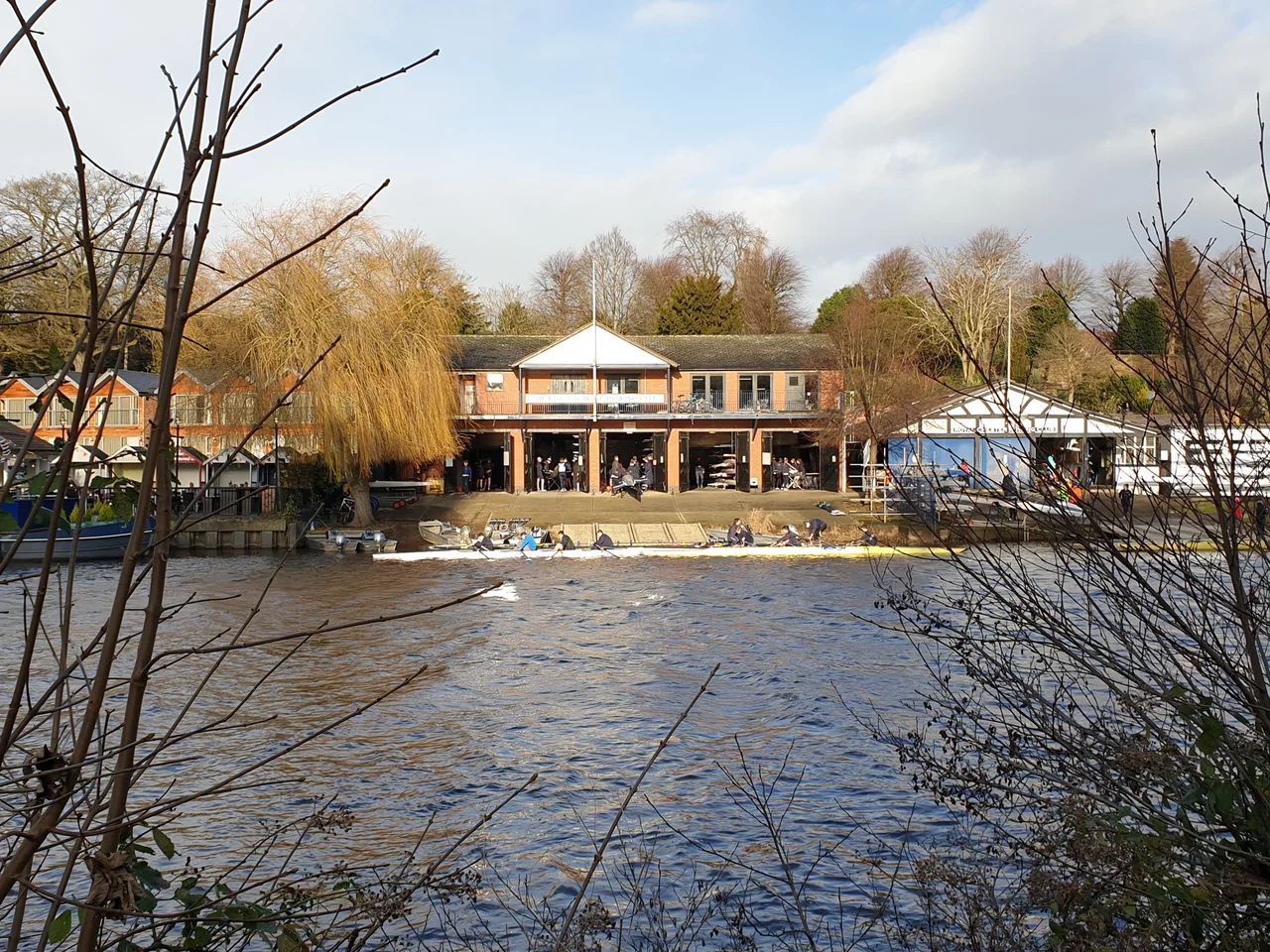
The King's School Rowing Club, founded in 1883, has been training rowers on the Dee in central Chester for more than a hundred and forty years. The numbers tell their own story. Old King's Scholars Alumni include seven Olympians and three rowers who competed in the London 2012 Games. The school has produced two Olympic gold medallists and one silver, fourteen Oxford and Cambridge Blues, and forty-seven GB Senior World Championship representatives since 1960. Tom James, the gold-medal oarsman, learned to row from this boat house. Olivia Whitlam and Harry Brightmore, the Olympic gold-medal coxswain, took their first strokes here. Rowing enters the sports curriculum from the third year onwards, which means thirteen-year-olds doing time trials on a river that has been carrying boats since the Romans.
Howson's Motto
The school's Latin motto, Rex dedit, benedicat Deus, was given by John Saul Howson, the Victorian Dean of Chester whose energy and persuasion drove the rebuilding and re-endowing of the school in the nineteenth century. Howson was already a national figure as a New Testament scholar, and his work at Chester combined fundraising, architectural vision, and a determination to reorganise the school on broader, more modern lines. The motto's translation, The King gave it, may God bless it, is a small piece of theology with a long memory: the king of the founding charter was Henry, not Christ, and the prayer is for divine sanction on a foundation that began with the seizure of monastic land. Howson was not naive about that history. He chose the wording precisely.
An Alumni Crowd
The post-1900 alumni list is varied enough to be slightly disorienting. Hugh Lloyd the comedy actor, Ronald Pickup the stage and screen actor, and the colonial administrator Glyn Smallwood Jones, who served as the last governor of Nyasaland (now Malawi). Matthew Hancock, who held cabinet positions including Secretary of State for Health during the early Covid-19 years. The cricketer Phil Salt of the England team, the racing driver Seb Morris, the computer scientist Phillip Hallam-Baker, the chemist Hagan Bayley at Oxford. Pre-1900, the list runs to John Bradbury, 1st Baron Bradbury, the civil servant whose name was printed on the paper currency of the First World War as the Treasury's chief economic adviser. The school's current pupils number something over a thousand, ages four to eighteen, day pupils only, and its boat house is still on the river it has used since Victoria's reign.
From the Air
Located at 53.167N, 2.900W on the Wrexham Road site on the southwest outskirts of Chester, since 1960. The original location in the Benedictine abbey refectory was beside Chester Cathedral in the city centre. From altitude the modern campus is recognisable as a substantial school complex with playing fields, in the suburban belt between Chester and the Welsh border. The Dee runs to the north, with the school's boat house on its banks closer to the city. Nearest airports: Hawarden (EGNR, 3nm west) and Liverpool John Lennon (EGGP, 19nm north).
Nearby Stories
- Goodison Park 1.5 km away
- First Battle of Middlewich 2.4 km away
- Whittington Castle 4.2 km away
- Worsley 9.5 km away
- Gwrych Castle 14 km away
- Lilleshall Abbey 22 km away
- Cymer Abbey 31 km away
- Celtic Array 70 km away