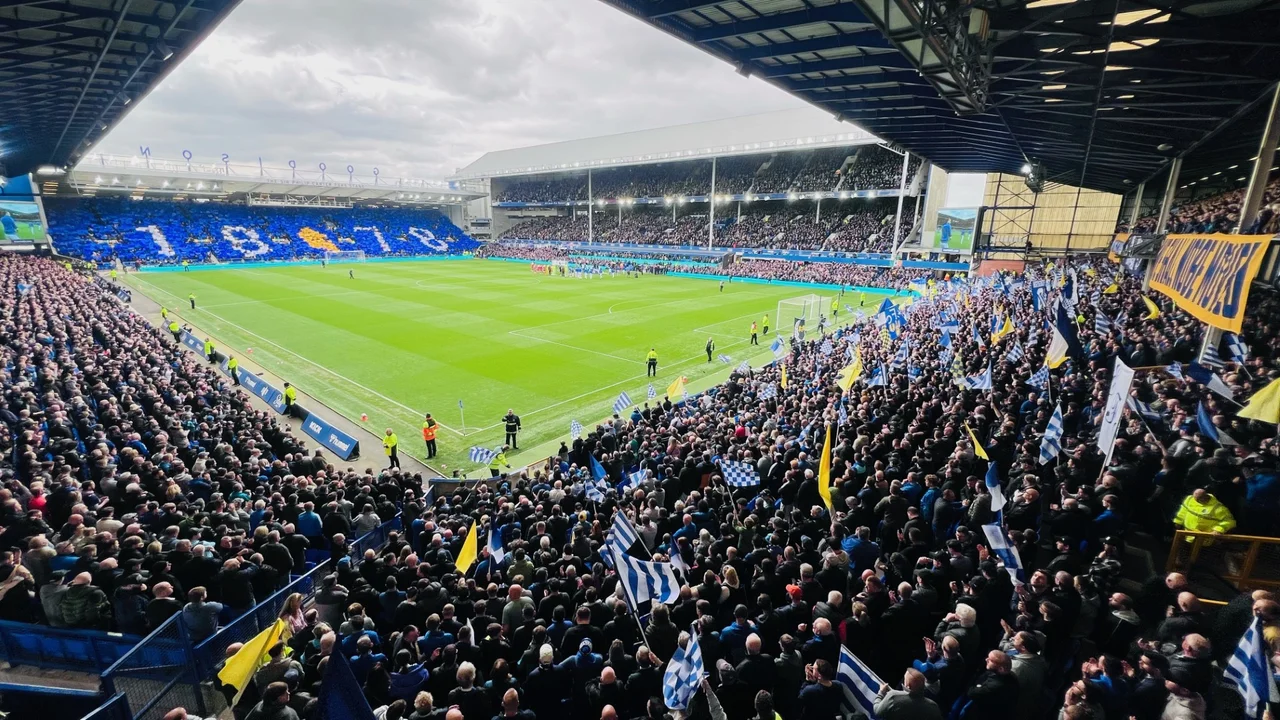

Goodison Park
On 13 May 2025, Everton played their last men's match at Goodison Park - a 2-0 home win over Southampton, both goals from Iliman Ndiaye - and after 133 years, the Grand Old Lady stepped back from the Premier League. Twelve days short of one hundred and thirty-three years earlier, on 24 August 1892, she had opened with no football at all: 12,000 people gathered to watch a short athletics meeting, listen to music, and then watch fireworks. Between those two evenings sat more top-flight football than any other ground in England has ever hosted.
The Mere Green Field
The site began as a field belonging to Christopher Leyland. Everton rented it first, then bought it outright, and the early ground was a 'formidable initial expenditure' of £552 - a sum that paid Mr Barton, the local contractor, fourpence-halfpenny per square yard to drain, level, and turf 29,471 square yards of Walton pasture. Dr James Baxter of the Everton committee underwrote the construction with a £1,000 interest-free loan. The result, when Lord Kinnaird of the Football Association declared it open in August 1892, was the first purpose-built football ground in England. The first league fixture against Nottingham Forest, on 3 September that year, ended 2-2. Fred Geary scored the first Everton goal. Forest's Horace Pike scored before him.
Archibald Leitch's Trusses
Across the next four decades the stands rose around the pitch in stages. The Bullens Road Stand, completed in 1926 to a design by the Glasgow engineer Archibald Leitch, is the part of the ground architects come to see. Its distinctive criss-cross balcony trusses serve as both decoration and structural handrail for the front row of the Upper Bullens. Leitch designed seventeen such trusses in his career. Only three full sets survive: at Glasgow's Ibrox, at Portsmouth's Fratton Park, and here at Goodison - and Goodison is the only ground with two complete sets. To stand at the Park End and look across to the Bullens Road is to see Edwardian football architecture in its most preserved form.
The World Cup and the Golden Boot
Goodison Park is the only English club ground to have hosted a World Cup semi-final. Five matches of the 1966 tournament were played here. In the quarter-final, Portugal's Eusebio - who would win the Golden Boot with nine goals across the competition - scored four of them on this pitch, inspiring a 5-3 comeback against North Korea. He later said: 'Goodison Park is for me the best stadium in my life.' The semi-final saw West Germany beat the Soviet Union 2-1. Brazil's Garrincha won 50 caps for his country in his career, and the only one of those caps that ended in defeat came here, against Hungary, at Goodison. The ground also staged the first FA Cup Final at a Football League venue (Notts County beat Bolton in 1894), the 1910 Cup final replay, and on 27 December 1920 a match between Dick, Kerr's Ladies and St Helens Ladies that drew an estimated 53,000 spectators - shortly before the Football Association banned women's football on its grounds, a ban that held until 1970.
Around the Pitch
The streets around Goodison are part of the ground's character. The terraced houses on Goodison Avenue were once built directly into the back of the Park End stand. Dixie Dean, the great Everton centre-forward, lived in one of them as a player - the club owned the houses and rented them to footballers - and his statue now stands on Walton Lane near the corner where his door used to be. St Luke's church, set into the corner between the Park End and Gwladys Street, has watched matches from its parish boundary since the ground was built and held funerals for Everton players including Brian Harris. King George V arrived in 1913, the first reigning monarch to visit an English football ground; 80,000 people came to see him. In 1924 Chicago White Sox and the New York Giants played a baseball exhibition on the turf, and one player hit a ball clear over the Goodison Road Stand.
The Grand Old Lady's Second Life
After the men's team moved to the new Everton Stadium at Bramley-Moore Dock, the original plan was demolition - 173 new homes, offices, a care home. The 2024 takeover changed that. In May 2025, Everton announced that Goodison would instead become the home of Everton Women, beginning with the 2025-26 Women's Super League season. With a capacity reduced from 39,572 to a configuration that closes the upper tiers, it is now the largest dedicated women's football stadium in the UK. The first WSL match here, on 14 September 2025, was a 2-0 home defeat to Tottenham, with the Finnish midfielder Olga Ahtinen scoring the first goal of Goodison's new chapter. Over 800 fans' ashes lie buried beneath this turf. The Grand Old Lady, for now, keeps her name and her work.
Flight Context
Goodison Park stands at 53.439 degrees north, 2.966 degrees west, in the Walton district of north Liverpool, immediately adjacent to Stanley Park - and across that park lies Anfield, home of Liverpool FC. Liverpool John Lennon Airport (EGGP) is approximately 6 nautical miles south-southeast. The two stadiums together form one of the most recognisable football landscapes in the world from the air: two cathedrals of green pitch within walking distance, framed by the curve of the Mersey to the southwest. Best viewed from 1,500 to 3,000 feet AGL.
From the Air
Located at 53.439N, 2.966W in Walton, north Liverpool, directly across Stanley Park from Anfield. Nearest airport: Liverpool John Lennon (EGGP), approximately 6nm south-southeast. The Goodison-Stanley Park-Anfield triangle is one of the most recognisable football landscapes from the air. Best viewed 1,500-3,000 feet AGL.
Nearby Stories
- Blackpool Pleasure Beach 4.4 km away
- Whalley Abbey 4.8 km away
- Worsley 5.4 km away
- Second Battle of Middlewich 7.7 km away
- Chester Zoo 7.9 km away
- Llanrwst 23 km away
- Abergele Rail Disaster 27 km away
- Sea Lion Rocks railway station 73 km away