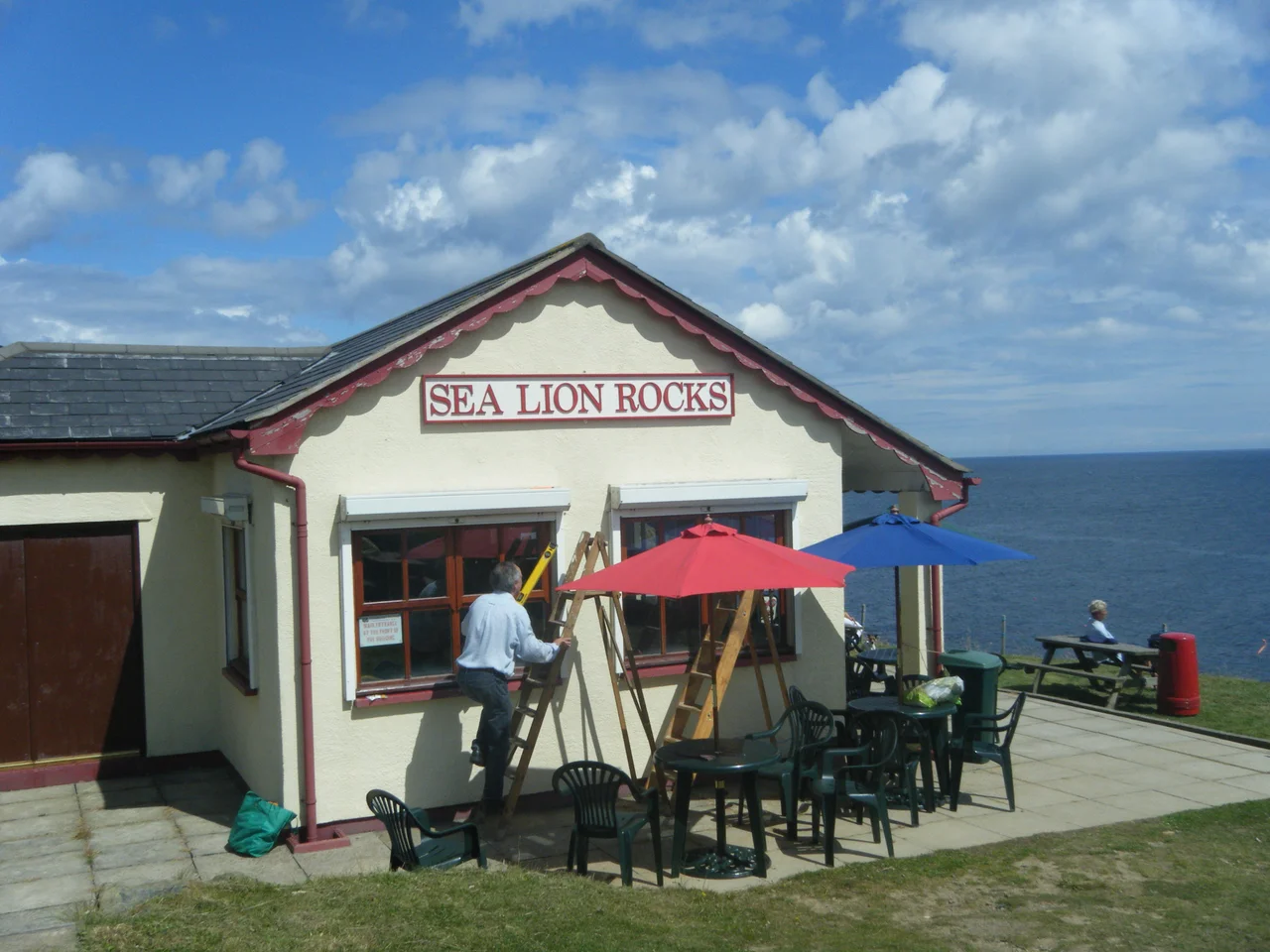

Sea Lion Rocks railway station
The volunteers used to call it Soil and Rocks, because for eight years that was what greeted them at the end of the line. In 1992, the Groudle Glen Railway's narrow-gauge track had finally been pushed back out to its original Victorian terminus on the headland north of Douglas, but the station building that once stood there was gone. The 1992 reopening was a ceremony at a bare clifftop. Eight years later, in the year 2000, volunteers began rebuilding the station directly on top of the original foundations they had uncovered, working only in summer because the weather on the headland would not permit anything else.
A Railway Built for a Zoo
The story does not start with the station. It starts with the animals. In 1893, three years before the railway, a rocky inlet on the cliffs east of Douglas was dammed off to make a saltwater enclosure for sea lions, and cages were built nearby for polar bears. The zoo was an immediate draw for the Victorian holidaymakers pouring into the Isle of Man each summer. By 1896 the Groudle Glen Railway had laid down a narrow-gauge line to deliver them in proper Victorian style, three-quarters of a mile from the inner terminus to the cliff edge. The outer station opened that year complete with tea rooms, a bake house, a fish store and seasonal living quarters for the staff. It even gave the railway's locomotives their names. Sea Lion was delivered in May 1896. Polar Bear joined her in 1905.
When the War Came
The First World War closed the zoo for the duration. It reopened in 1920, but the polar bears were no longer a feature. The sea lions hung on through the interwar years, alongside, at various times, brown bear cubs that for a small fee could be taken for a walk along the cliffs and an aviary of tropical birds. Local stories also speak of penguins, though no firm evidence has surfaced. The zoo closed at the end of the 1939 season and never reopened. The railway followed it into silence. When the line eventually came back in 1950, a wartime landslip prevented trains from reaching the old terminus, and the cliffside station was abandoned. It was apparently still standing in the early 1960s but had vanished completely by 1982, when restoration of the railway itself began.
Soil and Rocks Becomes Sea Lion Rocks Again
The winter of 1991 was when the heavy work happened: major earthworks to allow trains to reach the original terminus once more. On 23 July 1992 James Crookall Cain, Speaker of the House of Keys, hammered home the final burnished pandrol rail fastener and the line was open to its end again. But there was no building. For eight years the volunteers joked about Soil and Rocks instead of Sea Lion Rocks. Construction began in 2000, faithful to the original based on surviving postcards, sitting on the foundations that had been there since 1896. Since 2003 a tea room and souvenir outlet have operated at the station, alongside historical displays. A flagpole, prominent in old photographs, was reinstalled in 2010, making the cliffside station visible again from the coastal road on the opposite headland. Coin-operated telescopes, ornamental railings and landscaped lawns now sit where the polar bear cages once were.
A Modern Visitor Centre on a Victorian Cliff
Between 2011 and 2012, after five years of fundraising and applications, the building got its biggest upgrade since reconstruction. A new extension at the rear added the railway's first proper toilets, disabled facilities and a store room with a silent generator for power. Outside, new paving, ramps, a paved platform area, turf and shrubs filled in the spaces between the building and the cliff. Inside, the rooms were fitted out as a free visitor centre with displays charting the history of the railway and the zoo it once served. It partially reopened for Easter 2012 and fully reopened that May. The original cove can still be visited; the remains of the zoo enclosures are still there to be seen. The site even has a curious cameo in British television history, having appeared in the 1986 Lovejoy episode "Friends, Romans and Enemies."
From the Air
Sea Lion Rocks sits on the cliff edge at approximately 54.177 degrees north, 4.417 degrees west, about three miles northeast of Douglas. From the air, look for the narrow strip of Groudle Glen running down to a rocky cove with a small station building on the headland above. Ronaldsway Airport (EGNS) is roughly twelve nautical miles south. The Manx Electric Railway runs along the coast immediately inland, with Groudle station the junction point. Coastal weather can change quickly on this exposed headland.
Nearby Stories
- St Bees Lighthouse 15 km away
- Celtic Array 22 km away
- Kirkmaiden 23 km away
- Isle of Whithorn 23 km away
- Seascale Lifeboat Station 31 km away
- German submarine U-1024 36 km away
- SS Georgetown Victory 40 km away
- Blackpool Illuminations 56 km away