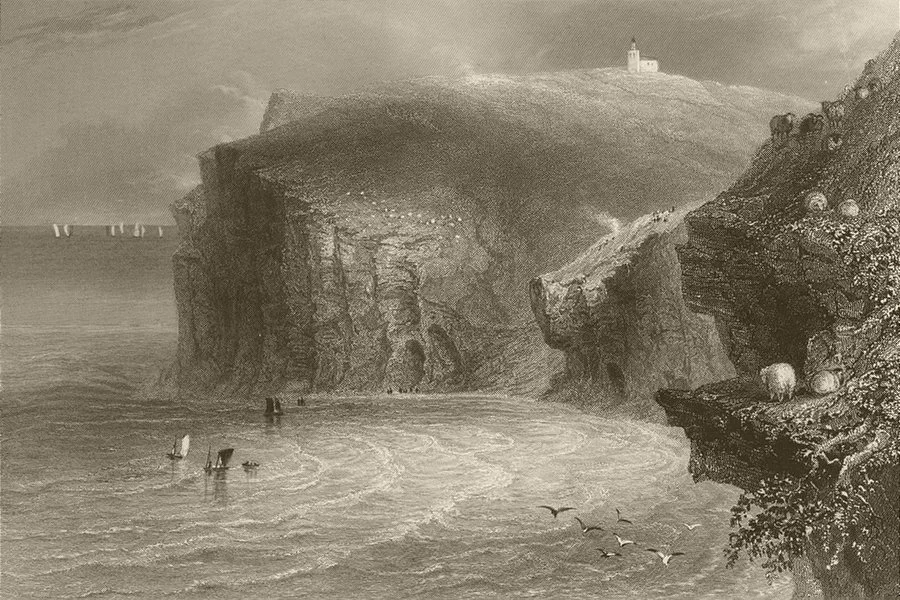

St Bees Lighthouse
On a winter night in 1822, fire took the keeper's wife and five children inside the lighthouse on St Bees Head. The lamp they tended was coal-burning, the last of its kind in Britain, and the same flame that had warned mariners for years killed the family who had made it their job to keep it lit. The new lighthouse that rose in its place did not pretend the old one had not failed. It moved further inland, swapped coal for cleaner oil, and gave Cumbria a light that has been signalling ever since.
A Light Born from Loss
The tragedy of 1822 marked the end of an era. St Bees had been the last coal-powered lighthouse in Britain, a holdout from an older technology that fed warmth and danger into the lantern in equal measure. Within a year, the engineer Joseph Nelson had built a replacement: a circular tower 27 feet high, lit by fifteen oil-burning Argand lamps set inside polished parabolic reflectors. The cost was £1,447, the lamps were operational from 1823, and the keeper's family was no longer asked to live with combustion at their hearth. The new light burned cleaner and brighter, but the memory of what had been lost the year before lingered in every shipping note that mentioned the cliff.
The Tower That Stands Today
By the 1860s the oil lamps were ageing, and Trinity House commissioned something grander. A round sandstone tower, seventeen metres tall and built by John Glaister of Whitehaven under resident engineer Henry Norris, rose further from the cliff edge in 1866. Beneath its foundation stone, the builders sealed a zinc box: a dated scroll signed by Norris and Glaister, newspapers, and coins of the realm. The lantern crowning the tower had originally been destined for Gibraltar. Inside it sat a first-order catadioptric optic by Chance Brothers, supplied with a clever dioptric mirror that reflected light from the lamp's landward side back out toward the sea. Construction overshot its end, and in November 1866 a painter sued Norris for unpaid lettering on a notice board. The light was working by the end of the year all the same.
Air Races and Air Raids
Through the twentieth century the lighthouse picked up second jobs. Between the wars, pilots in the London-to-Isle of Man air races used it as a turning marker, banking around the cliffs at 102 metres above the waves. During the Second World War, the local Home Guard used the headland to practise defence and attack manoeuvres. No record survives of live ammunition being fired at the lighthouse itself, which is just as well: the optic that had crossed Britain by horse and rail to reach Cumbria was still doing its job. In 1951 the light was electrified, then refined again in the 1960s. A 1999 modernisation swapped in three 250-watt halogen lamps clustered together. The character has settled: two flashes every twenty seconds, visible eighteen nautical miles out.
The Voice in the Fog
From 1913 an explosive fog signal sounded from St Bees, firing once every five minutes when visibility failed. Imagine the routine: a lighthouse keeper walking out into the wind, setting a charge, walking back, waiting. In 1964 the explosives gave way to a stack of thirty Tannoy emitters in a small building 150 yards forward of the lighthouse, perched almost at the cliff edge. Two motor-driven alternators powered the assembly, which sounded two blasts every 45 seconds. The fog signal was decommissioned in 1987. Today only the light remains, but the geometry of the headland is the same: chalky red sandstone, sheer drops to the Irish Sea, gulls riding the updrafts that drove generations of keepers indoors before they had time to think about it.
From the Air
St Bees Head sits at 54.51N, 3.64W on the Cumbrian coast, with the lighthouse standing 102 metres above the Irish Sea — the highest cliff-top light in England. The white sandstone tower and red sandstone cliffs are conspicuous from low to medium altitudes; the headland sticks west into the Solway approaches, making it a useful turning point for VFR work along the coast. Nearest field is Carlisle Lake District Airport (EGNC) some 30 nm north-east. Watch for sea fog rolling in from the west, which historically demanded the explosive fog signal sited just forward of the tower.
Nearby Stories
- Derwentwater 1 km away
- Cashtal yn Ard 10 km away
- Buittle Castle 14 km away
- Carlisle Castle 15 km away
- Isle of Whithorn 16 km away
- Conishead Priory 17 km away
- Black Combe 24 km away
- Battle of Glen Trool 32 km away