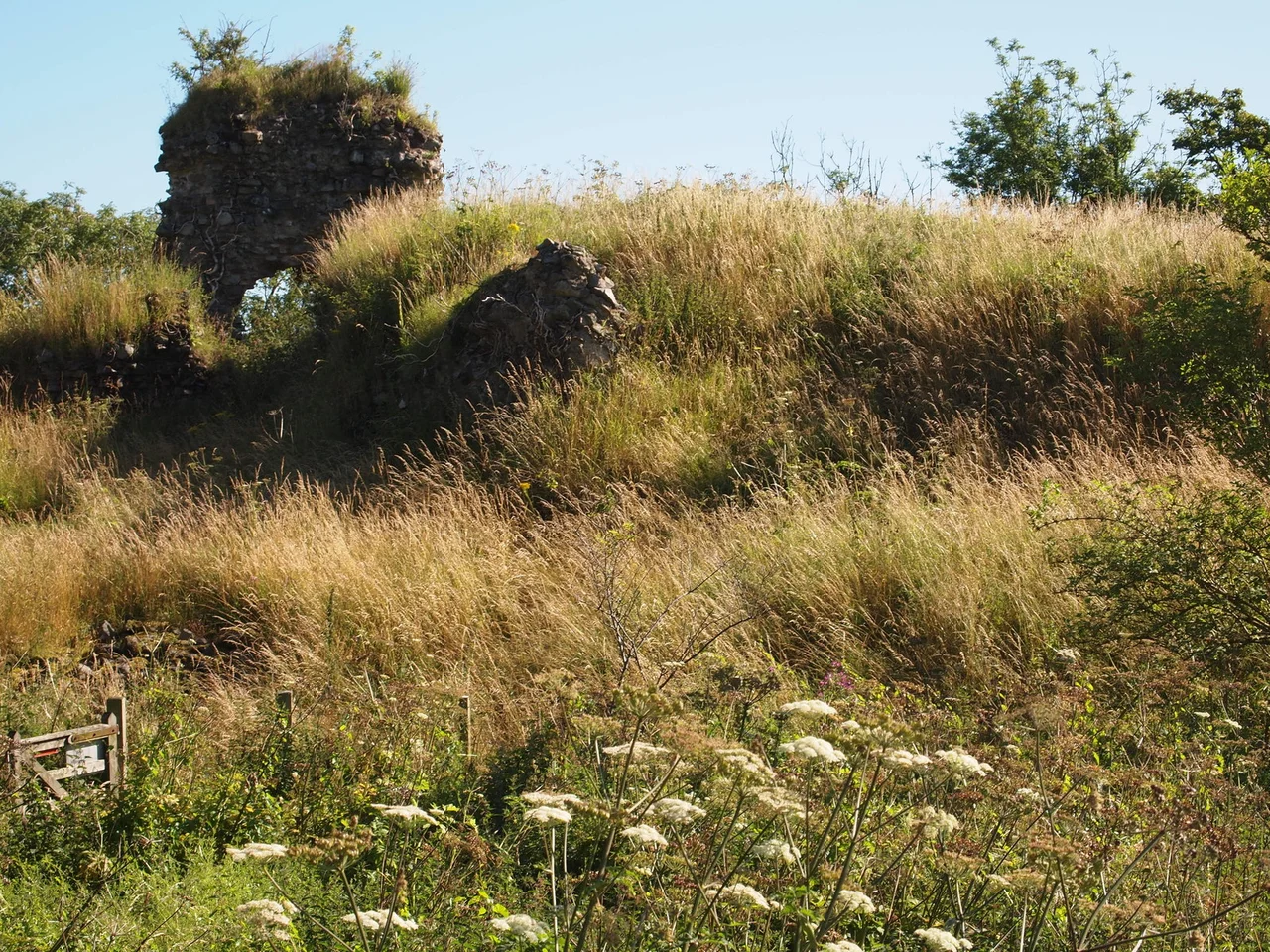

Buittle Castle
In 1984, an old motte in the valley of the River Urr was gifted to Balliol College, Oxford. The donor was Peter Maxwell QC, a Balliol man and a descendant of the Maxwells of Munches. The conveyance marked the 720th anniversary of the founding of Balliol College itself - and brought the place back, at last, to the family that had given Balliol its name. Buittle Castle was the seat of Lady Dervorguilla, the woman who funded the college from her widow's purse. Her marriage to John Balliol once made this riverbank a small capital of Anglo-Scottish power. The college owns the motte to this day.
Older Than Galloway Itself
Excavations between 1993 and 2000 turned up something the medieval lords could not have guessed. The Buittle site has been occupied since the Mesolithic, with a permanent settlement that may go back nearly ten thousand years. The Romans were here too, fortifying this strategic crossing of the Water of Urr from the time of Agricola's Galloway campaign in AD 82-84. Among the finds: prehistoric lithics, sherds of Roman amphora, a small Romano-Celtic shrine, and a bronze cavalry stud lost by some forgotten trooper. Around the turn of the 11th century, the rising ground was moated, and a timber motte-and-bailey fortress went up. Stone walls followed around 1200. The motte rose to a hundred by a hundred and fifty feet at its base, large enough for private chambers and the public reception rooms a near-sovereign Galloway lordship required.
Lady Dervorguilla's Statutes
Dervorguilla of Galloway inherited Buittle as sole surviving heiress of Alan, Lord of Galloway. Her marriage to John de Balliol of Barnard Castle joined two of the most powerful houses in the British Isles. In her own right she owned manors from France to Hitchin in Hertfordshire. Contemporary accounts agree she was deeply pious and ruled benevolently, with her husband, in the interests of the people of Galloway. When John died in 1268, she kept his embalmed heart in a casket of ivory and silver and carried it with her for the rest of her life. The Chapel of Ease at Buittle - no longer standing - was likely built under her hand. So too, almost certainly, were the Statutes of Balliol College, which her son's later charter annotates as drafted 'apud Botel' - at Buittle. A papal bulla of Pope Honorius IV was found in the bailey during the excavations, possibly connected to that work. Her son, also John, became King of Scots in 1292. His reign was tragic and short.
Bruce, Balliol, Bruce Again
The Balliol king's followers were broken at the Battle of Dunbar in 1296, and he himself was stripped of the crown by Edward I and taken to England, never to return to Buittle. The castle went through hands like a coin. Robert de Brus, 5th Lord of Annandale, captured it in 1286. By 1296 the English held it. King Robert the Bruce's brother Edward took it back in February 1313, and Bruce granted it to Good Sir James Douglas. When Edward Balliol - the failed king's son - made his disastrous attempt at the throne in 1332, Buittle returned to the Balliol line for two decades, until Sir William Douglas recaptured it for David II in 1352. After the 9th Earl of Douglas's 1455 forfeiture, James III settled the Barony on his Queen, Margaret of Denmark, as part of her dowry. From there it passed to the Maxwells, in whose various branches it remained for the next four and a half centuries.
The Burns Connection, and the Quiet Years
By the mid-18th century the Maxwells had moved to Munches House, a Robert Adam-style mansion a few miles west, and the old castle was put to agricultural use. The 15th Lord Maxwell had backed the failed Jacobite Rising of 1745. Like all Jacobites, he could not legally repair fortified buildings, so he simply closed the tower and unroofed it for tax purposes. The most famous of the late 18th-century Buittle Maxwells was John Maxwell of Terraughty, born at the castle, immortalised in Robert Burns's birthday epistle: 'Health to the Maxwell's veteran Chief! Health, aye unsour'd by care or grief.' Around 1820 the tower was re-roofed for tenant farmers. The bartizan angle turrets - those little projecting corner towers - were taken off during this farming century. The site was sold in 1992 to Jeffrey Burn, an artist and historical re-enactor, who began the long work of stripping away the agricultural accretions to reveal what remained of the medieval building.
What You Find There Now
The bailey is now a private residence with a B&B, a tea room - the Talla-bidh - and a garden laid out in 15th-century models by designer Anne Jennings. In the vaulted undercroft of the tower, a small chapel offers liturgical services according to the medieval Use of Sarum, under the auspices of an Orthodox jurisdiction. The motte itself - the older Norman mound, where Dervorguilla's stone walls once stood - is owned by Balliol College, Oxford, a quiet patch of grass on the east side of the Bailey that connects an Oxford college to its own foundation in Galloway eight hundred years ago.
From the Air
Buittle Castle sits at 54.94 N, 3.84 W in the valley of the River Urr, one kilometre west of Dalbeattie. The nearest airport is Dumfries (former RAF Dumfries) about 15 nm northeast; Carlisle (EGNC) lies 35 nm southeast across the Solway Firth, and Prestwick (EGPK) is 50 nm northwest. From 1,500 to 3,000 feet AGL the Urr Water shows clearly as it cuts south toward Auchencairn Bay, and the village of Dalbeattie - a granite town with distinctive light-grey buildings - is the strongest landmark. Threave Castle's island in the Dee is just 10 nm to the west. Expect changeable Solway weather and low scud on westerly winds.
Nearby Stories
- Keswick 7.7 km away
- Workington Lifeboat Station 8.2 km away
- Morton Castle 9.5 km away
- Quintinshill Rail Disaster 9.8 km away
- Garlieston 19 km away
- Cumnock 29 km away
- Point of Ayre Lighthouse 30 km away
- Kielder Observatory 35 km away