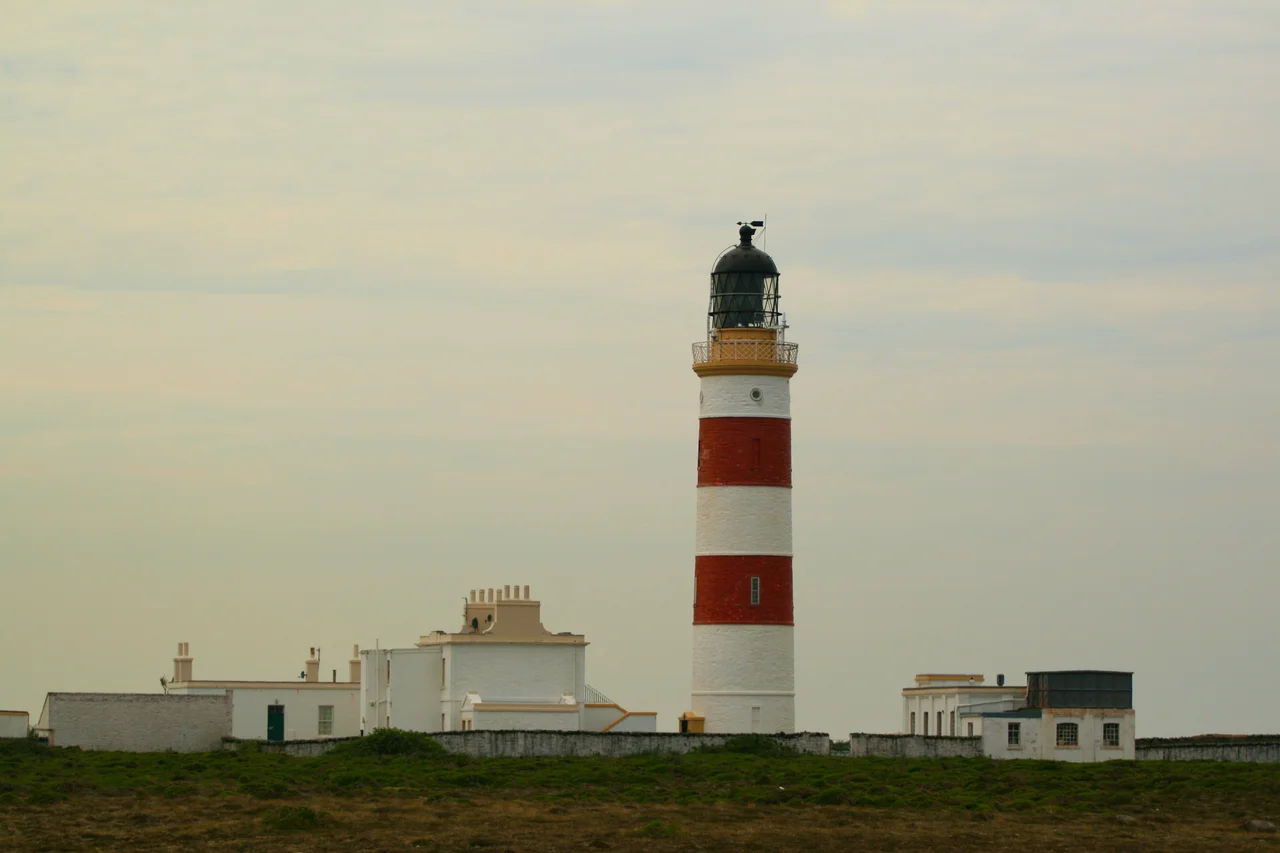

Point of Ayre Lighthouse
Robert Louis Stevenson, who wrote Treasure Island and Kidnapped, came from a family of lighthouse engineers, and his grandfather Robert Stevenson designed the tower at the north-east tip of the Isle of Man that has been flashing since 1818. The Point of Ayre Lighthouse is the oldest operational lighthouse on the island and one of the older working lights in the British Isles. The novelist hated his family's trade and refused to follow it. His grandfather built lights, his father built lights, his uncle built lights, and Robert Louis kept slipping off to read books and write stories instead. Two red bands run around the tower at the north-east tip of Mann as a daymark; at night, four flashes of white light every twenty seconds remain its signature.
An Act of Parliament for a Point
The Isle of Man and Calf of Man Lighthouses Act of 1815, recorded in the dry shorthand of British statute as 55 Geo. 3. c. lxvii, gave Robert Stevenson the authority and the money to build the Manx lights. Three years later the Point of Ayre tower was first lit. Stevenson, then in his prime as the engineer behind the Bell Rock Light off the coast of Angus, brought to the Isle of Man the same combination of granite and Fresnel optics that would define Northern Lighthouse Board engineering for the rest of the 19th century. The original 1818 light has been upgraded over the years, but the tower itself, 30 metres tall with a focal height of 32 metres above sea level, still does its job. Its light reaches nominally 19 nautical miles, far enough to be seen from south-west Scotland on a clear night.
The Fresnel from Paris
The lens currently sitting in the lantern room is a first-order Fresnel lens, supplied in 1890 by the celebrated Parisian firm Barbier, Benard et Turenne. A first-order Fresnel is the largest standard size and is the kind of optic you find in the most important coastal lighthouses, the ones meant to be seen far out to sea. It still works. More than 135 years after it was shipped from Paris, the lens continues to focus the keeper's lamp, now an automated bulb, into the narrow beams that mark four flashes every twenty seconds. The light characteristic was chosen for distinctiveness, so that mariners scanning a dark coast could read it from miles away and know which point they were rounding.
The Winkie
The Point of Ayre is a moving frontier. Strong currents constantly deposit shingle and gravel along the shore, and the new land grows seaward year by year. By 1899 the main lighthouse no longer stood at the actual seaward edge, and a smaller light, affectionately called the winkie, had to be built 750 feet closer to the water. In 1950 the same problem returned, and the winkie was repositioned a further 250 feet seaward. By 2010, GPS and modern shipping electronics had made it redundant, and the winkie was discontinued on 7 April that year. The same currents that built the spit kept eating away the relevance of the structures built upon it. Today the main lighthouse remains active, but its fog signal was decommissioned in August 2005, judged unnecessary in an age of satellite navigation.
Privately Owned, Still Lit
Automation arrived in 1993. The keepers left, the buildings and the land went into private ownership, and the Northern Lighthouse Board in Edinburgh retained responsibility only for the light itself. The keepers' cottages now sit silent next to the working tower. From a small boat in the Sound of Mann, or from a glider riding the lift along the dunes, the two red bands of the daymark remain the brightest visual signature of the north of the island. The lighthouse has watched the rise of steam packets, the disappearance of sail, the arrival of car ferries, and the quiet supersession of optical lights by GPS. It has outlived its keeper-tended era and entered an automated one. Robert Stevenson would probably have been satisfied. His grandson, who once wrote that the work of his ancestors gave shelter to forgotten coasts, might even have approved.
From the Air
The Point of Ayre Lighthouse stands at 54.415N, 4.368W (gcsvs), at the absolute north-east tip of the Isle of Man. The nearest active airport is Isle of Man Airport (Ronaldsway, EGNS) about 25 nm south. The closest active general aviation strip is Andreas Airfield 4 nm south-west; the local gliding club operates from there and the dunes around the lighthouse generate excellent ridge lift. For a low transit at 1,500 ft AGL, the tower with its two red bands is unmistakable against the gravel spit. The Mull of Galloway lighthouse in Scotland is visible 19 nm to the north on clear days; the entrance to Belfast Lough is 50 nm to the west. Coastal advection fog from the Solway can roll in quickly here; weather brief is essential.
Nearby Stories
- Kirkmaiden 3.2 km away
- Isle of Whithorn 4.1 km away
- Santon Railway Station 13 km away
- Solway Firth 16 km away
- St Bees Lighthouse 19 km away
- Portavogie 34 km away
- Walney Island 40 km away
- German submarine U-1024 55 km away