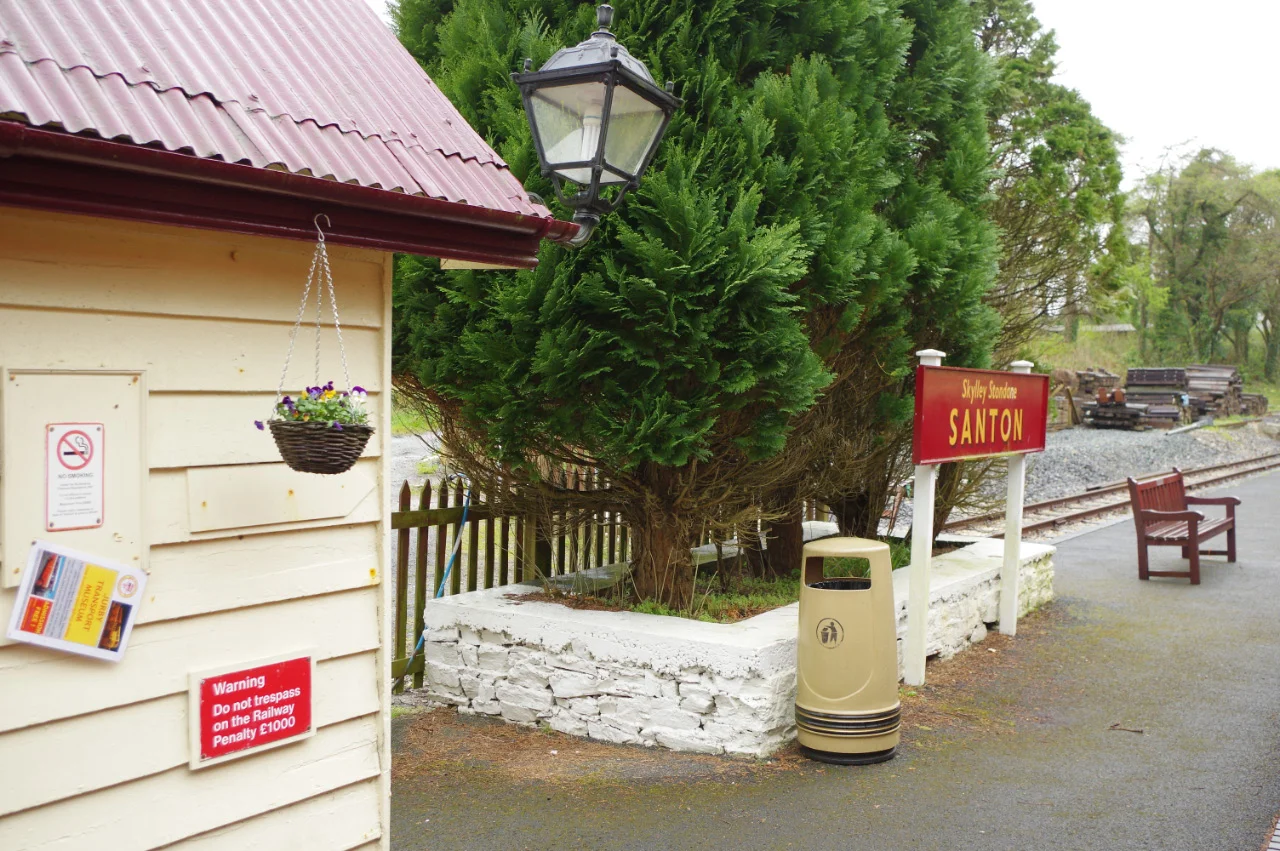

Santon Railway Station
Of all the small wooden station buildings the Isle of Man Railway threw up along its tracks in 1874, exactly one survives where it was first put. Port St Mary's was replaced in 1898. Ballasalla's came down in 1985. Colby's was demolished in 1980. Santon's, painted cream and red since the late 1960s, with corrugated iron roofing and timber slatting and a small recessed waiting shelter where the same handful of regular passengers have boarded the same handful of summer trains for over a century, is still doing its job. It is the kind of preservation that happens not through grand intervention but through quiet failure to find anything better to replace it with.
Ballavale That Never Was
When the railway surveyors laid out the route in 1872, they wrote Ballavale in the plans - the name of the local farm. By the time the line opened on 1 August 1874 the station had become Santon, after the parish, and it has been Santon ever since. The original intended name persisted in railway paperwork for years, an administrative ghost. The actual village area today, called Newtown, sits some distance off, which means Santon Station serves a parish rather than a settlement - it is a station in the countryside, with hedgerows and a few farms in walking distance, two large bridges marking its boundaries, and beneath the platform the recurring music of trains crossing the Santon Burn on a man-made embankment a hundred yards to the south.
Lost Property Capital of Mann
Legend - and the more detailed history written by the railway's own enthusiasts - says that for decades, any parcel left on any platform on the entire forty-six-mile Isle of Man Railway network eventually found its way to Santon. The covered storage areas at the station, by the time it became an unstaffed halt in 1958, were packed floor to ceiling with passengers' unclaimed belongings. Why Santon? Because Santon was quiet enough that nobody minded the clutter, central enough to be reachable from any other station, and staffed long enough into the era of road competition that its station master still came to work when other halts had given up. The story is half-true and entirely characteristic: a Victorian railway running out of better ideas, depositing the entire island's misplaced cargo at the same forgotten siding.
Cattle, Manure, and the Hoardings
Until road haulage finally killed it, Santon was also the line's cattle station. Farms in the surrounding parish drove their animals here for shipment to Douglas market on dedicated livestock trains. The cattle dock survives, repurposed now as a ballast storage area; the cattle pen itself was removed in 1975 when its condition could no longer be defended. Manure was the other freight, and a great deal of it - droppings from outlying farms were shipped island-wide from this siding. The volume and unsavouriness reached the point where the railway erected a long advertisement hoarding along the siding's length, partly to sell advertising, mostly to spare passing passengers the sight and smell. The hoardings are gone now. So is the manure trade. The siding remains, used as occasional storage and occasionally as the photographic backdrop for charter specials, because Santon's surviving 1874 building photographs beautifully.
Santa's Halt
From 1986 the railway started running Santa Trains in early December, terminating at Santon and renaming the station Santa's Halt for the occasion. Volunteers panelled in the recessed waiting shelter as a grotto. The three-coach Bar Set of saloon carriages was placed in the siding to serve mulled wine, mince pies, tea, and coffee. Father Christmas distributed presents from the platform. Between 2010 and 2013 the operation moved up the line to Castletown, which was renamed Tinseltown for the period, but Santon got its festive role back from 2014. In a country where the trains run only six months of the year and where one of the few winter sights of a working locomotive comes during the Santa specials, this is how the station earns its keep through December. The 2014 revival also saw a special service haul a train carrying Peel P.50 motorcars - the smallest production car ever built, manufactured on the Isle of Man in the 1960s - on the line's 140th anniversary.
Palms, Volunteers, the Fairy Bridge
Santon's sheltered cutting has nurtured a row of magnificent palm trees - cordylines flourishing in the mild Manx Gulf Stream air against a backdrop of slate-coloured corrugated iron. A small group called the Friends of Santon Station, founded in 2013, tend the floral displays in summer, install period furniture, and dream of period signage. The platform has hanging baskets. A brass-plaqued park bench sits on the up platform commemorating somebody, somewhere. From the station, walkers head out to the Mann Cat Sanctuary, to Murray's Motorcycle Museum, to Port Grenaugh cove on the coast, and to the Fairy Bridge - the small road crossing of a stream where Manx tradition still requires passing motorists to greet themmoidhachtee, the little people, by name. The trains run between mid-March and the end of October. The 2026 timetable, like many before it, did not bother to mention that Santon would actually stop, but the trains continue to do so anyway.
From the Air
Santon Railway Station lies at 54.118N, 4.584W on the south of the Isle of Man, in a rural cutting between Ballasalla and Port Soderick stations, off the A5 Douglas-to-Port Erin road. From the air, look for the small railway crossing of the Santon Burn and the original cream-and-red timber station building. Cruising altitude 2,000-3,000 ft works well for sightseeing the rural southern parish. Nearest airport: Isle of Man Airport (Ronaldsway, EGNS) approximately 3 nm south. The narrow-gauge line runs roughly parallel to the A5 road through gently rolling pasture.
Nearby Stories
- RAF Jurby Head 14 km away
- German submarine U-246 16 km away
- German submarine U-1051 17 km away
- Kilclief Castle 18 km away
- Ardglass 31 km away
- St Bees Lighthouse 44 km away
- Trwyn Du Lighthouse 54 km away
- Seascale Lifeboat Station 61 km away