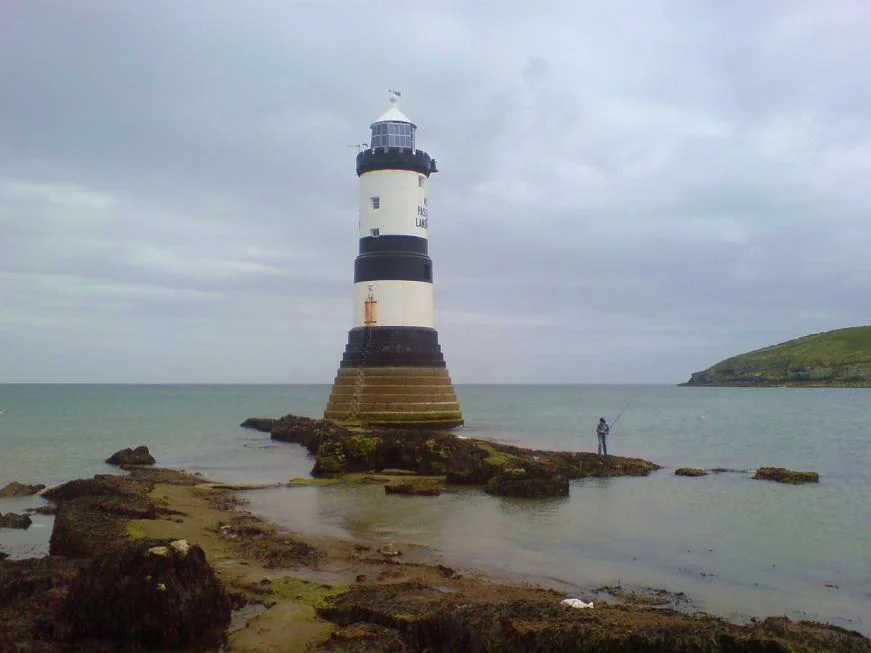

Trwyn Du Lighthouse
The words painted on the tower's north and south faces are unambiguous. NO PASSAGE LANDWARD. The narrow channel between Trwyn Du Lighthouse and Puffin Island looks tempting from a small boat, especially when the open water beyond Penmon Point is rough, but the seabed between is a trap of unmarked rocks and shifting sands. The lighthouse, completed in 1838, was built to keep ships from making exactly that mistake, after a paddle steamer carrying day-trippers from Liverpool had run aground on the Lavan Sands seven years earlier and a hundred and thirty people had died.
Why It Stands Here
Liverpool's shipmasters had been asking for a light at Penmon for years. The traffic into and out of the Mersey passed close to the eastern tip of Anglesey, and the combination of strong tides, the Lavan Sands drying for square miles at low water, and the narrow funnel between the island and the mainland made the channel a known killer. The wreck of the Rothsay Castle on Dutchman Bank in August 1831 finally forced the question. A hundred and thirty people had died on a vessel that should not have left port, and the inquest at Beaumaris had been blistering. Trinity House commissioned a sea tower. James Walker, one of the great lighthouse engineers of his generation, took the design and built it for £11,589, an enormous sum in 1830s money. The tower was his first sea-washed structure and would serve as the prototype for his more ambitious tower at the Smalls off Pembrokeshire.
Walker's Engineering
The lighthouse stands twenty-nine metres tall and rises in stages, the lower courses splayed out into a stepped base designed to break the upsurge of waves before they could batter the main walls. Earlier sea towers on similar sites had suffered structural damage from water hammer at their feet. Walker's stepped base reduced that force by allowing the water to climb the lower courses and lose energy before reaching the slender tower above. The vertical walls of the upper tower are austere, almost military, in contrast to the more graceful curves of his later designs. The gallery has a crenellated stone parapet rather than the usual iron railings. The tower narrows above the halfway point in a feature Walker would repeat across his career. The three black bands painted on the white background are original and the words NO PASSAGE LANDWARD have been there from the beginning. The lighthouse looks like nothing else on the Welsh coast.
The Light Itself
The original light source was a four-wick Argand lamp set within a first-order fixed catadioptric optic made by Isaac Cookson and Co. It showed a fixed red light, a colour that distinguishes hazard markers from major coastal lights in the standard navigational code. Joseph Steer, born at Bovey Tracey in Devon in 1831, the same year the Rothsay Castle went down, would later spend years here as one of the keepers. The light has been modernised more than once. In 1922 Trwyn Du became the first Trinity House lighthouse to be automated, converted to unwatched acetylene operation. The keepers went home. In 1996 the lamp was converted to solar power, and now flashes once every five seconds with 15,000 candela of light visible from twelve nautical miles away. It runs without anyone tending it. Holyhead Control Centre checks the systems remotely.
An Unsuccessful Water Closet
Walker tried to give the lighthouse keepers a modern convenience that the lighthouse keepers would not have appreciated. He fitted what he called a primitive water closet, with a drain exiting at the base of the tower at the high tide line. The stepped lower courses, in theory, would help wash the discharge away when the sea rose. In practice the surges of seawater that the steps were designed to break ran straight back up the drain in heavy weather, with consequences that anyone who has plumbed a basement near a tide line will appreciate. The fitting was abandoned. The story is the kind of detail that turns a lighthouse from a monument into a building people had to live in.
Getting There
Penmon Point is accessible by car from Beaumaris, through Llangoed, along a road that turns into a private toll route for the last stretch to the lighthouse. The toll is small. The parking is closer to the lighthouse than the free parking at Dinmor, about a mile back, where there is a cafe, a shop, public toilets, and good fishing off the rocks. From the point you can watch the lighthouse standing in the channel and read the painted warning that has not changed in nearly two centuries. The bell that hung at the base for foghorn duty has gone now. Trinity House began trials of a new fog signal in 2019, the old electronic striker mechanism having become unreliable. The lighthouse is still working. It is still saving lives by the simple act of being where it is.
From the Air
Trwyn Du Lighthouse stands at 53.31 north, 4.04 west, just offshore between Black Point on the eastern tip of Anglesey and Puffin Island (Ynys Seiriol) to the north. The 29-metre tower has three black bands on a white background and is unmistakable from the air. Recommended viewing altitude 1,500 to 3,000 feet for the channel and surrounding waters. The Lavan Sands and Dutchman Bank lie to the south. Nearest airports EGOV Valley on Anglesey to the northwest, EGCK Caernarfon to the south. The Penmon boathouse and Beaumaris town are visible to the southwest.
Nearby Stories
- Pen-y-Pass 1.6 km away
- Rhyl Lifeboat Station 2.4 km away
- HMS Resistance (1861) 3.1 km away
- Tudweiliog 21 km away
- German submarine U-246 22 km away
- Horseshoe Pass 22 km away
- Celtic Array 30 km away
- Birkdale Palace Hotel 32 km away