.jpg)
HMS Resistance (1861)
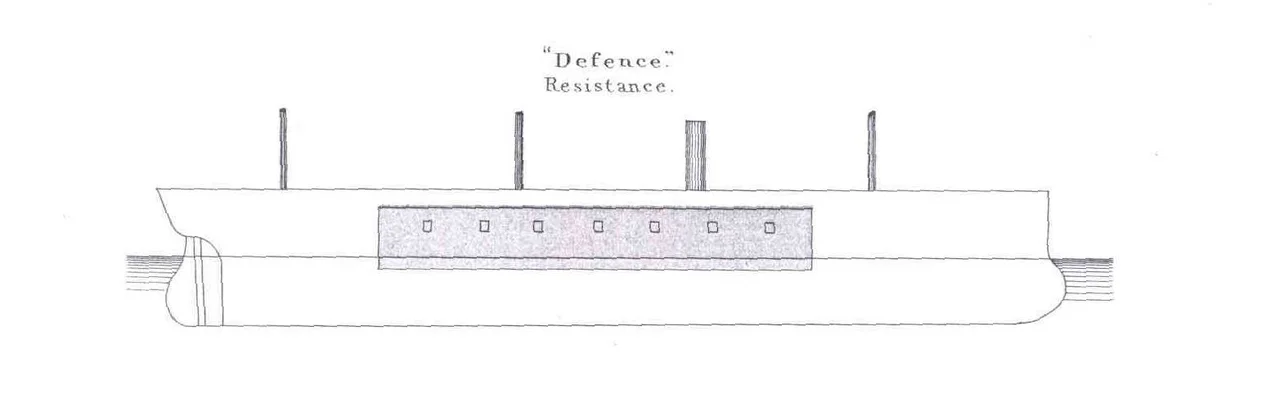
She had a steel beak shaped like a plough's blade welded to her bow, and that was why they called her Old Rammo. HMS Resistance was the second of two Defence-class ironclads built for the Royal Navy in the 1860s, and she was the first capital ship in the British fleet to be fitted with a naval ram -- a Victorian revival of an idea last taken seriously by the Greeks at Salamis. The thinking was that the new ironclad armour made guns less effective and old shipboard tactics needed reconsidering. The Resistance was the test of that thinking. She was launched at Cubitt Town on the Isle of Dogs on 11 April 1861, served thirty-eight years, and on a stormy night in February 1899 nearly went down inside Holyhead Breakwater on her way to the scrapyard.
Old Rammo
She displaced 6,070 long tons -- considerable for the period, though more than 3,000 tons less than the larger Warrior-class ironclads that preceded her. She was 280 feet long overall, 54 feet in the beam, drew 26 feet at full load. Her hull was subdivided by watertight transverse bulkheads into 92 compartments, with a double bottom under the engine and boiler rooms -- a level of survivability that was unusual in 1861. Four rectangular boilers fed steam to her engine at the modest pressure of 20 pounds per square inch. The engine made 2,329 indicated horsepower; her sea trials in 1873 recorded a maximum speed of 11.4 knots. She carried 450 long tons of coal, enough to steam 1,670 nautical miles at 10 knots. From September 1864 to April 1866 she was re-rigged as a barque to reduce her sail crew; afterwards she was returned to her original full ship rig. The ram itself was a plough-shaped projection at the waterline -- a steel beak meant for crushing the hulls of opponents at speed.
The Question of Armament
Her original armament was a mix of smoothbore muzzle-loaders and breech-loaders -- eighteen 68-pounder smoothbores firing 68-pound solid shot at a muzzle velocity of 1,579 feet per second, plus a handful of rifled 110-pounder Armstrong breech-loaders, plus saluting guns. The 68-pounders could hit a target at 3,200 yards at twelve degrees of elevation. The 110-pounder fired a 107-pound shell out to 4,000 yards. All the guns could fire either solid shot or explosive shells. In her 1867-1868 refit at Portsmouth she was rearmed for the new age of armour-piercing rifled ordnance: fourteen 7-inch and two 8-inch rifled muzzle-loading guns. The 8-inch was credited with penetrating 9.6 inches of wrought iron armour at the muzzle, the 7-inch with 7.7 inches. These were heavier guns than the ones they replaced, so fewer of them could be carried. The wrought-iron armour belt around her hull was 4.5 inches thick, 140 feet long, extending from the upper deck down to 6 feet below the waterline, backed by 18 inches of teak. The ends of the ship were entirely unarmoured -- a serious vulnerability for the steering gear.
A Working Life
She was ordered on 14 December 1859 and laid down a week later by Westwood, Baillie at Cubitt Town on the Isle of Dogs in London. Launched 11 April 1861, commissioned July 1862, completed at a cost of £258,120. She served first in the Channel Fleet until 1864, then was transferred to the Mediterranean Fleet as the first British ironclad assigned to that station -- a significant signal of Royal Navy commitment to the Mediterranean in the years after the Crimean War. In 1867 she paid off at Portsmouth for her refit and rearmament. She recommissioned in 1869 as the guardship in the River Mersey, defending the approaches to Liverpool, where she served until 1873. Back to the Channel Fleet, then back to the Mersey in 1877, then paid off at Devonport in 1880. From 1885 her useful life ended in a particular Victorian way: she was towed out and used as a target for testing armour against torpedoes and gunfire. The Navy needed data, and an old ironclad whose value as a fighting ship was past had data to offer.
The Last Voyage
She was sold for scrap to J. S. Turnbull of Glasgow on 11 November 1898. On 4 February 1899 she departed Spithead in tow of the Liverpool tugs Pathfinder and Wrestler, bound for the Mersey and the breakers. On 8 February a gale caught the convoy in the Irish Sea. The Resistance's steam steering engine failed when a boiler problem stopped its supply; she shipped water in her forward compartments and her stokehold; she could not steer. The tugs sought refuge and brought her to anchor inside Holyhead Breakwater. Early the next morning the situation worsened -- she was taking on more water and clearly going to founder where she lay, in 42 feet of water at the harbour mouth, where her wreck would be a danger to navigation. The tugs and the local harbour boats hauled her further into the harbour and put her ashore deliberately in Penrhos Bay, beaching her to save what could be saved. After salvage work she was refloated on 17 February. The tow to the Mersey was completed and she was beached at Oglet Point near Garston on 13 March. There she was broken up by Monks, Hall and Company of Warrington. Holyhead Breakwater, where she nearly went down, is just over a mile long; the inner harbour where she was beached is now home to the Stena Line ferry terminal. The ironclad nicknamed Old Rammo ended her life inside Welsh limestone arms built to hold ships safer than her own makers had built her.
From the Air
Final grounding site: Penrhos Bay inside Holyhead Breakwater at approximately 53.35N, 4.62W; broken up at Oglet Point near Garston in the Mersey. The Holyhead site is the inner harbour at Holyhead, Anglesey, surrounded by the massive 1.7-mile breakwater. Nearest airport: Valley (EGOV) about 5 nm southeast. Best viewed at 1,500-3,000 ft AGL flying over Holyhead. The breakwater is one of the longest in Britain and is the dominant landmark from the air; the inner harbour where Resistance was beached is now occupied by ferry terminals.
Nearby Stories
- Snowdon Mountain Railway 8 km away
- German submarine U-1051 8.3 km away
- German submarine U-246 11 km away
- Trwyn Du Lighthouse 13 km away
- Irish Sea Bridge 20 km away
- HMS Manners (K568) 34 km away
- HMS Tyler 47 km away
- Birkdale Palace Hotel 79 km away