.JPG)
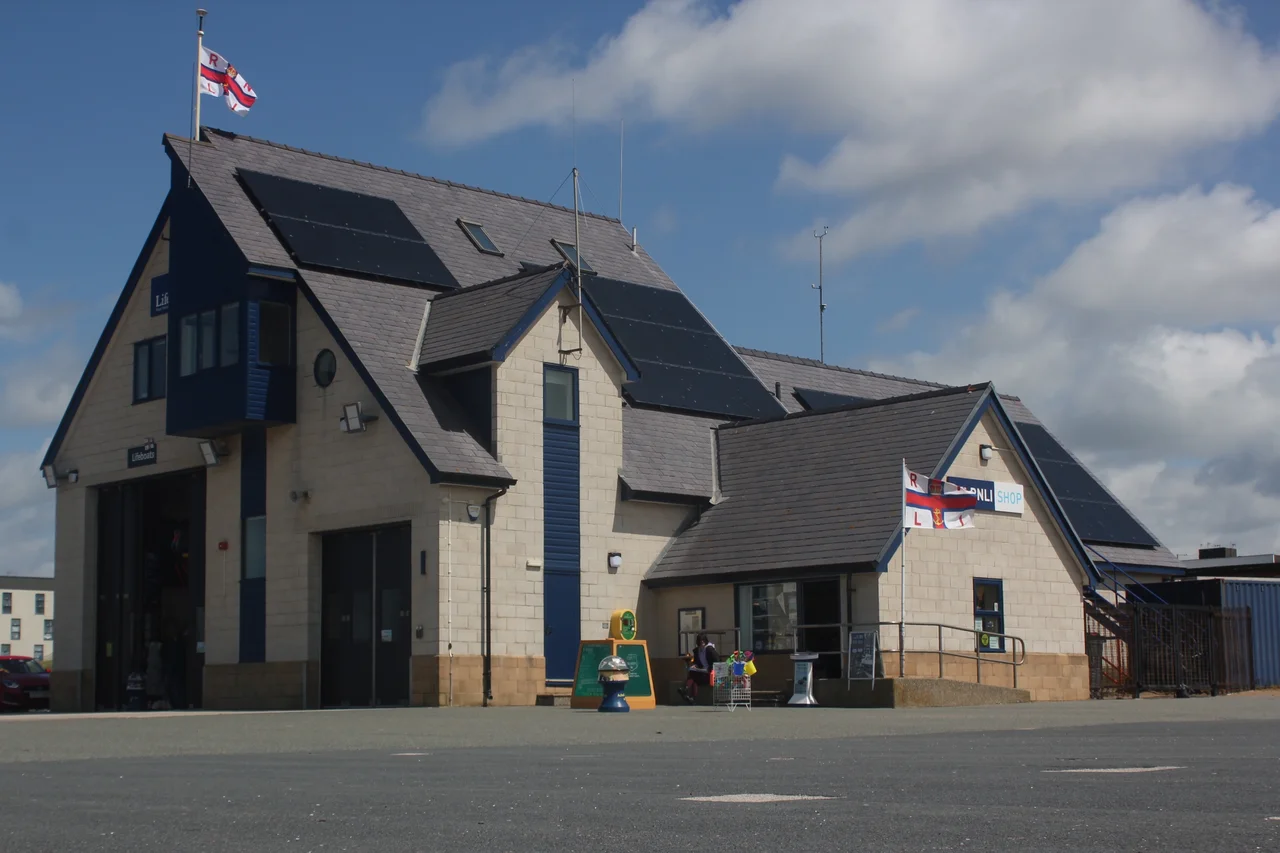
Rhyl Lifeboat Station
On 22 January 1853, the brand-new Rhyl lifeboat Gwylan-y-Mor - Sea Gull - capsized on its way back from a fruitless search off the West Hoyle bank, and did not self-right. Six of her nine crew drowned. The boat was a prize-winning Beeching design, marked with a brass plaque reading 'Northumberland Prize Boat', and it should have righted itself within seconds. It did not. Three months earlier, an identical boat at a different station had capsized and drowned eight men. The post-mortem found that someone had cut storage doors into the airtight boxes that gave the boat its buoyancy, and had failed to plug the water-ballast tanks. The self-righting capability of the most celebrated lifeboat design of the early Victorian era turned out to depend on small details of construction that the prize had not actually guaranteed.
The Prize Boat
In 1851 the Duke of Northumberland, president of the Royal National Institution for the Preservation of Life from Shipwreck, offered one hundred guineas for the best design of self-righting lifeboat. The prize was won by James Beeching of Great Yarmouth. The Shipwrecked Fishermen and Mariners' Royal Benevolent Society - a separate charity from the RNIPLS - bought one of the Beeching design for Rhyl in 1852, named her Gwylan-y-Mor, and built a boathouse between the beach and the River Clwyd on the west side of the estuary. Twenty-six feet by six feet six, eight oars, sails, a brass plaque, and a fatal defect. The Rhyl disaster was already in motion before the boat was launched.
The Tubular Lifeboat
After the 1853 capsizing, the local committee resolved never to use the Gwylan-y-Mor again, even though the boat was officially in service until 1856. They wanted something genuinely safe. In October 1854 the RNIPLS became the Royal National Lifeboat Institution under the Duke's guidance. In December the SFMRBS handed the Rhyl station over to the new RNLI. And the committee asked for something unconventional: a tubular lifeboat, of the design recently invented by H. Richardson of Bala. The new boat, built in 1856 by Lees of Manchester and towed to Rhyl across the country, consisted of two thirty-two-foot iron tubes, each two feet eight inches in diameter, divided into eight airtight compartments and joined by a deck eight feet four inches wide. Total buoyancy: 140 cubic feet of trapped air. The deck sat eleven inches above water at rest. Once over, it would not stay over.
Morgan and the Cheltenham Widow
In 1867 the RNLI committee announced that Miss Ellen Hodgson, executor of the will of the late Mrs Elizabeth Morgan of Cheltenham, had given £650 - the full cost of renovating the Rhyl station - in her memory. The lifeboat, recently damaged and sent for repairs, returned and was renamed Morgan. Mrs Morgan, who had never set foot in north Wales as far as the records show, paid for the boathouse that protected the lifeboatmen of Rhyl. The boat carried her name for the next twenty-six years. While the tubular was away for repairs, the relief boat was Henry Nixson No. 2 - a brand-new lifeboat built for a planned station at Abergele that, in the event, was never opened. The boat went to Rhyl as a stopgap and then to another station altogether. The Abergele station never happened.
The Hovercraft, 1962
At 01:17 on 17 September 1962, Coxswain Harold Campini took the Rhyl lifeboat Anthony Robert Marshall out into a north-west gale to assist a craft that had broken adrift along the promenade. It was a hovercraft - one of the early experimental commercial machines operating that summer between Rhyl and Hoylake as a passenger service. The first ever lifeboat service to a hovercraft. Unable to attach a line in the conditions, Campini manoeuvred his lifeboat between the helpless air-cushion vehicle and the seawall and rescued the three crewmen. The hovercraft itself drifted on through the night until conditions allowed it to be brought to harbour an hour later. Campini received the RNLI Silver Medal. The hovercraft service did not survive the season. The lifeboat station continued.
Anthony Kenneth Heard
The station today operates the all-weather Shannon-class lifeboat 13-34 Anthony Kenneth Heard (ON 1341), on station since 2019, alongside the inshore D-class boat Geoff Pearce (D-903), on station since 2025. The all-weather boat's coverage stretches from Colwyn Bay to Mostyn along the coast and reaches out to the gas platforms of the Douglas and Hamilton fields and the wind farms of North Hoyle, Rhyl Flats, and Gwynt-y-Môr. The station is part of the contingency plan for the offshore platforms. The boathouse stands on the East Parade promenade in Rhyl itself, not at the original site by the river - a short concrete slipway runs down to the beach. Tractors haul the boats down and back. The same town that put a lifeboat in the water in 1852 still puts one in the water today, 174 years and many designs later.
From the Air
Rhyl Lifeboat Station stands at 53.332°N, 3.493°W on the East Parade promenade in Rhyl, north Wales, just east of the mouth of the River Clwyd. The boathouse is visible from the air on the seafront, with the slipway running down to the beach. Best viewed at 1,500-2,500 feet AGL. Nearest airports are Hawarden (EGNR) 22 nm east, Caernarfon (EGCK) 30 nm west, and Liverpool John Lennon (EGGP) 22 nm north-east. The Clwyd estuary lies immediately to the west; the offshore wind farms of North Hoyle and Rhyl Flats are visible to the north. The Pontins holiday park makes a distinctive cluster on the seafront.
Nearby Stories
- Dolwyddelan Castle 4.6 km away
- Silver Jubilee Bridge 5 km away
- PS Rothsay Castle 11 km away
- Horseshoe Pass 12 km away
- Battle of Bamber Bridge 16 km away
- Combermere Abbey 17 km away
- Birkdale Palace Hotel 21 km away
- Celtic Array 40 km away