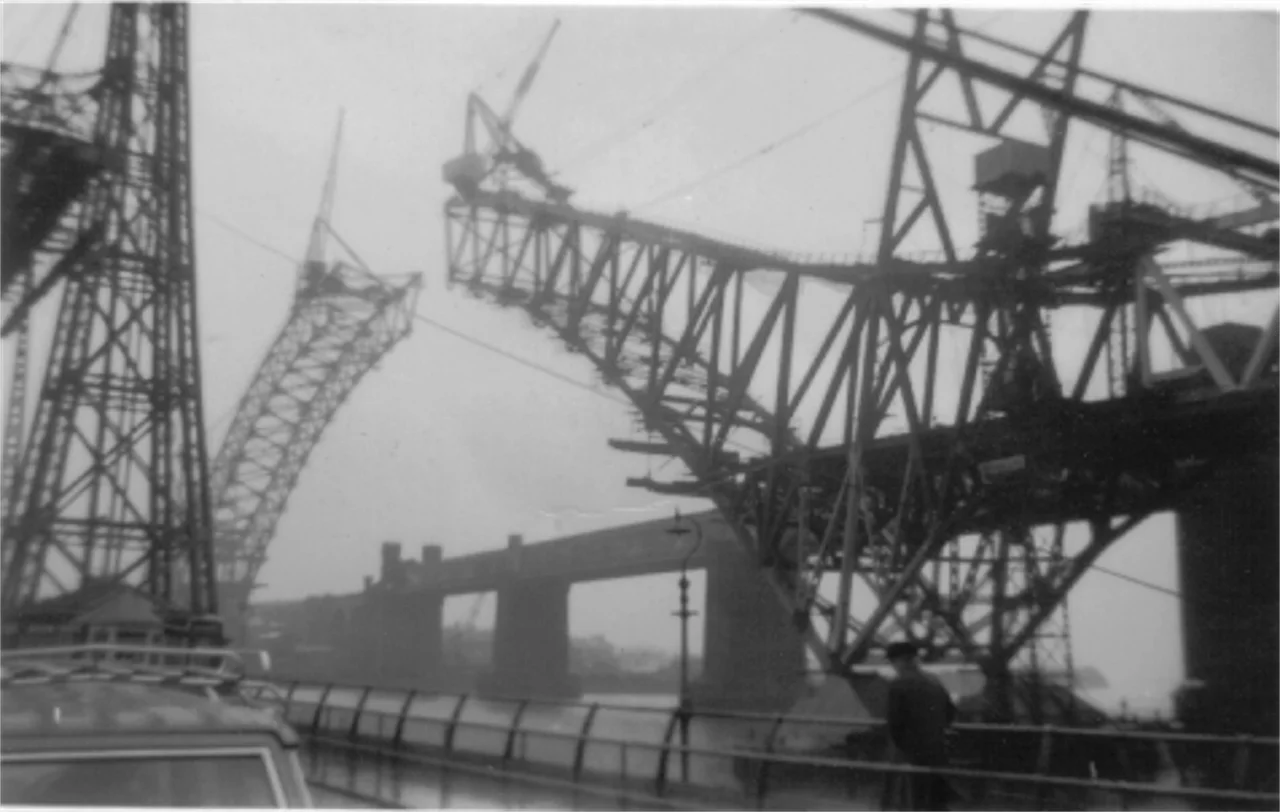

Silver Jubilee Bridge
Engineers studying scale models of the new bridge in the late 1950s noticed something disconcerting. The bridge they were designing was stable. But put it next to the existing Victorian railway bridge that already crossed Runcorn Gap, and the wind began to do strange things. Vortices rolled off one structure and slapped into the other, setting the model swaying in a way that no driver would ever want to experience at 285 feet above the Mersey. The suspension design was scrapped. What replaced it was a steel through-arch, modelled loosely on Sydney Harbour Bridge but with one crucial difference: the side spans were welded continuously into the main arch rather than left separate, a quiet trick of engineering that defeated the oscillation problem. The bridge that opened in 1961 has been painted the same light green ever since, and it has become the silhouette by which Runcorn Gap is recognised from miles away.
The Gap That Demanded a Bridge
For most of recorded history, anyone trying to cross the Mersey at Runcorn Gap had two unappealing options: wade through the mud at low tide, or take a ferry. The first vehicular crossing here was the Widnes-Runcorn Transporter Bridge, an extraordinary 1905 contraption that hoisted railway wagons and motor cars across the river on a swinging gondola. It worked, after a fashion, but a transporter bridge is essentially a slow lift, and by the late 1930s the queues to use it had become impossible. The Ministry of Transport agreed in 1946 that a replacement was needed. War recovery delayed everything. It took a further decade before the consulting engineers Mott, Hay and Anderson finally settled on their design and Leonard Fairclough of Adlington broke ground on 25 April 1956.
Building an Arch Without a River Closure
The Manchester Ship Canal ran directly beneath the planned bridge site, which meant that nothing the contractors did could obstruct seagoing traffic. A truss bridge with multiple piers was ruled out because one of the piers would have ended up too close to the canal wall. So the arch had to be built in mid-air. Dorman Long of Middlesbrough, the same firm that had built Sydney Harbour Bridge in the 1920s, took over the steelwork. Crews cantilevered the arch outward from each side, working from the piers toward the centre of the river. In November 1960 the two halves met in the middle. The carriageway was hung below the arch on forty-eight lock-coil wire ropes, and on 21 July 1961 Princess Alexandra cut the ribbon. The main span was 361 yards. Seven hundred and twenty thousand rivets held it together.
Renamed for a Queen, Worn Out by Traffic
The bridge was first christened the Runcorn-Widnes Bridge, but by 1977 it had a new name. That year the road was widened by absorbing the original footpaths into a fourth lane, and a cantilevered footway was tacked onto the east side. The Queen had just celebrated her Silver Jubilee, and the bridge was rechristened in her honour. By that point traffic was punishing. The single-carriageway design had been overwhelmed almost from opening day. A middle lane added in 1965 had earned the grim nickname the suicide lane, because cars in opposing directions met head-on with no barrier between them. Even after the 1977 widening, the bridge groaned under 80,000 vehicles a day. Salt from winter gritting attacked the deck. Engineers eventually pioneered an electrolytic technique to draw chloride ions back out of the concrete, work that was shortlisted for the 2010 Prime Minister's Award for Better Public Building.
A Crossing for the Twenty-First Century
On 14 October 2017 a new bridge opened a short distance to the east. The Mersey Gateway is a six-lane cable-stayed structure with tolls, and within hours of its first cars crossing, the Silver Jubilee Bridge was closed to traffic for a full refurbishment. When it reopened on 26 February 2021, it was a different sort of bridge: one lane in each direction, a generous cycle and pedestrian path, and a toll matched to the new crossing alongside. The old Trumpet Loop viaduct on the Runcorn side was demolished and replaced with a roundabout, releasing land for new leisure and retail use. The green arch still dominates the gap, still requires six thousand imperial gallons of paint for every coat. The Victorian railway bridge crosses just downstream, the Mersey Gateway curves to the east, and between them the Silver Jubilee Bridge holds the middle distance, sixty-plus years into the job it was built to do.
From the Air
The Silver Jubilee Bridge sits at 53.346N, 2.738W, spanning the Mersey and the Manchester Ship Canal at Runcorn Gap. From the air, three river crossings stand in close formation: the 1868 stone-arched Runcorn Railway Bridge to the west, the green steel arch of the Silver Jubilee in the centre, and the white cable-stayed Mersey Gateway curving to the east. The arch rises 285 ft above the riverbed and is unmistakable from cruise altitude. Recommended viewing altitude 2,000-3,500 ft for the bridge profile, higher to capture the relationship between the three crossings and the Manchester Ship Canal. Nearest airports: Liverpool John Lennon (EGGP) 7 nm north-northwest, Manchester (EGCC) 18 nm east, Hawarden (EGNR) 10 nm southwest. Crosswinds across the gap can be significant in westerlies; the bridge itself was specifically engineered to resist aerodynamic coupling with the adjacent railway bridge.
Nearby Stories
- Anson Engine Museum 1.3 km away
- West Kirby 2.9 km away
- Battle of Nantwich 6.2 km away
- Winter Hill Air Disaster 8.3 km away
- Horseshoe Pass 8.8 km away
- Caverswall Castle 12 km away
- Murder of Lindsay Rimer 15 km away
- Piel Castle 50 km away