
West Kirby
Watch the tide go out from the West Kirby promenade and the sea seems to disappear. The water pulls back across the broad flats of the Dee estuary, exposing wet sand that catches the sky like a polished mirror, and from the slipway it is possible to walk - carefully, with attention to the returning tide - out to three small islands that stand off the coast: Little Eye, Middle Eye, and Hilbre. The largest, Hilbre Island, was a medieval monastic retreat dedicated to St Hildeburgh, the saint who gave Hoylake its parish church its name. Half the year the islands are walkable. Half the year they are unreachable. The rhythm has been the same since the eighth century.
Kirkjubyr
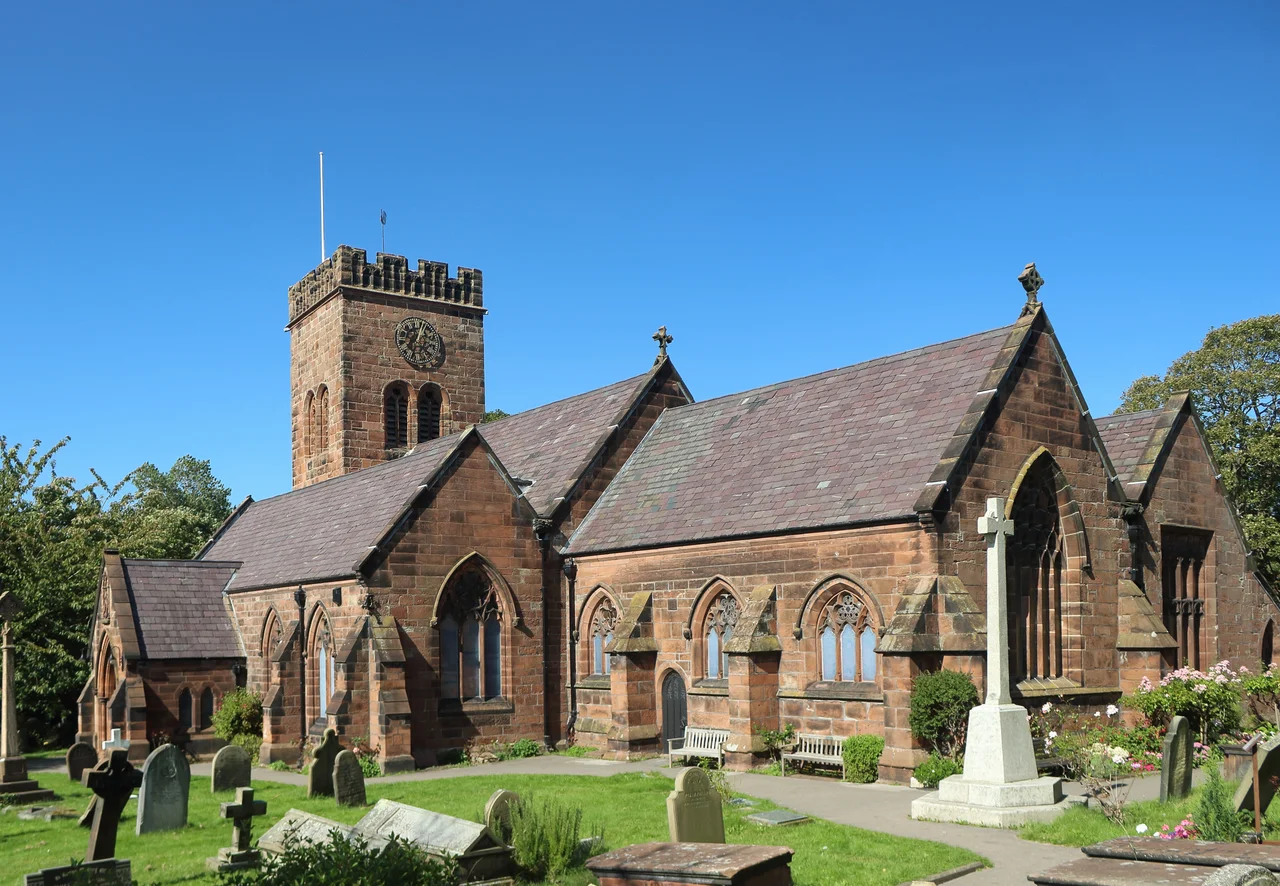
The Vikings named the place. Kirkjubyr - the village with a church - appears in the Old Norse settlement layer that runs across the Wirral peninsula, evidence of Scandinavian colonisation in the tenth and eleventh centuries. The 'West' was added later, by 1285, to distinguish this Kirkby from another Kirkby in the same district that has since become Wallasey. The earliest written form is West Kyrkeby in Wirhale - the Wirral - in a document of that year. The church the Vikings named is gone, but its successor is not far away: St Bridget's Church, with a chancel dating from around 1320, stands in the old village core. The West Kirby Museum, founded in 1892, is right next door, with one of the most striking Anglo-Scandinavian hogback grave-marker collections in the north-west of England.
Marine Lake
The Marine Lake on the West Kirby foreshore is one of the great pieces of Edwardian municipal engineering on the British coast. A large rectangle of water held by a stone wall along the seafront, the lake fills at high tide from the estuary and remains full while the open sea retreats across the flats. The result is a permanent body of safe sailing water for windsurfers, dinghies, and kayaks even when the actual sea has gone two miles offshore. In October 1991, Dave White set the World Windsurfing Production Speed Record on the Marine Lake at 42.16 knots - a sustained achievement that says something about the wind conditions over the lake when the right gusts come off the Dee. The lake suffered erosion damage in 2009 and was repaired with a £750,000 refurbishment. Bathers are warned about weaver fish in the sand: small, half-buried, and equipped with sharp poisonous spines.
Hilbre at Low Water
From the bottom of Dee Lane, at low tide, you can walk out across the flats to the three islands. Little Eye comes first, no more than a sandstone outcrop with a few tufts of vegetation. Middle Eye is larger, a proper miniature island. Hilbre Island itself, the largest of the three, supports a small community of buildings and a tiny ranger's hut. The medieval monastery is long gone but the position - looking out toward Wales across the mouth of the Dee - is unchanged. The walk takes about an hour each way. Tide tables matter enormously: the returning sea fills the channels around the islands fast, and visitors who misjudge the timing can find themselves marooned for the next twelve hours. Local guides recommend leaving the shore no later than three hours after high tide and starting back no later than three hours before the next.
Daniel Craig's Other Town
If Hoylake claims Daniel Craig as a son, West Kirby has equal title - the actor attended Hilbre High School and then Calday Grange Grammar School here. George Mallory, the mountaineer who disappeared on Everest in 1924, was schooled in West Kirby. Glenda Jackson, the actress and Labour MP, went to West Kirby Grammar School. Selwyn Lloyd, who served as Foreign Secretary, Chancellor of the Exchequer, and Speaker of the House of Commons, lived here. Olaf Stapledon, the philosopher and pioneering science-fiction author of Last and First Men and Star Maker, was a resident. Esther McVey, the Conservative politician, comes from West Kirby. Rafa Benitez, the football manager, lives here now. The town runs to roughly 13,000 residents and produces an unusual concentration of public figures - the Wirral's quiet alternative to Hoylake's louder bohemian celebrity list.
Looking Across to Wales
What sets West Kirby apart from the other Wirral seaside towns is the view. The Welsh coast lies directly across the Dee estuary, visible on any clear day - the Clwydian Range rising behind, Point of Ayr lighthouse marking the headland to the south-west, and the distant outline of the Snowdonia massif when the air is unusually transparent. The Hoylake and West Kirby War Memorial - the Charles Sargeant Jagger sculpture of 1922 - stands above the promenade, sighting out across the estuary toward the country whose fields the lost soldiers might once have walked across in peacetime. The Wirral Way long-distance footpath starts here, following the trackbed of the old Birkenhead Railway south through the peninsula. The whole town is oriented toward Wales, toward the islands, toward the slow exchange of tide and sky that defines this corner of the British coast.
From the Air
West Kirby sits at 53.373°N, 3.184°W on the north-western corner of the Wirral Peninsula, facing the Dee estuary across to north Wales. The Marine Lake is the most distinctive feature from the air - a rectangle of permanent water along the seafront. The line of three islands (Little Eye, Middle Eye, Hilbre) extends offshore. Best viewed at 1,500-3,000 feet AGL. Nearest airports are Liverpool John Lennon (EGGP) 13 nm east, Hawarden (EGNR) 13 nm south, and Manchester (EGCC) 35 nm east. Hoylake lies just to the north on the same peninsula; the Welsh coast and the Point of Ayr lighthouse are visible to the south-west across the estuary.
Nearby Stories
- Dolwyddelan Castle 4.6 km away
- Silver Jubilee Bridge 5 km away
- PS Rothsay Castle 11 km away
- Horseshoe Pass 12 km away
- Battle of Bamber Bridge 16 km away
- Combermere Abbey 17 km away
- Birkdale Palace Hotel 21 km away
- Celtic Array 40 km away