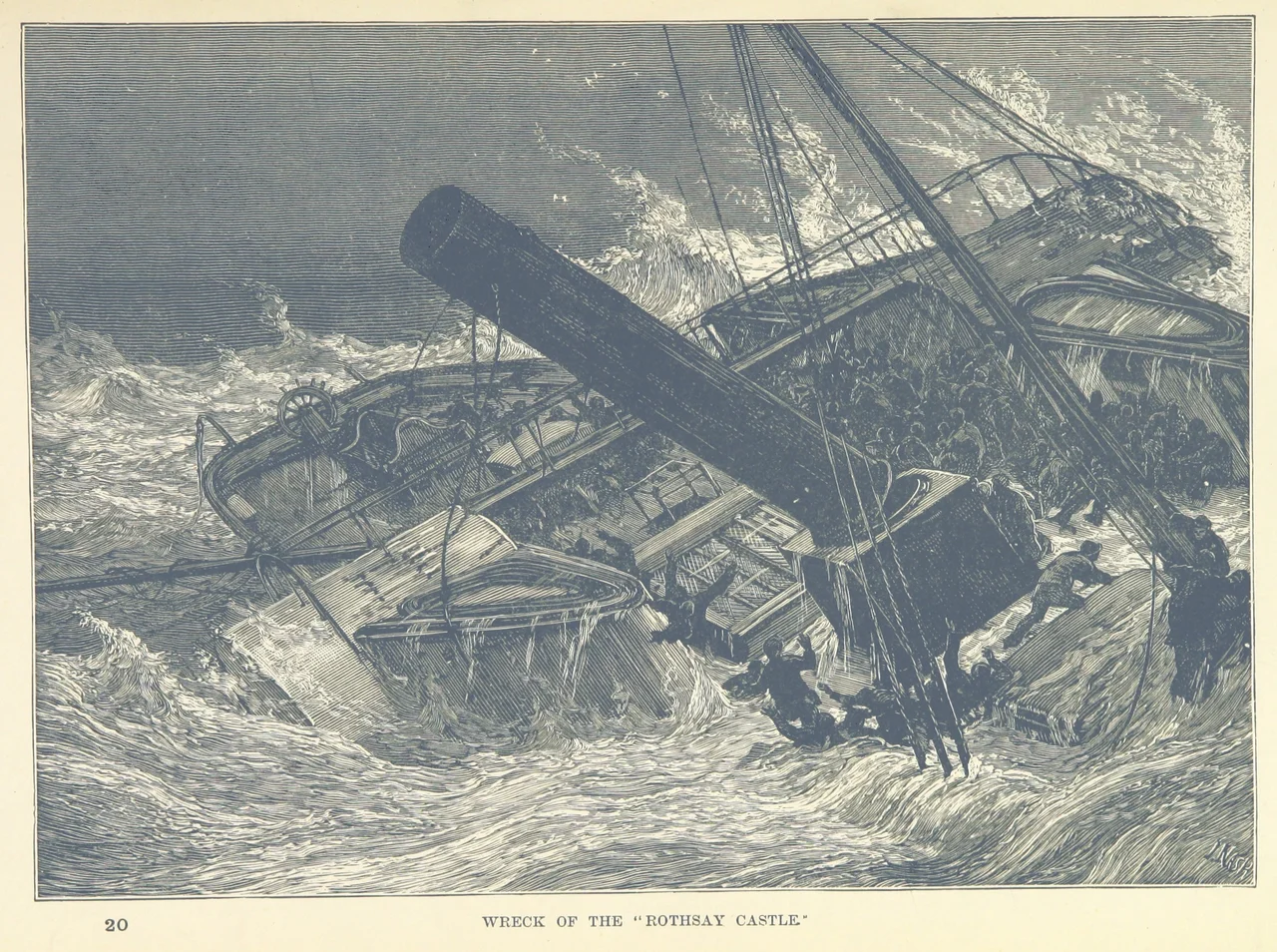

PS Rothsay Castle
They were going on a day trip. A hundred and fifty people, men and women and children, boarded the paddle steamer Rothsay Castle at Liverpool on the morning of 17 August 1831, dressed for a summer excursion along the North Wales coast to Beaumaris. By the early hours of the next morning, a hundred and thirty of them were dead. The captain was drunk. The pumps did not work. The single lifeboat had a hole in the bottom and no oars. Bodies washed up along the shores of Anglesey and the Welsh mainland for days afterwards. The inquest jury at Beaumaris struggled to disguise its indignation at the conduct of those who could place such a vessel on this station.
The People Aboard
The Rothsay Castle's passenger list survives only in fragments and in the memories preserved by the survivors and the bereaved. They were the kind of people who could afford a day's outing and the steamer fare, but most were not wealthy. Tradesmen taking their families. Servants on a holiday. Travellers heading to Beaumaris for the regatta. Children. A child of nine and her mother. A wife with her husband. The names that come down to us are from the gravestones at Llanfaes churchyard near Beaumaris, where many of the recovered bodies were buried in a mass grave that still attracts visitors with flowers. The dead were not statistics. They were a community of strangers thrown together for one day, who shared a boat, a hope of a summer day on the water, and finally a sandbank in the dark.
The Captain
The vessel was supposed to leave Liverpool at ten in the morning. She left around noon, delayed by rough weather and a late passenger. By the time she cleared the Mersey estuary the wind had hardened to a strong NNW gale and the sea was building. One of the passengers went forward to find Captain Atkinson and ask him to turn back. Atkinson was drunk. He refused, saying that there was a great deal of fear on board and very little danger, and that turning back with passengers would set a bad commercial precedent. He continued the voyage. By ten that evening the steamer had only reached the Great Orme, two feet of water lay in the stokehold, the pumps were choked beyond use, and there was not so much as a bucket aboard for bailing. The single lifeboat carried for the safety of all hands had a hole in its bottom and no oars. Atkinson was not a man whose judgement had improved as the situation deteriorated. He kept going.
The Wreck
At around one in the morning of 18 August, the Rothsay Castle struck Dutchman Bank on the Lavan Sands at the eastern end of the Menai Strait. The hull held briefly. Then she broke up. The funnel collapsed and swept Atkinson and both his mates into the water, where they drowned. Survivors clung to floating timbers and to fragments of the deck. The summer night was cold. The tide was running. Beaumaris was visible across the strait, lights showing, but no boat came out for hours because the alarm could not be raised and no organised rescue service existed on this shore in 1831. Twenty-three of the hundred and fifty aboard survived to be picked up in the morning. The others were already gone.
The Inquest, and the Names
The bodies came ashore over a wide area. Some were buried where they were found, some at Llanfaes, some carried home by relatives. The inquest convened at Beaumaris and questioned the survivors, the rescuers, and the agents of the steamer's owners. The jury's verdict was unforgiving. Had the Rothsay Castle been a seaworthy vessel and properly manned, this awful calamity might have been averted. They therefore cannot disguise their indignation at the conduct of those who could place such a vessel on this station. The owners were never criminally prosecuted. The legal infrastructure to do so did not yet exist. The captain was dead and beyond the reach of any court.
What the Disaster Built
Public outrage was enormous. Newspapers in Liverpool and Manchester carried survivor accounts for weeks. Parliament debated marine safety. Two things came directly from the disaster on the Anglesey shore. In 1832 a permanent lifeboat was placed at Penmon Point, the eastern tip of Anglesey, formally managed under what would become the RNLI. In 1838 the great stone tower of Trwyn Du Lighthouse was completed off Penmon, designed by James Walker as his first sea-washed tower, with its white walls and three black bands and the painted warning NO PASSAGE LANDWARD facing both north and south. The lighthouse marks the channel between Black Point and Puffin Island. It also marks something less tangible. The Rothsay Castle's dead are why those structures exist, and the people they have helped save in the two centuries since are part of the dead's legacy too. The graves at Llanfaes are quiet. The lifeboat at Beaumaris is not.
From the Air
The wreck site lies on Dutchman Bank in the Lavan Sands at approximately 53.32 north, 4.02 west, at the eastern end of the Menai Strait between Anglesey and the Welsh mainland. The Lavan Sands dry to extensive flats at low water and read clearly from the air. Recommended viewing altitude 2,000 to 4,000 feet for an oblique view that takes in the Trwyn Du lighthouse to the north, the Beaumaris and Penmon stations on the Anglesey shore, and the open water of Conwy Bay to the east. Nearest airports EGOV Valley on Anglesey to the northwest, EGCK Caernarfon to the south.
Nearby Stories
- Pen-y-Pass 1.6 km away
- Rhyl Lifeboat Station 2.4 km away
- HMS Resistance (1861) 3.1 km away
- Tudweiliog 21 km away
- German submarine U-246 22 km away
- Horseshoe Pass 22 km away
- Celtic Array 30 km away
- Birkdale Palace Hotel 32 km away