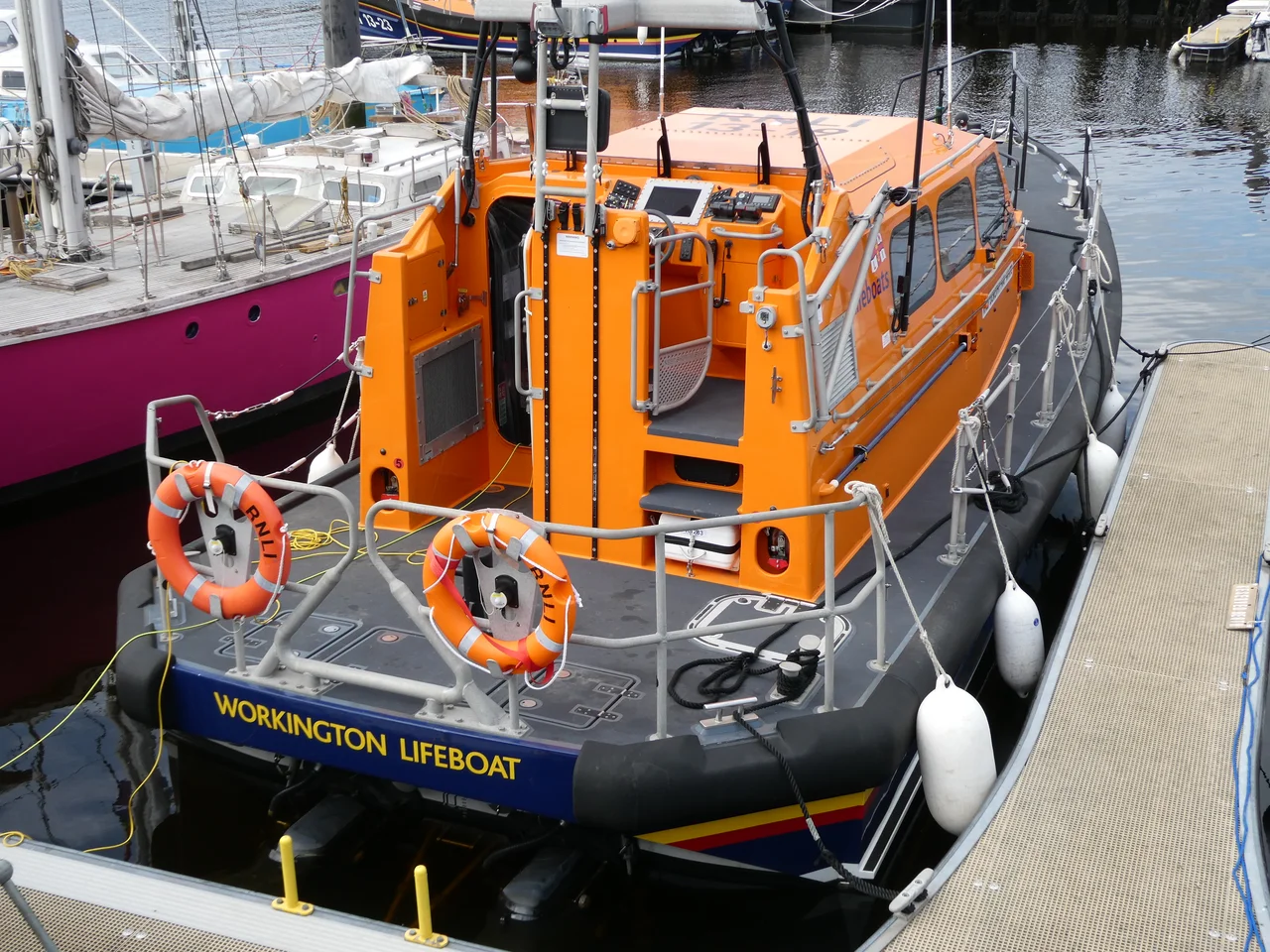

Workington Lifeboat Station
At daybreak on Saturday 19 September 1885, only the top of a mast was showing above the water off Mossbay Point, between Harrington and Workington. The schooner Margaret of Ramsey had broken up overnight, and her crew had climbed into the rigging to wait for help. By the time anyone on shore saw the mast, the last survivor had been washed away. The tug Derwent went out from Workington, towing a harbour boat with four men aboard. The harbour boat capsized. One of those four men was lost too. The bodies of William Cowle, William Kennish, and the Master Robert Christian came ashore on the beach. James Henry Christian — the Master's son, thirteen years old — was found later.
A Station Begun in Grief
It was the kind of morning that changes things. In the weeks that followed, requests went to the Royal National Lifeboat Institution for the provision of a proper lifeboat at Workington. The RNLI agreed. A lifeboat house and slipway were built at a cost of £395, and in 1886 the first boat — Dodo, official number 79 — arrived on station. The first replacement came in 1899: an older boat called Theodore and Herbert, oddly senior to the first, but identical in design. She was renamed Dodo at Workington, then changed back to her original name in 1902. The early station did not last long; work on the piers around 1905 forced its closure. The families who had pressed for it in 1885 watched the boat go away, and the question of how the next ship in trouble would be reached was left to the tug Derwent and whatever the harbour had on hand.
Return and Service
The station reopened, eventually, and in March 1953 it received the Manchester and Salford XXIX (ON 841), a 46-foot Watson-class lifeboat already a decade old when she arrived. Then came the rescue that still defines the station's modern history. At 21:25 on 27 January 1974, the relief lifeboat City of Edinburgh launched into extremely rough conditions to reach the fishing vessel Kia Ora, which had broken down off Hestan Island in Auchencairn Bay and was dragging her anchor. Six men and a ten-year-old boy were aboard. The lifeboat got alongside on the second attempt. All seven were recovered. Coxswain Albert Brown was awarded the RNLI Bronze Medal — the first and only Bronze Medal for gallantry in Workington's history.
Dorothy May White
In 2017, after 131 years of using boats that had served somewhere else first, Workington finally received a brand-new lifeboat of its own. She is called 13-19 Dorothy May White (ON 1326), a Shannon-class all-weather boat that cost £2.2 million and is davit-launched from the North Jetty on Prince of Wales Dock. The naming matters. The first Workington boat, Dodo in 1886, had been new at delivery; every boat between had been a hand-me-down from somewhere bigger. Dorothy May White ended that streak. She works alongside an inshore lifeboat, James R Allen (D-901), on station since 2025. At a ceremony in February 2025, the Lord Lieutenant for Cumbria, Alexander Scott, presented the King's Coronation Medal to 24 members of the crew with more than five years' frontline service. It was a quiet ceremony for a quiet kind of courage.
The Sea, the Same
Workington sits at the mouth of the River Derwent on the Cumbrian coast, where the Solway Firth meets the Irish Sea and the weather can turn from calm to violent in less time than it takes to drink a cup of tea. The hazards that wrecked the Margaret in 1885 — sudden squalls, the bar at the harbour mouth, the slow grind of an anchor dragging across silt — are still there. So is the routine they demand: the pager going off in the middle of a meal, the boots pulled on, the boat slipping down the slipway into water that has not got any warmer in 140 years. The names on the station's honours boards belong to volunteers. They always have. They probably always will.
From the Air
Workington Lifeboat Station sits at 54.65N, 3.57W on the North Jetty of Prince of Wales Dock, where the River Derwent meets the Irish Sea on the Cumbrian coast. From the air, the harbour mouth and twin breakwaters are obvious, with the inland docks and the wider Derwent estuary stretching east. The lifeboat house and davit cradle for Dorothy May White are visible on the North Jetty. Nearest field is Carlisle Lake District (EGNC) some 24 nm north-east. The Solway approaches off Workington can produce sudden weather changes, particularly with westerlies funnelling between the Cumbrian coast and the Isle of Man.
Nearby Stories
- Derwentwater 1 km away
- Cashtal yn Ard 10 km away
- Buittle Castle 14 km away
- Carlisle Castle 15 km away
- Isle of Whithorn 16 km away
- Conishead Priory 17 km away
- Black Combe 24 km away
- Battle of Glen Trool 32 km away