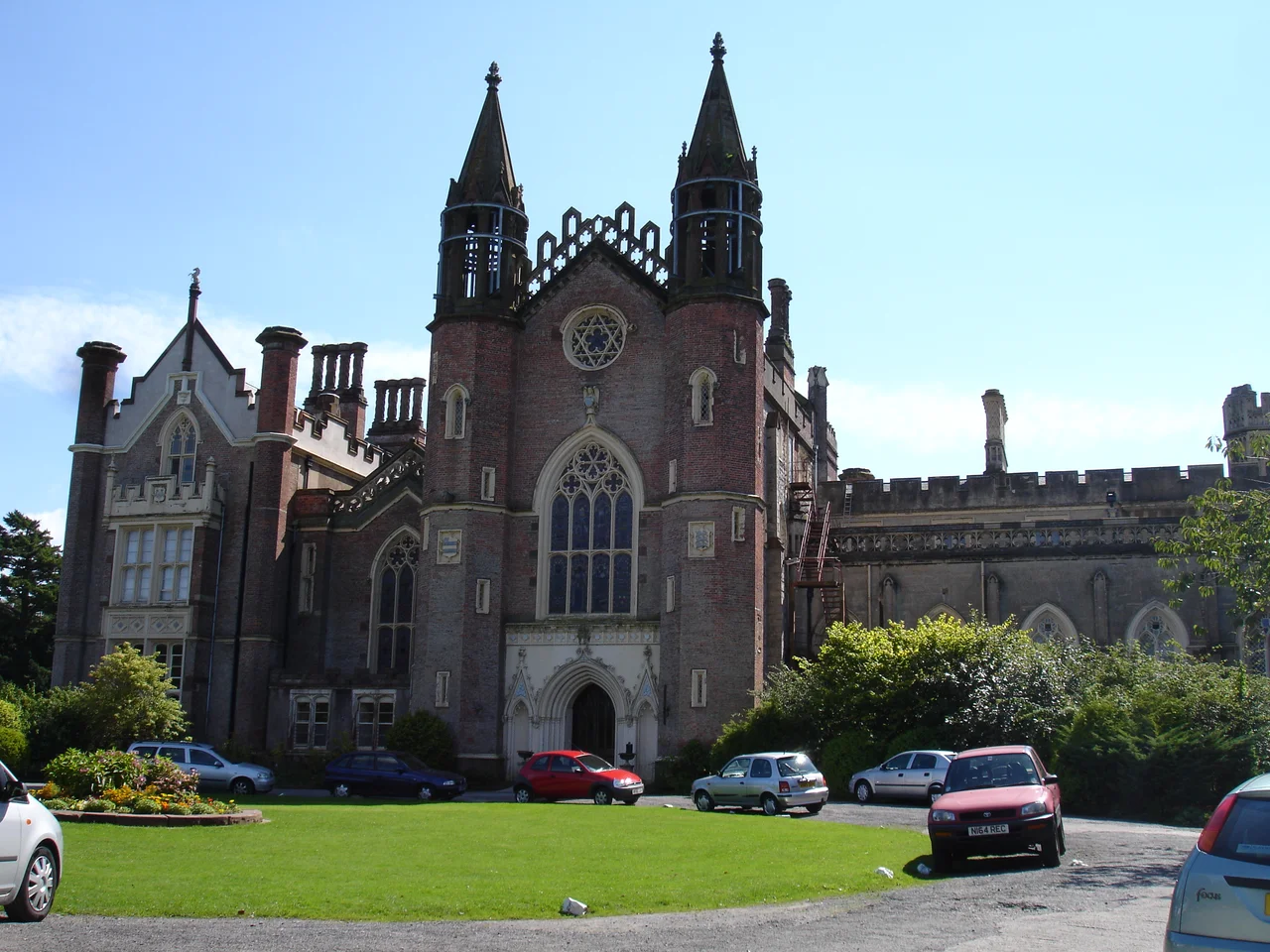

Conishead Priory
Few buildings in northwest England have been so many different things to so many different people. Conishead Priory rises from a wooded slope just south of Ulverston, its octagonal towers and pointed Gothic windows looking like something William Beckford might have dreamed up after a heavy supper. The name translates, plainly enough, as 'King's Hill Priory.' What is anything but plain is the sequence of owners, fortunes, and bankruptcies the building has absorbed since its first stones were laid in the 12th century - and the unlikely community that now lives behind its tracery.
From Medieval Hospital to Augustinian House
The first Conishead began as a hospital under the reign of Henry II, probably founded around 1167 by Gamel de Pennington - though William de Lancaster II, baron of Kendal, also claimed it. By the late 12th century it had grown into a house of Augustinian canons, who tended the sick and the souls of travellers along the dangerous coastal sands of Morecambe Bay. The priory survived for nearly four centuries, until Henry VIII's Dissolution of the Monasteries swept it away in the 1530s. The lands changed hands repeatedly: leased to Thomas Stanley, 2nd Baron Monteagle, briefly held by William Paget, then bought in 1548 by William Sandys, brother of Archbishop Edwin Sandys. Sandys himself was killed in a dispute in 1559 and is commemorated by an effigy in Ulverston church.
Inheritance by Marriage, Generation After Generation
From Sandys the estate passed through a long chain of daughters, cousins, and renamings. George Dodding, a zealous Roundhead during the English Civil War, bought out his Philipson relatives. The Bradylls inherited via the marriage of Sarah Dodding to John Bradyll of Portfield, and their son Dodding Braddyll became Whig MP for Lancaster from 1715 to 1722. Each generation adjusted the buildings; none demolished them entirely - until Thomas Richmond-Gale-Braddyll inherited in 1818 and, in 1821, the year he served as high sheriff of Lancashire, tore the old house down to make way for something grander. That ambition would ruin him.
A Gothic Dream That Bankrupted Its Builders
The new Conishead was designed by Philip William Wyatt, son of the celebrated James Wyatt and a member of one of England's great architectural families. He was dismissed mid-project, declared bankrupt in 1833, sent to a debtors' prison, and died in 1835. George Webster of Kendal - from another architectural family - completed the work. The building took twenty years and around 140,000 pounds to finish. Its owner, having sunk fortunes into speculations in the Durham coal mines, was bankrupted in turn and forced to sell to Henry William Askew in 1850. Askew remortgaged the priory at least five times. By 1874 it had passed to a Ulverston solicitor, then to a Scottish syndicate that turned it into a spa hotel grand enough to deserve its own railway station. In 1883 the Furness Railway opened the Bardsea Loop Line just to deliver guests to the door.
A Home for the Coal Miners
There is something almost circular about what happened next. In 1929, after the spa era faded, the priory was bought - somewhat ironically - by the Durham Miners Welfare Committee, the very industry that had bankrupted Braddyll a century earlier. The Committee employed architect Arthur Kellett of Barnard Castle to redesign the interior, and on 29 August 1930 it opened as a convalescent home. Every two weeks, up to 150 miners arrived to recover from injuries sustained underground. During the Second World War the building was earmarked as an emergency hospital for air-raid victims, but instead became a treatment centre for wounded servicemen - around 8,000 men were cared for here. The Welfare Committee reopened the convalescent home in April 1946 and ran it until the early 1970s.
Buddhists at the Gothic Door
After a brief period of uncertainty - planned and rejected as a hotel, then a caravan park - Conishead found its current and most unlikely community. Since 1976 it has been the home of a Kadampa Buddhist community, and the grounds now include the Kadampa Temple for World Peace, a purpose-built temple opened in the 1990s. Visitors who arrive expecting a stately home find something stranger and gentler: monks in maroon robes crossing limestone steps that were once climbed by Augustinian canons, then by Victorian spa-goers, then by men with broken backs from the pits. The building's walls have heard prayers in Latin, English, and now Tibetan. Same stones. Different chants.
From the Air
Conishead Priory sits at 54.1732N, 3.067W on the Furness peninsula, on the western shore of Morecambe Bay just south of Ulverston. From altitude the building's pinnacles and the dome of the adjacent Kadampa Temple stand out against the wooded slope behind. The mudflats of Morecambe Bay stretch east. Nearest airports are Walney Island (EGNL) 10 nm west, Blackpool (EGNH) 40 nm south, and Carlisle Lake District (EGNC) 50 nm north. Recommended viewing altitude 2,000-3,000 ft AGL.
Nearby Stories
- Red Tarn 4.2 km away
- Fleetwood Lifeboat Station 4.3 km away
- St Bees Priory 5 km away
- Brough Castle 9.5 km away
- Sawley Abbey 9.8 km away
- Hawes Junction Rail Crash 15 km away
- Egremont Castle 28 km away
- Celtic Array 63 km away